Η Αστρονομική Εικόνα της Ημέρας από τη NASA
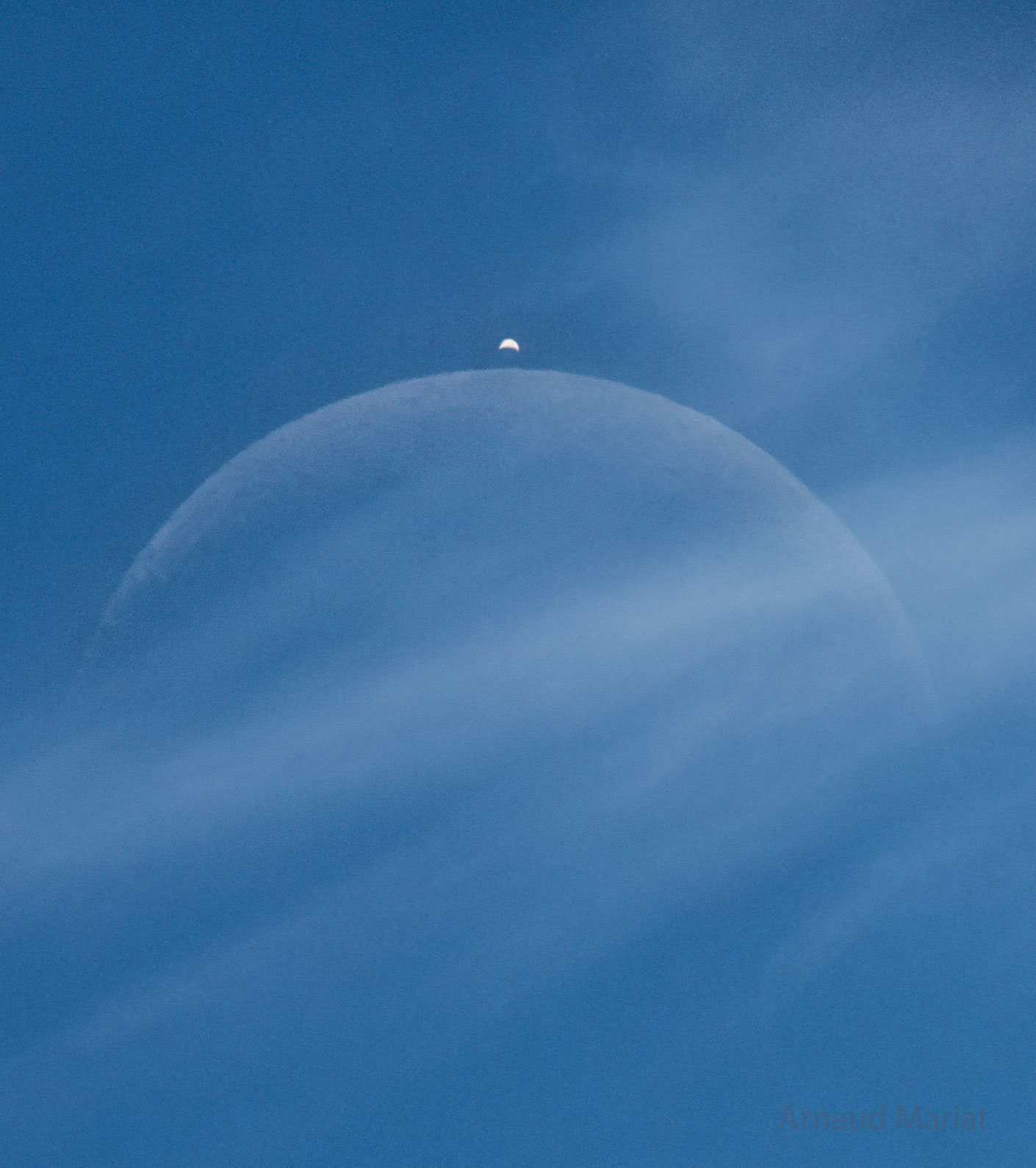
A Daytime Eclipse: Moon Occults Venus
15/09/2026
There was something behind the clouds. Upon close inspection, it was the Moon, which was hard to see yesterday around noon above the small village of Cessy, France. But soon, it was not only the Moon. As expected, a bright dot suddenly appeared from behind the Moon -- the planet Venus far in the distance. Captured in the single featured exposure, both appeared to show a crescent phase. The Moon's crescent was quite slight -- with only about 10 percent of its face illuminated by the Sun. In contrast, Venus's crescent was more full -- showing about 25 percent illumination. Venus appeared brighter because it is nearer the Sun and because its clouds are more reflective than the dark lunar surface. An occultation of Venus by the Moon is visible to only about 10 percent of the Earth, but in yesterday's event even most of that was experiencing daytime. APOD's main NASA site is moving: From apod.nasa.gov to science.nasa.gov/apod
Copyright: Arnaud Mariat
Προηγούμενες Αστρονομικές Εικόνες της Ημέρας από τη NASA
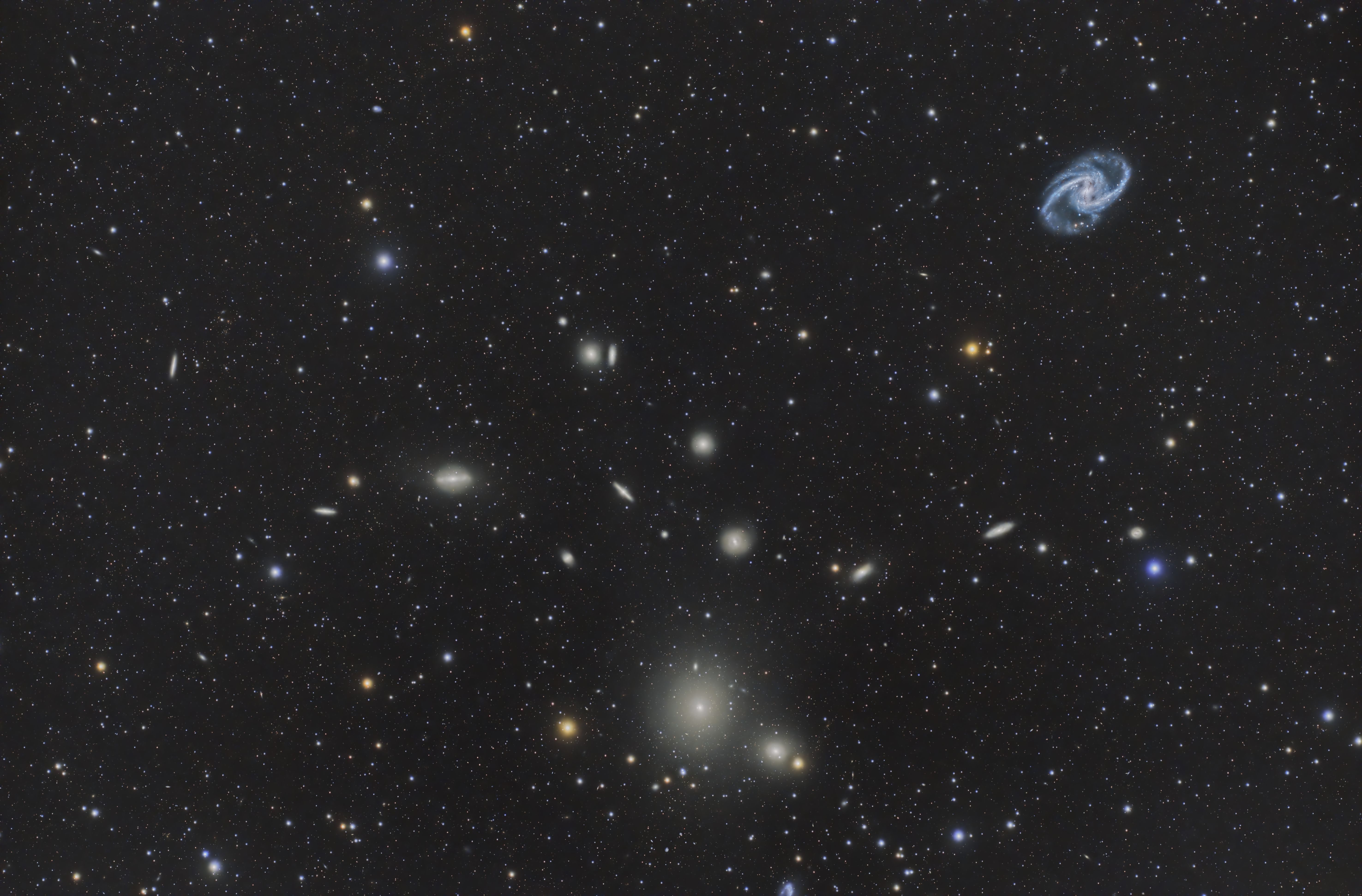
The Fornax Cluster of Galaxies
02/11/2023
Named for the southern constellation toward which most of its galaxies can be found, the Fornax Cluster is one of the closest clusters of galaxies. About 62 million light-years away, it's over 20 times more distant than our neighboring Andromeda Galaxy, but only about 10 percent farther along than the better known and more populated Virgo Galaxy Cluster. Seen across this three degree wide field-of-view, almost every yellowish splotch on the image is an elliptical galaxy in the Fornax cluster. Elliptical galaxies NGC 1399 and NGC 1404 are the dominant, bright cluster members toward the bottom center. A standout, large barred spiral galaxy, NGC 1365, is visible on the upper right as a prominent Fornax cluster member.
Copyright: Marcelo Rivera
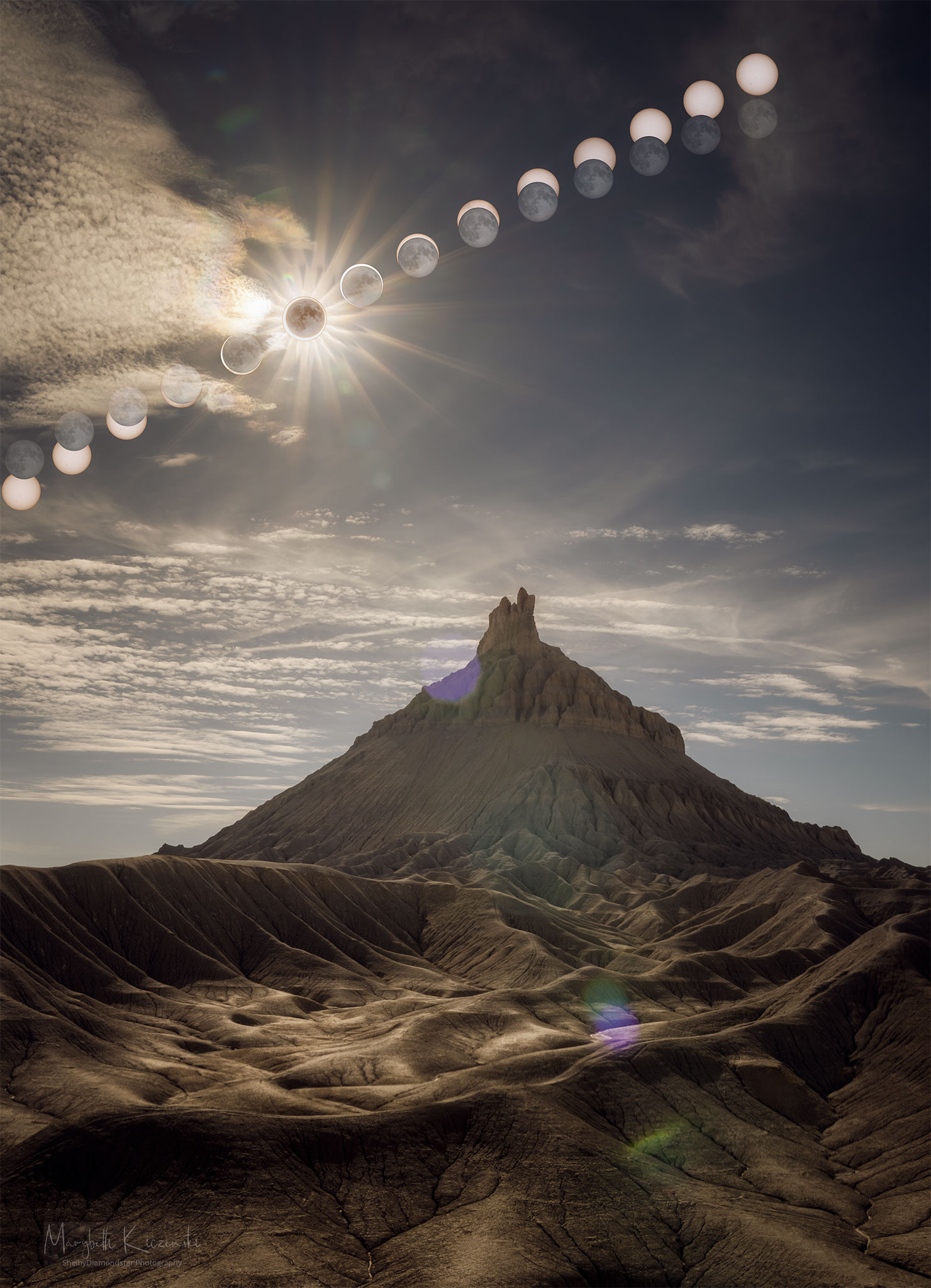
Annular Solar Eclipse over Utah
01/11/2023
Part of the Sun disappeared earlier this month, but few people were worried. The missing part, which included the center from some locations, just went behind the Moon in what is known as an annular solar eclipse. Featured here is an eclipse sequence taken as the Moon was overtaking the rising Sun in the sky. The foreground hill is Factory Butte in Utah, USA. The rays flaring out from the Sun are not real -- they result from camera aperture diffraction and are known as sunstar. The Moon is real, but it is artificially brightened to enhance its outline -- which helps the viewer better visualize the Moon's changing position during this ring-of-fire eclipse. As stunning as this eclipse sequence is, it was considered just practice by the astrophotographer. The reason? She hopes to use this experience to better photograph the total solar eclipse that will occur over North America on April 8, 2024. Apply today (USA): Become a NASA Partner Eclipse Ambassador Eclipse Album: Selected images sent in to APOD
Copyright: MaryBeth Kiczenski
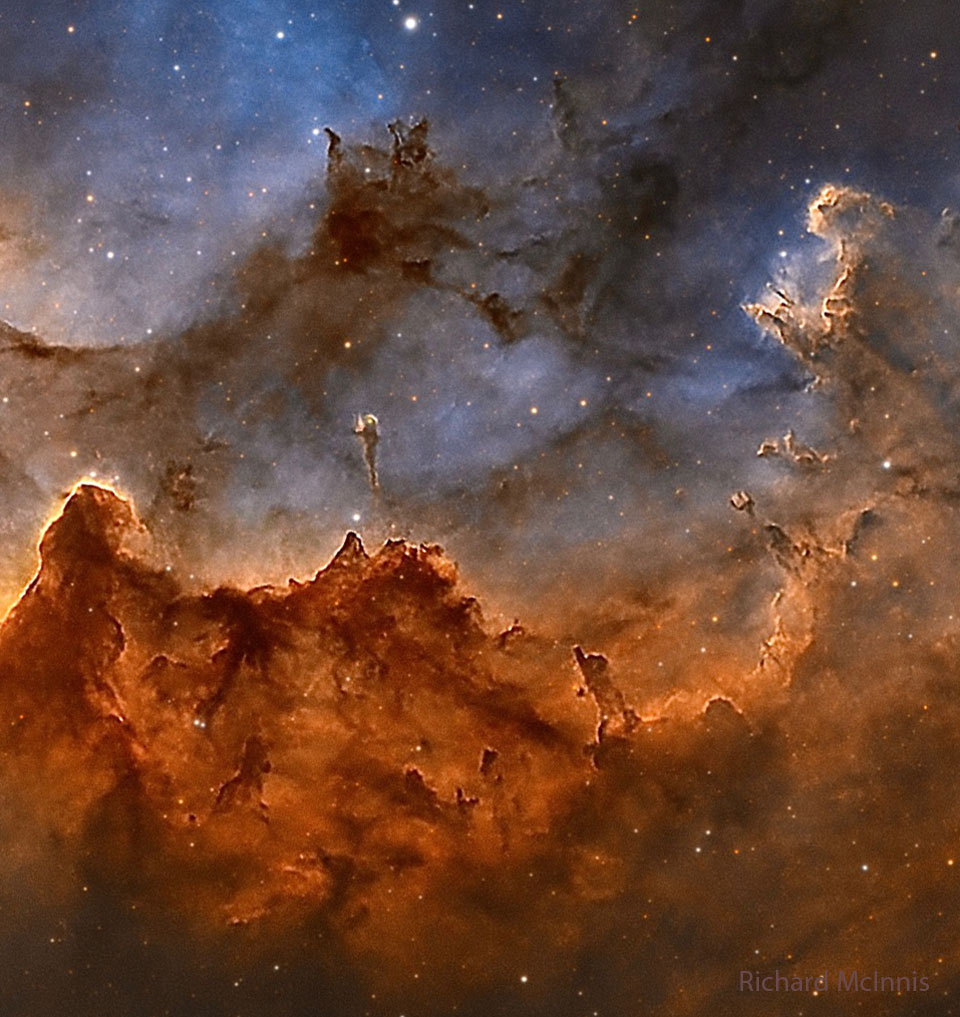
Halloween and the Wizard Nebula
31/10/2023
Halloween's origin is ancient and astronomical. Since the fifth century BC, Halloween has been celebrated as a cross-quarter day, a day halfway between an equinox (equal day / equal night) and a solstice (minimum day / maximum night in the northern hemisphere). With a modern calendar however, even though Halloween occurs today, the real cross-quarter day will occur next week. Another cross-quarter day is Groundhog Day. Halloween's modern celebration retains historic roots in dressing to scare away the spirits of the dead. Perhaps a fitting tribute to this ancient holiday is this closeup view of the Wizard Nebula (NGC 7380). Visually, the interplay of stars, gas, and dust has created a shape that appears to some like a fictional ancient sorcerer. Although the nebula may last only a few million years, some of the stars being conjured from the gas by the great gravitational powers may outlive our Sun.
Copyright: Richard McInnis
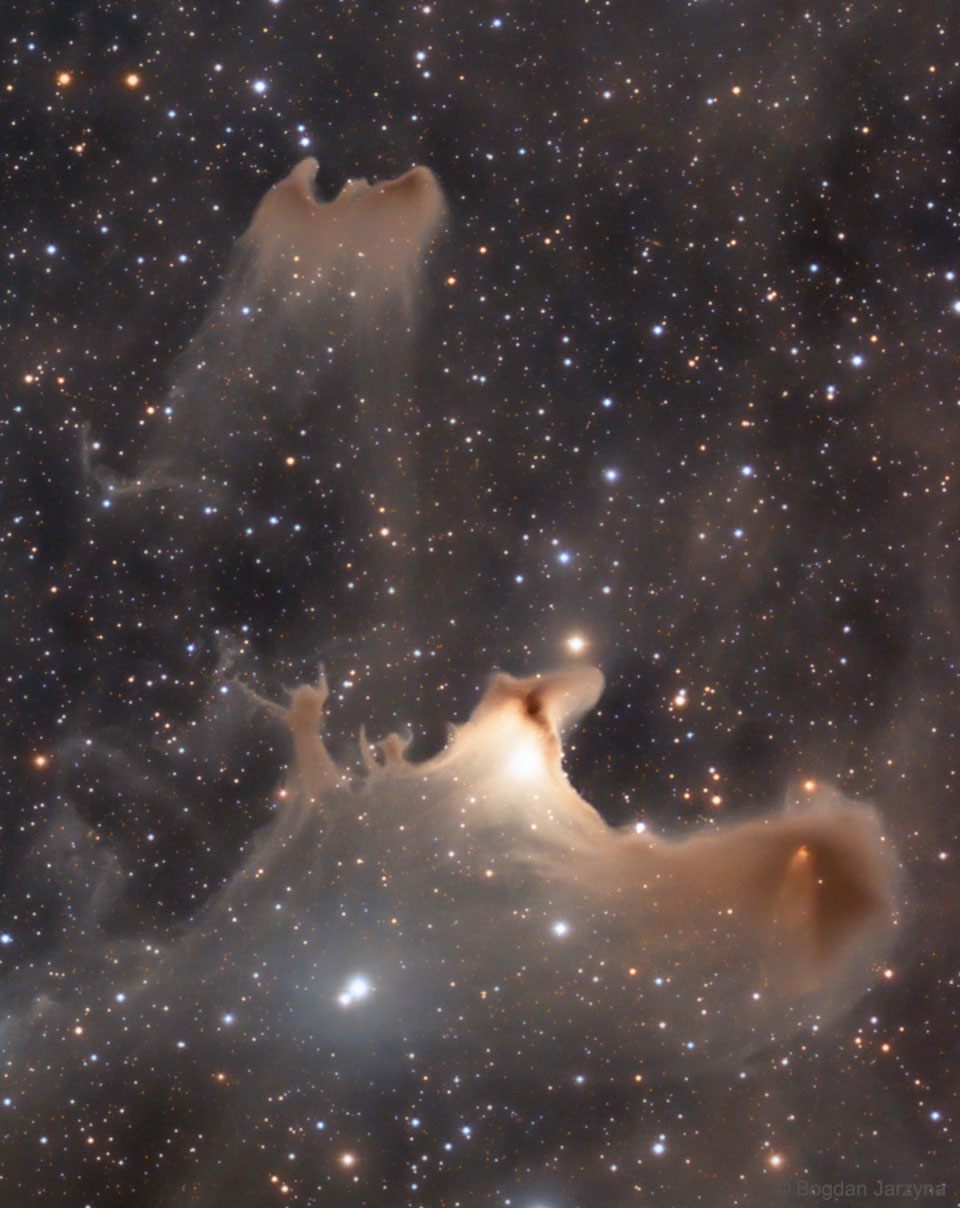
Reflections of the Ghost Nebula
30/10/2023
Do any shapes seem to jump out at you from this interstellar field of stars and dust? The jeweled expanse, filled with faint, starlight-reflecting clouds, drifts through the night in the royal constellation of Cepheus. Far from your own neighborhood on planet Earth, these ghostly apparitions lurk along the plane of the Milky Way at the edge of the Cepheus Flare molecular cloud complex some 1,200 light-years away. Over two light-years across and brighter than the other spooky chimeras, VdB 141 or Sh2-136 is also known as the Ghost Nebula, seen toward the bottom of the featured image. Within the reflection nebula are the telltale signs of dense cores collapsing in the early stages of star formation. Tour the Universe: Random APOD Generator
Copyright: Bogdan Jarzyna
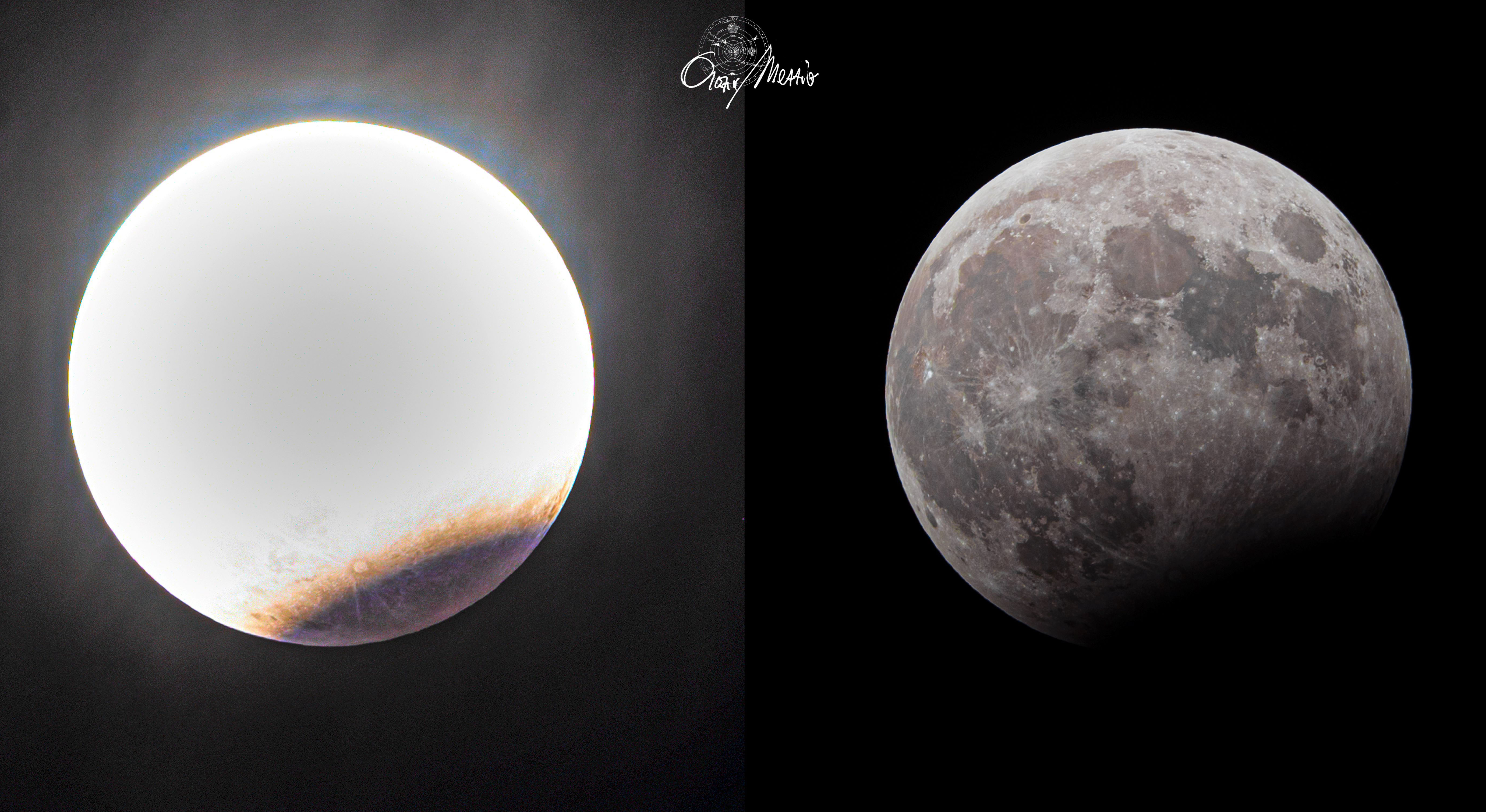
A Partial Lunar Eclipse
29/10/2023
What's happened to the Moon? Within the last day, part of the Moon moved through the Earth's shadow. This happens about once or twice a year, but not every month since the Moon's orbit around the Earth is slightly tilted. Pictured here, the face of a full Hunter's Moon is shown twice from Italy during this partial lunar eclipse. On the left, most of the Moon appears overexposed except for the eclipsed bottom right, which shows some familiar lunar surface details. In contrast, on the right, most of the (same) Moon appears normally exposed, with the exception of the bottom right, which now appears dark. All lunar eclipses are visible from the half of the Earth facing the Moon at the time of the eclipse, but this eclipse was visible specifically from Europe, Africa, Asia, and Australia, clouds permitting. In April, a total solar eclipse will be visible from North America. Album: Selected partial lunar eclipse images sent in to APOD
Copyright: Orazio Mezzio
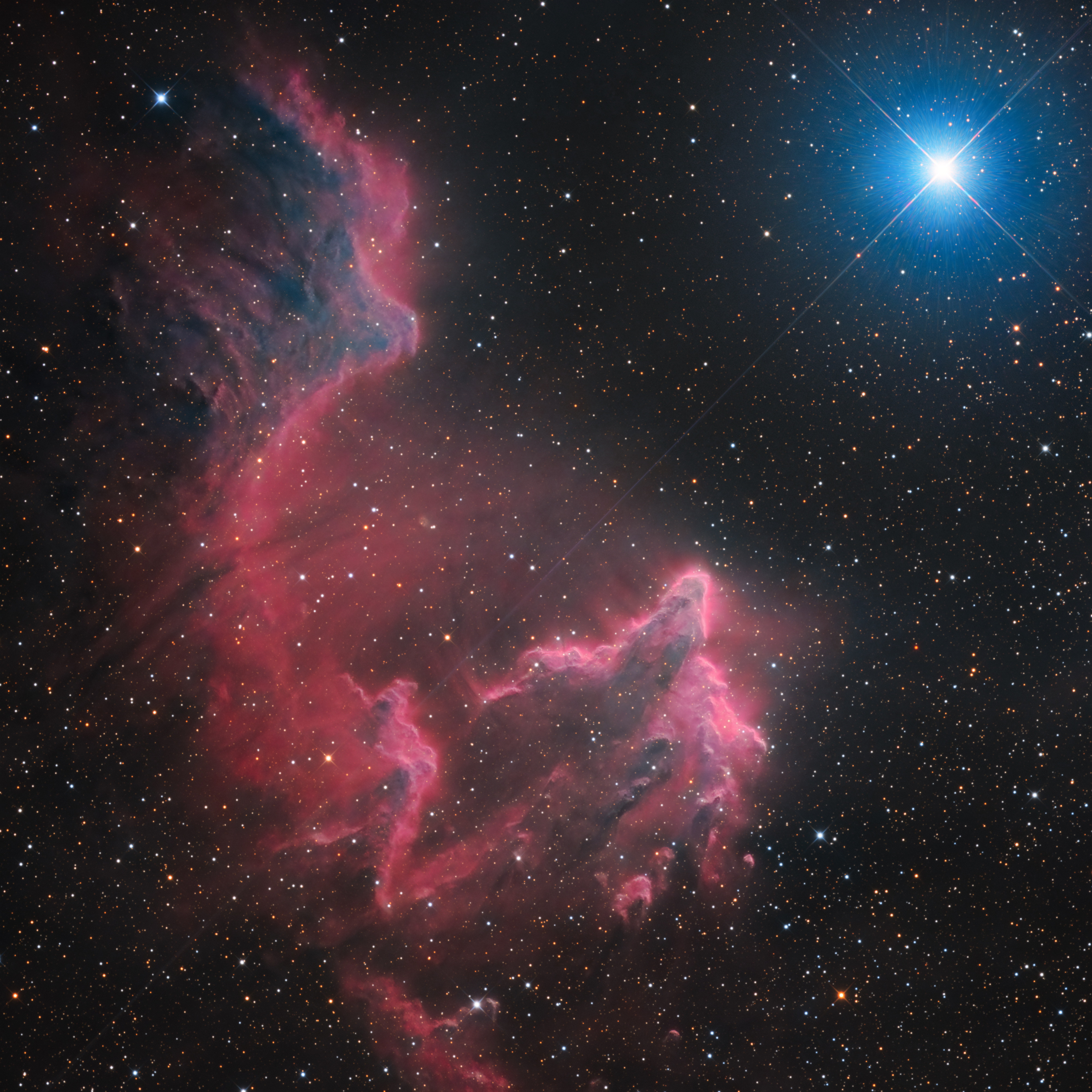
The Ghosts of Gamma Cas
28/10/2023
Gamma Cassiopeiae shines high in northern autumn evening skies. It's the brightest spiky star in this telescopic field of view toward the constellation Cassiopeia. Gamma Cas shares the ethereal-looking scene with ghostly interstellar clouds of gas and dust, IC 59 (top left) and IC 63. About 600 light-years distant, the clouds aren't actually ghosts. They are slowly disappearing though, eroding under the influence of energetic radiation from hot and luminous gamma Cas. Gamma Cas is physically located only 3 to 4 light-years from the nebulae. Slightly closer to gamma Cas, IC 63 is dominated by red H-alpha light emitted as hydrogen atoms ionized by the star's ultraviolet radiation recombine with electrons. Farther from the star, IC 59 shows proportionally less H-alpha emission but more of the characteristic blue tint of dust reflected star light. The cosmic stage spans over 1 degree or 10 light-years at the estimated distance of gamma Cas and friends.
Copyright: Guillaume Gruntz
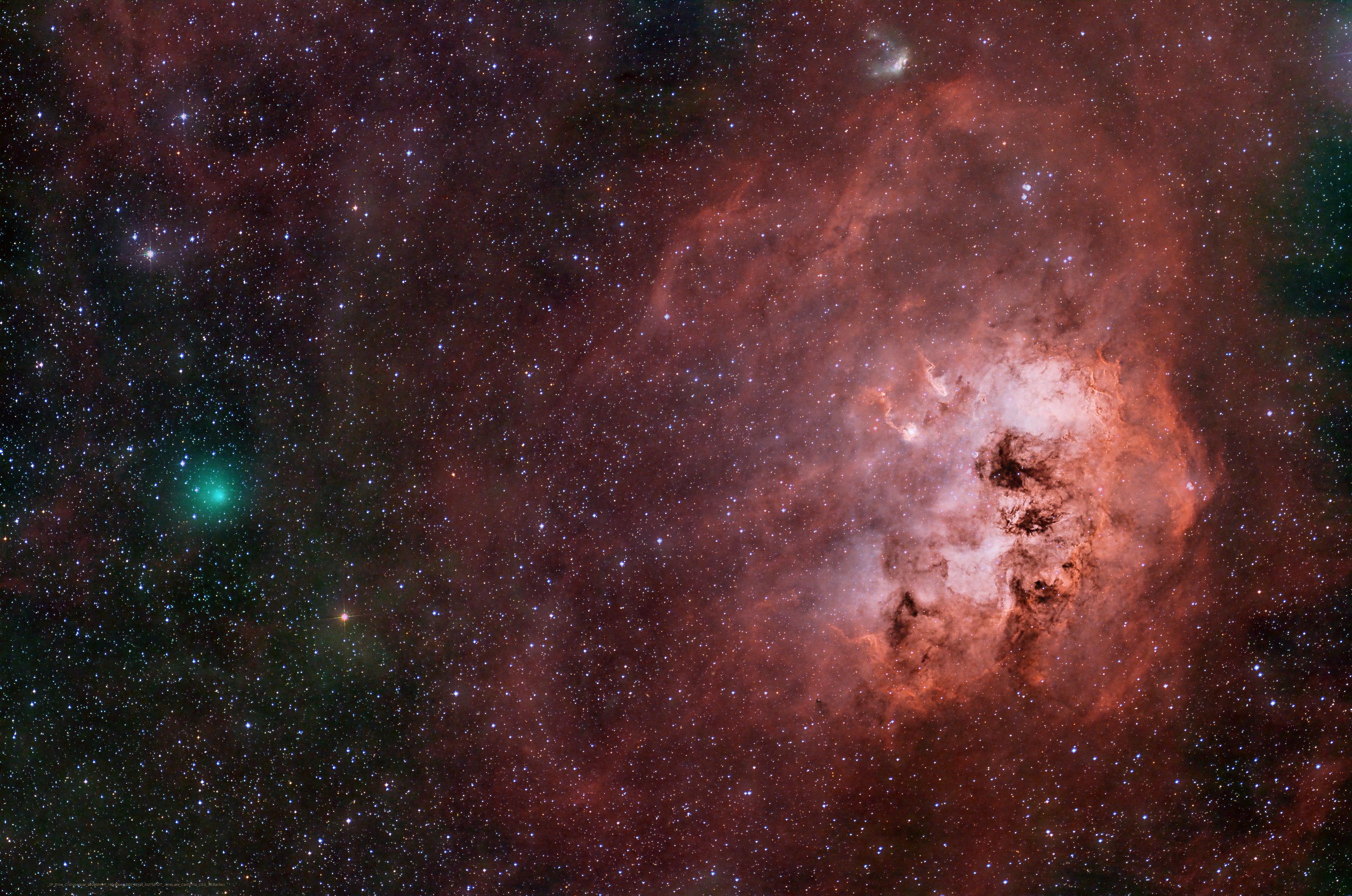
Encke and the Tadpoles
27/10/2023
History's second known periodic comet is Comet Encke (2P/Encke). As it swings through the inner Solar System, Encke's orbit takes it from an aphelion, its greatest distance from the Sun, inside the orbit of Jupiter to a perihelion just inside the orbit of Mercury. Returning to its perihelion every 3.3 years, Encke has the shortest period of the Solar System's major comets. Comet Encke is also associated with (at least) two annual meteor showers on planet Earth, the North and South Taurids. Both showers are active in late October and early November. Their two separate radiants lie near bright star Aldebaran in the head-strong constellation Taurus. A faint comet, Encke was captured in this telescopic field of view imaged on the morning of August 24. Then, Encke's pretty greenish coma was close on the sky to the young, embedded star cluster and light-years long, tadpole-shaped star-forming clouds in emission nebula IC 410. Now near bright star Spica in Virgo Comet Encke passed its 2023 perihelion only five days ago, on October 22.
Copyright: Dan Bartlett
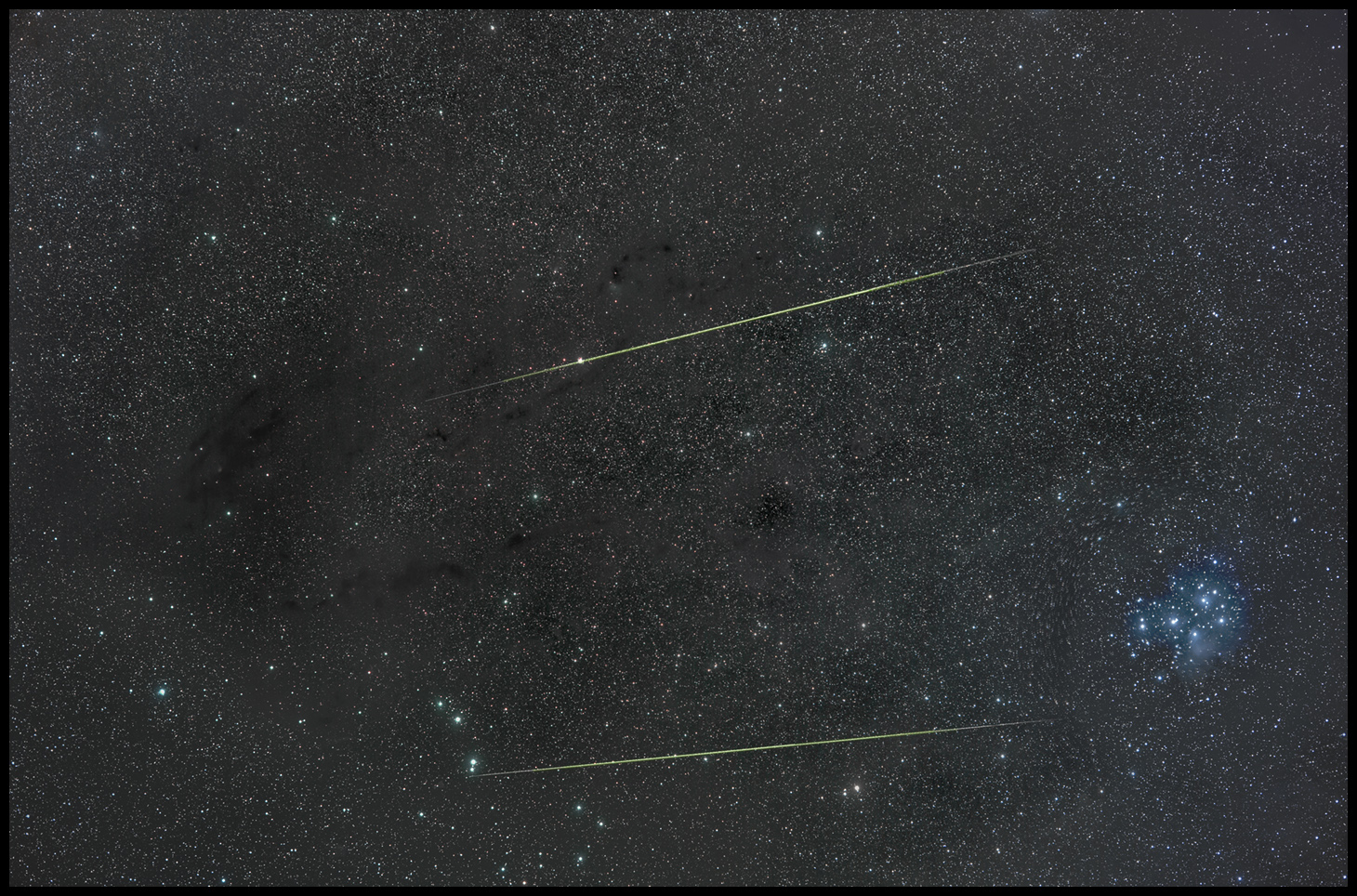
Orionids in Taurus
26/10/2023
History's first known periodic comet, Comet Halley (1P/Halley), returns to the inner Solar System every 76 years or so. The famous comet made its last appearance to the naked-eye in 1986. But dusty debris from Comet Halley can be seen raining through planet Earth's skies twice a year during two annual meteor showers, the Eta Aquarids in May and the Orionids in October. In fact, an unhurried series of exposures captured these two bright meteors, vaporizing bits of Halley dust, during the early morning hours of October 23 against a starry background along the Taurus molecular cloud. Impacting the atmosphere at about 66 kilometers per second their greenish streaks point back to the shower's radiant just north of Orion's bright star Betelgeuse off the lower left side of the frame. The familiar Pleiades star cluster anchors the dusty celestial scene at the right.
Copyright: David Cortner
Η Αστρονομική Εικόνα της Ημέρας από τη NASA (NASA Astronomy Picture of the Day) είναι μια δωρεάν υπηρεσία που παρέχει καθημερινά μια εντυπωσιακή εικόνα από το σύμπαν, την λήψη της οποίας έχει πραγματοποιήσει κάποιος από τους αστρονόμους της NASA ή από κάποιον από τους δορυφόρους ή τα τηλεσκόπια που η NASA λειτουργεί. Οι εικόνες που εμφανίζονται καλύπτουν μια ευρεία γκάμα από θέματα, συμπεριλαμβανομένων των αστερισμών, των γαλαξιών, των πλανητικών συστημάτων, των κομητών, των αστρικών σωμάτων και των παρατηρητηρίων. Κάθε εικόνα συνοδεύεται από μια σύντομη εξήγηση και πληροφορίες σχετικά με το τι παρατηρείται στην εικόνα.