Η Αστρονομική Εικόνα της Ημέρας από τη NASA
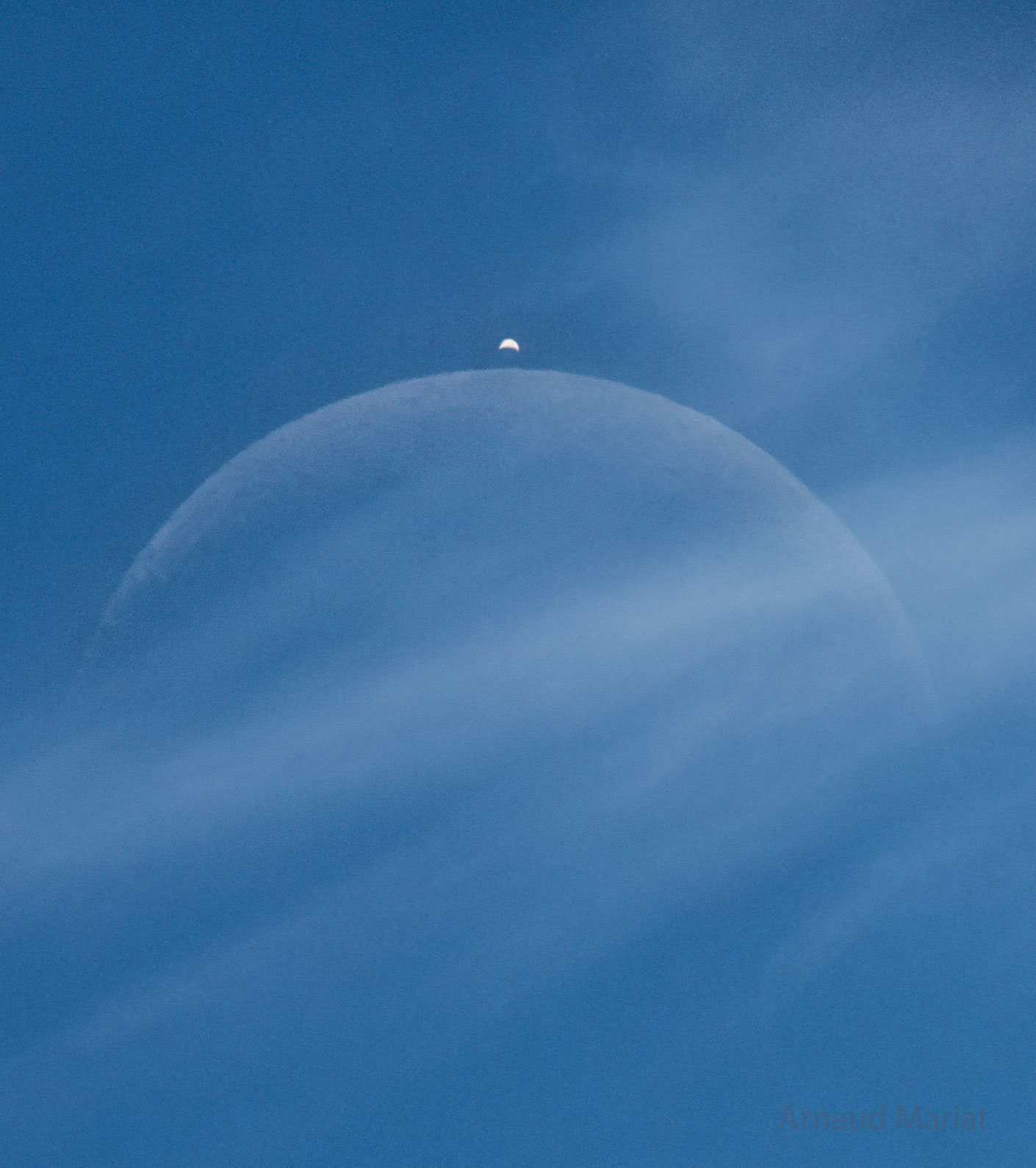
A Daytime Eclipse: Moon Occults Venus
15/09/2026
There was something behind the clouds. Upon close inspection, it was the Moon, which was hard to see yesterday around noon above the small village of Cessy, France. But soon, it was not only the Moon. As expected, a bright dot suddenly appeared from behind the Moon -- the planet Venus far in the distance. Captured in the single featured exposure, both appeared to show a crescent phase. The Moon's crescent was quite slight -- with only about 10 percent of its face illuminated by the Sun. In contrast, Venus's crescent was more full -- showing about 25 percent illumination. Venus appeared brighter because it is nearer the Sun and because its clouds are more reflective than the dark lunar surface. An occultation of Venus by the Moon is visible to only about 10 percent of the Earth, but in yesterday's event even most of that was experiencing daytime. APOD's main NASA site is moving: From apod.nasa.gov to science.nasa.gov/apod
Copyright: Arnaud Mariat
Προηγούμενες Αστρονομικές Εικόνες της Ημέρας από τη NASA
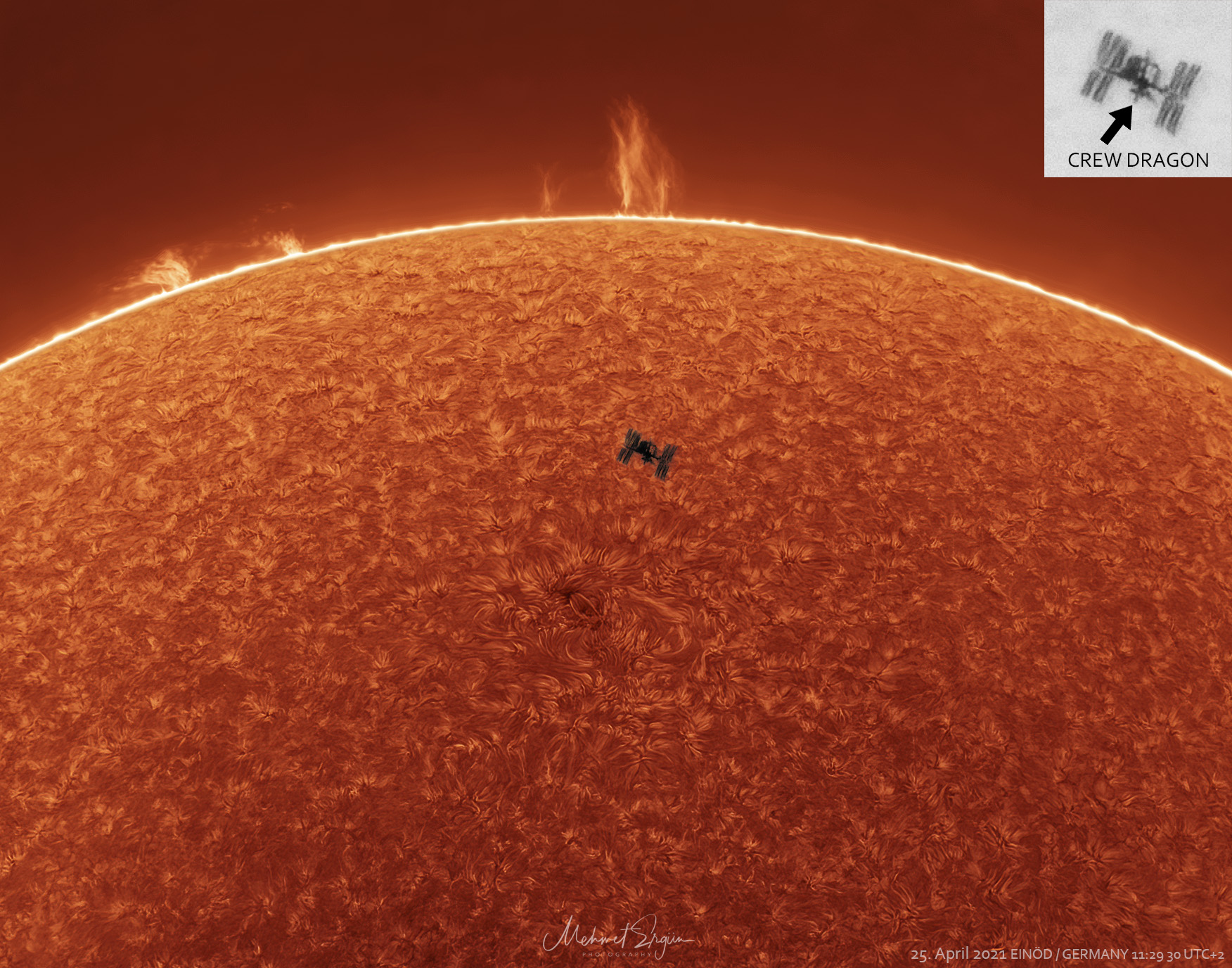
Space Station, Solar Prominences, Sun
19/11/2023
That's no sunspot. It's the International Space Station (ISS) caught passing in front of the Sun. Sunspots, individually, have a dark central umbra, a lighter surrounding penumbra, and no Dragon capsules attached. By contrast, the ISS is a complex and multi-spired mechanism, one of the largest and most complicated spacecraft ever created by humanity. Also, sunspots circle the Sun, whereas the ISS orbits the Earth. Transiting the Sun is not very unusual for the ISS, which orbits the Earth about every 90 minutes, but getting one's location, timing and equipment just right for a great image is rare. The featured picture combined three images all taken in 2021 from the same location and at nearly the same time. One image -- overexposed -- captured the faint prominences seen across the top of the Sun, a second image -- underexposed -- captured the complex texture of the Sun's chromosphere, while the third image -- the hardest to get -- captured the space station as it shot across the Sun in a fraction of a second. Close inspection of the space station's silhouette even reveals a docked Dragon Crew capsule. Follow APOD on Instagram in: Arabic, English, Persian, Portuguese, and Taiwanese
Copyright: Mehmet Ergün
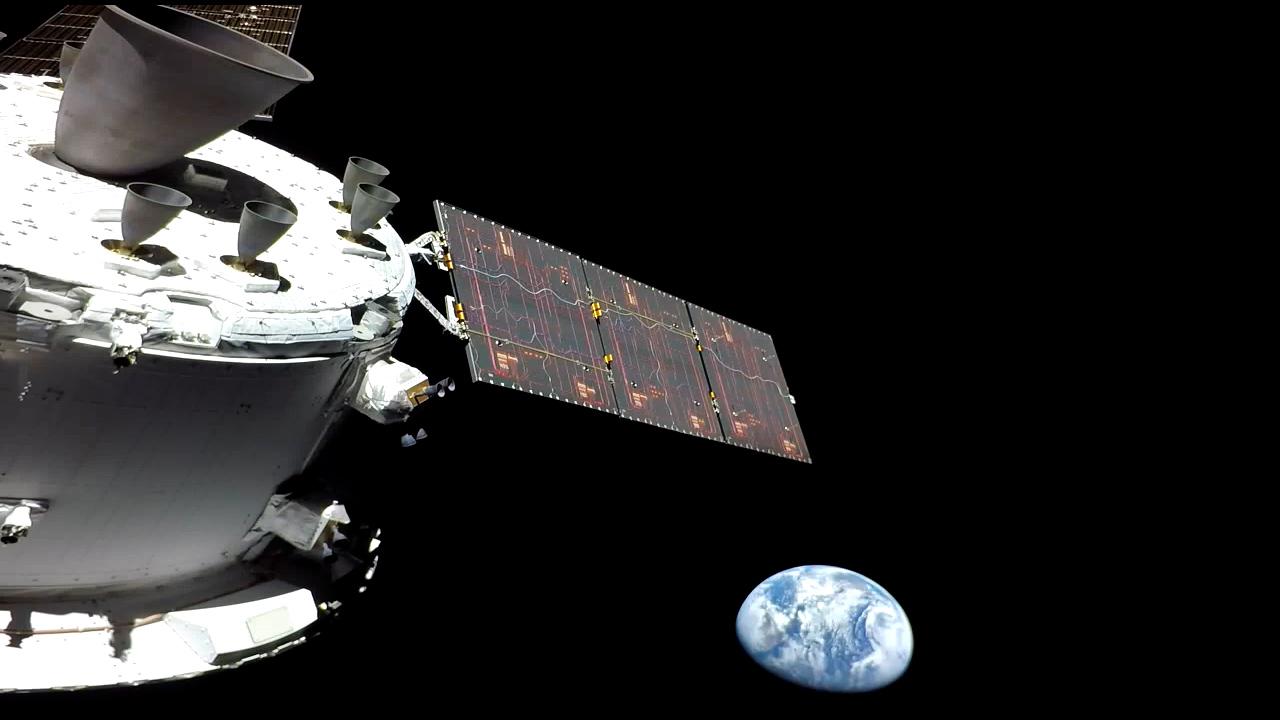
Planet Earth from Orion
18/11/2023
One year ago a Space Launch System rocket left planet Earth on November 16, 2022 at 1:47am EST carrying the Orion spacecraft on the Artemis I mission, the first integrated test of NASA’s deep space exploration systems. Over an hour after liftoff from Kennedy Space Center's historic Launch Complex 39B, one of Orion's external video cameras captured this view of its new perspective from space. In the foreground are Orion's Orbital Maneuvering System engine and auxillary engines, at the bottom of the European Service Module. Beyond one of the module's 7-meter long extended solar array wings lies the spacecraft's beautiful home world. Making close flybys of the lunar surface and reaching a retrograde orbit 70,000 kilometers beyond the Moon, the uncrewed Artemis I mission lasted over 25 days, testing capabilities to enable human exploration of the Moon and Mars. Building on the success of Artemis I, no earlier than November 2024 the Artemis II mission with a crew of 4 will venture around the Moon and back again.
Copyright: NASA
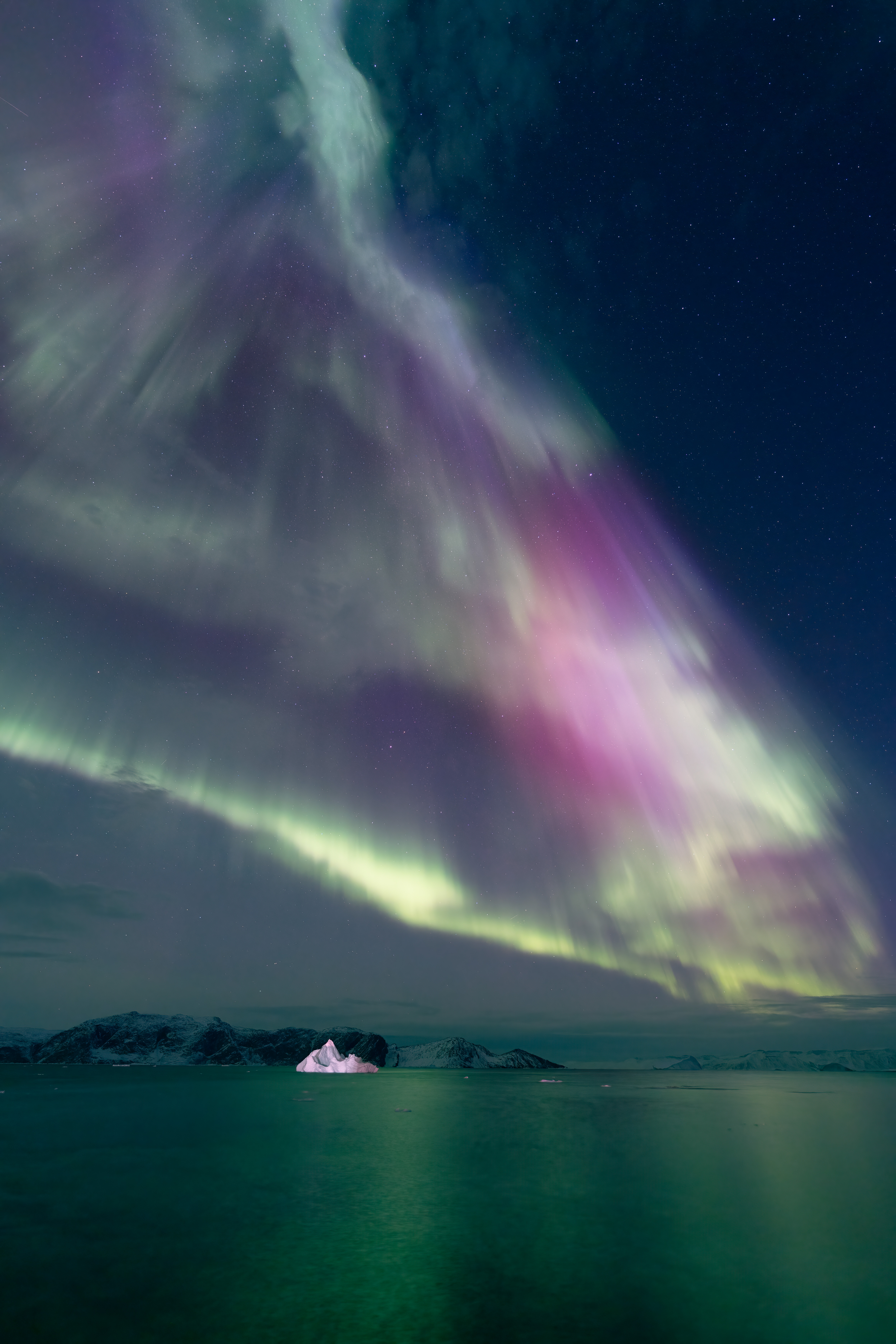
Nightlights in Qeqertaq
17/11/2023
Light pollution is usually not a problem in Qeqertaq. In western Greenland the remote coastal village boasted a population of 114 in 2020. Lights still shine in its dark skies though. During planet Earth's recent intense geomagnetic storm, on November 6 these beautiful curtains of aurora borealis fell over the arctic realm. On the eve of the coming weeks of polar night at 70 degrees north latitude, the inspiring display of northern lights is reflected in the waters of Disko Bay. In this view from the isolated settlement a lone iceberg is illuminated by shore lights as it drifts across the icy sea. Weekend Watch: The Leonid Meteor Shower.
Copyright: Dennis Lehtonen
Daytime Moon Meets Morning Star
16/11/2023
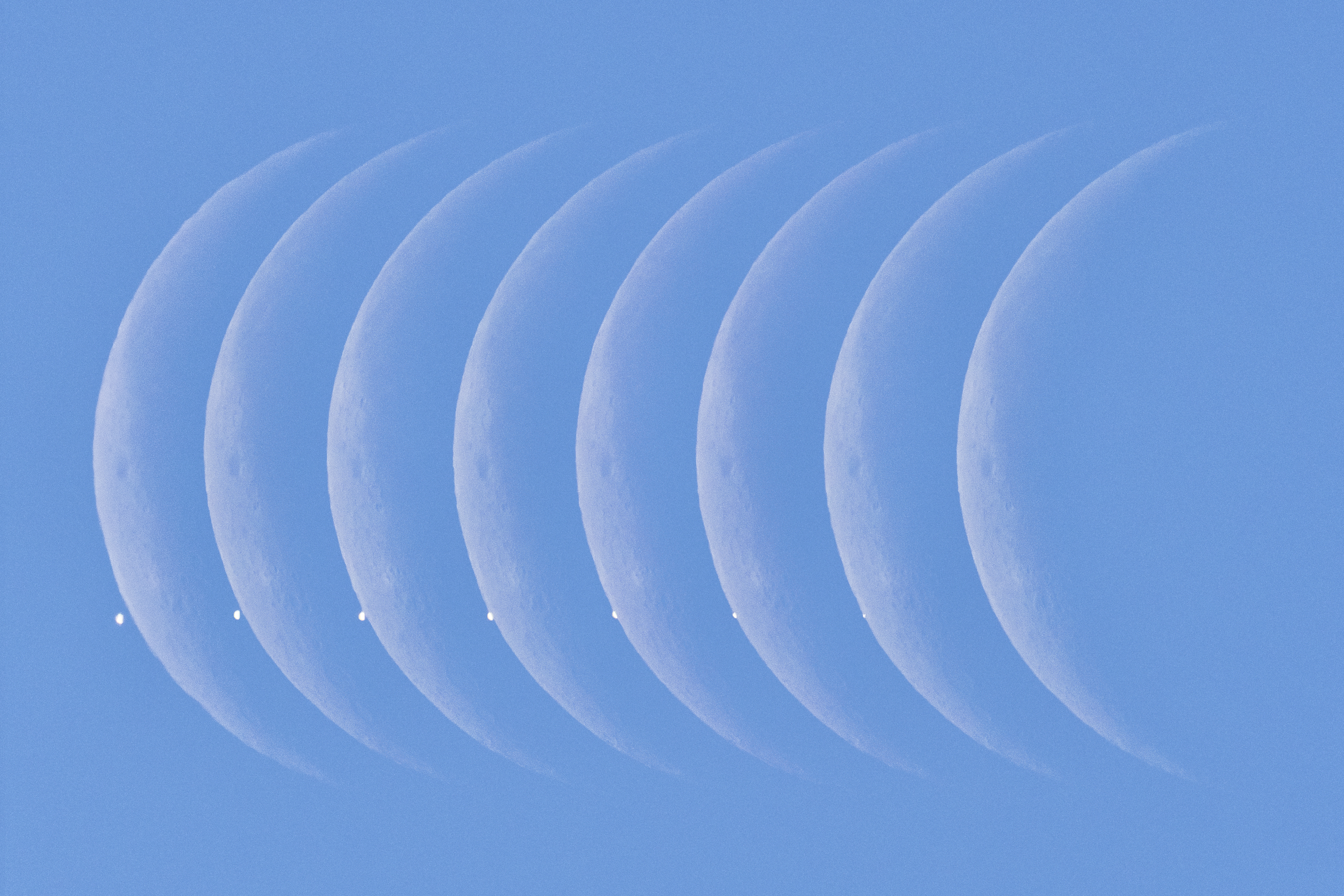
Venus now appears as Earth's brilliant morning star, shining above the southeastern horizon before dawn. For early morning risers, the silvery celestial beacon rose predawn in a close pairing with a waning crescent Moon on Thursday, November 9. But from some northern locations, the Moon was seen to occult or pass in front of Venus. From much of Europe, the lunar occultation could be viewed in daylight skies. This time series composite follows the daytime approach of Moon and morning star in blue skies from Warsaw, Poland. The progression of eight sharp telescopic snapshots, made between 10:56am and 10:58am local time, runs from left to right, when Venus winked out behind the bright lunar limb.
Copyright: Katarzyna Kaczmarczyk
M1: The Incredible Expanding Crab
15/11/2023
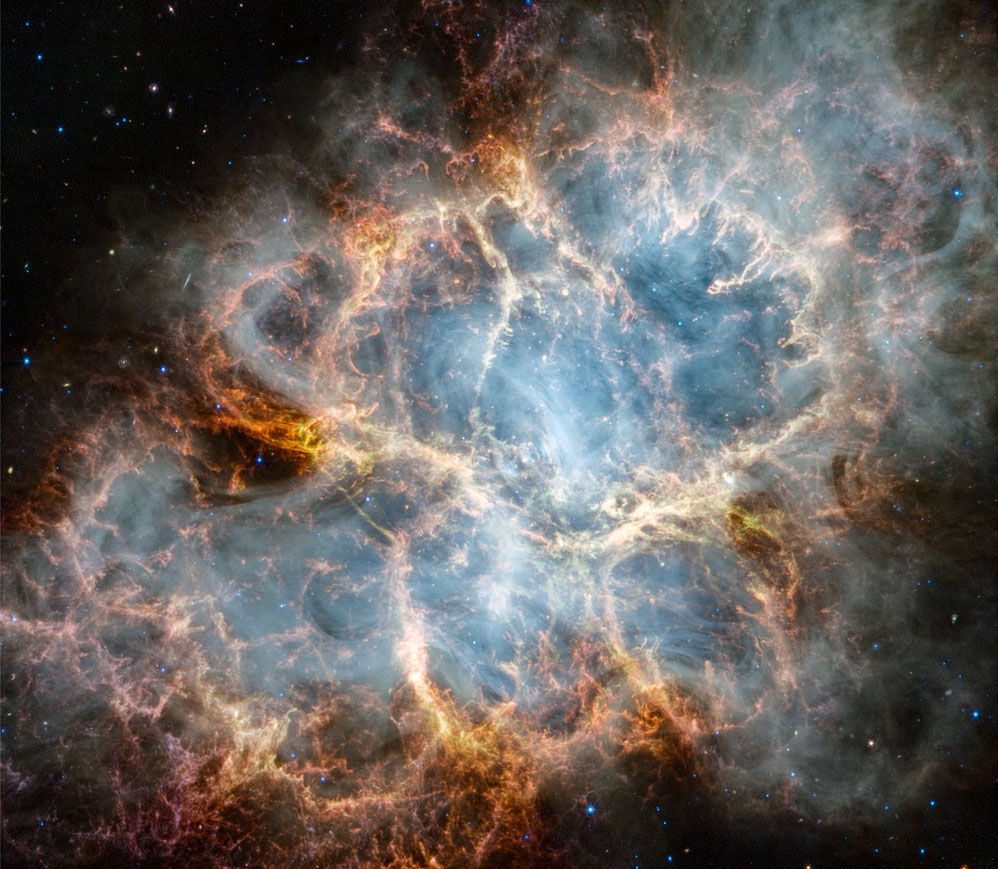
Cataloged as M1, the Crab Nebula is the first on Charles Messier's famous list of things which are not comets. In fact, the Crab Nebula is now known to be a supernova remnant, an expanding cloud of debris from the death explosion of a massive star. The violent birth of the Crab was witnessed by astronomers in the year 1054. Roughly 10 light-years across, the nebula is still expanding at a rate of about 1,500 kilometers per second. You can see the expansion by comparing these sharp images from the Hubble Space Telescope and James Webb Space Telescope. The Crab's dynamic, fragmented filaments were captured in visible light by Hubble in 2005 and Webb in infrared light in 2023. This cosmic crustacean lies about 6,500 light-years away in the constellation Taurus.
Copyright: NASA
Three Planets Rock
14/11/2023
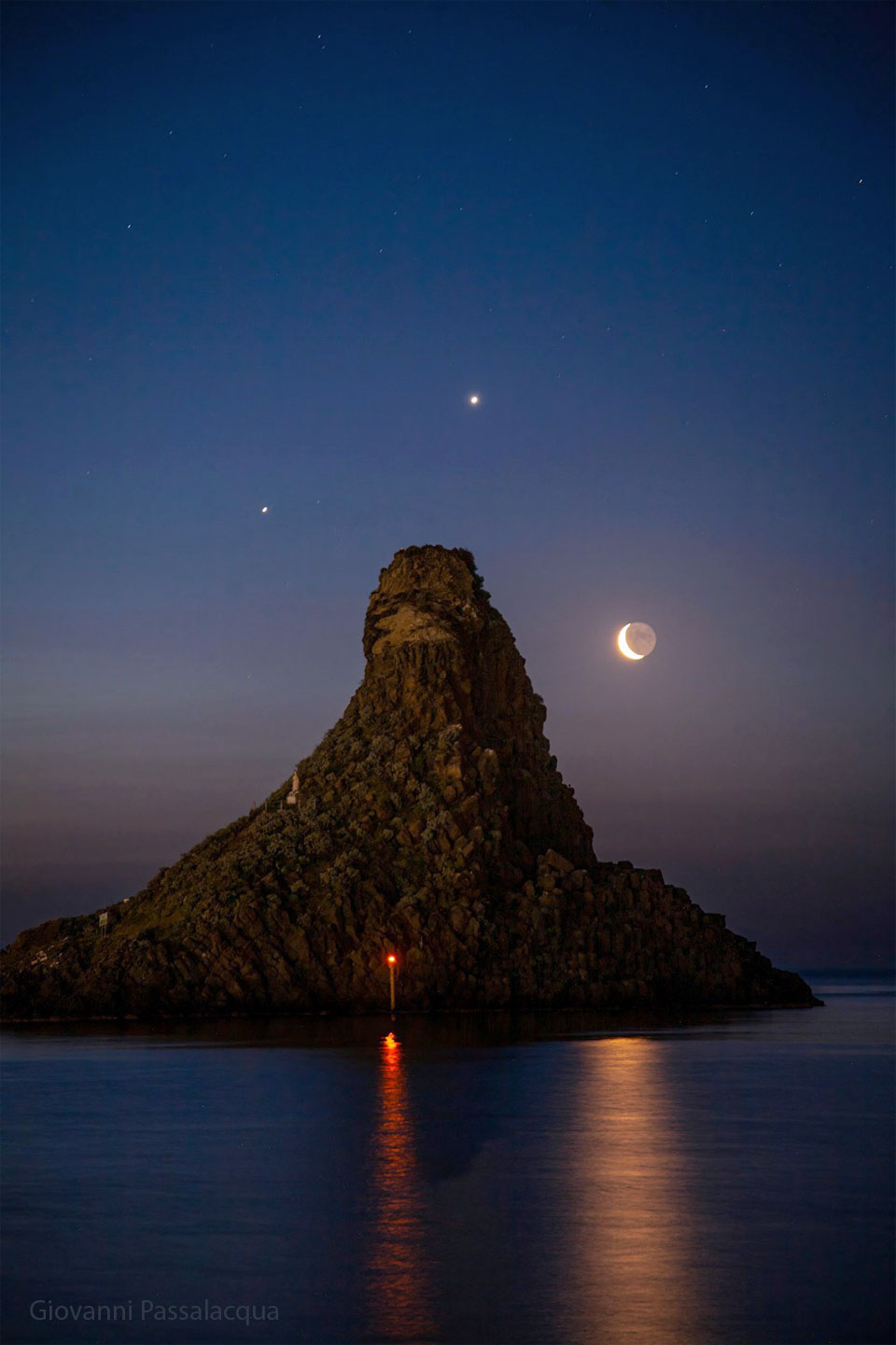
In the fading darkness before dawn, a tilted triangle appeared to balance atop a rock formation off the southern tip of Sicily. Making up the points of the triangle are three of the four brightest objects visible in Earth’s sky: Jupiter, Venus and the Moon. Though a thin waning crescent, most of the moon’s disk is visible due to earthshine. Captured in this image on 2022 April 27, Venus (center) and Jupiter (left) are roughly three degrees apart -- and were headed toward a close conjunction. Conjunctions of Venus and Jupiter occur about once a year and are visible either in the east before sunrise or in the west after sunset. The featured image was taken about an hour before the arrival of the brightest object in Earth’s sky – the Sun.
Copyright: Giovanni Passalacqua; Text: Liz Coelho (Pikes Peak)
Andromeda over the Alps
13/11/2023
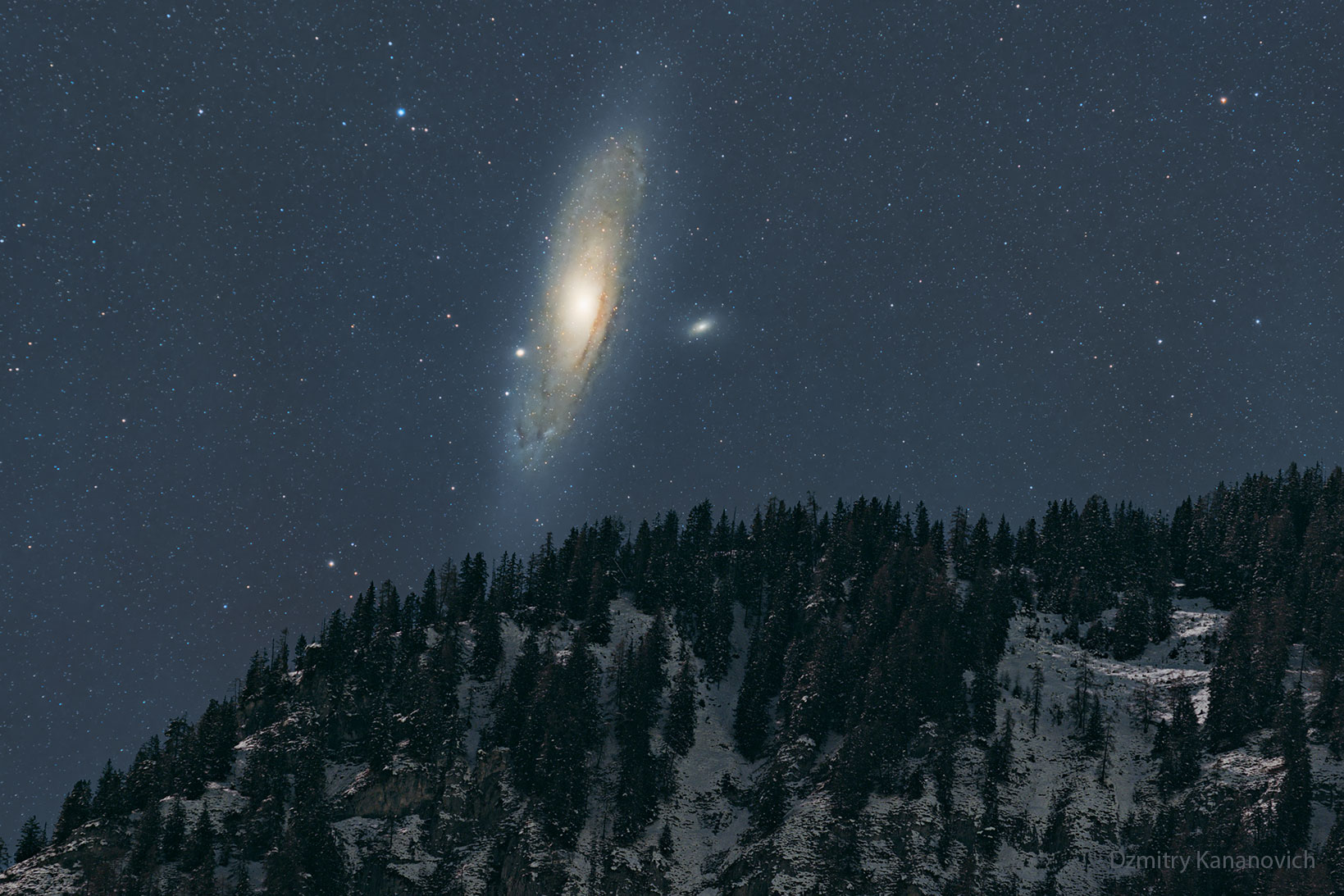
Have you ever seen the Andromeda galaxy? Although M31 appears as a faint and fuzzy blob to the unaided eye, the light you see will be over two million years old, making it likely the oldest light you ever will see directly. The featured image captured Andromeda just before it set behind the Swiss Alps early last year. As cool as it may be to see this neighboring galaxy to our Milky Way with your own eyes, long duration camera exposures can pick up many faint and breathtaking details. The image is composite of foreground and background images taken consecutively with the same camera and from the same location. Recent data indicate that our Milky Way Galaxy will collide and coalesce with Andromeda galaxy in a few billion years. Follow APOD on Facebook in: Arabic, English, Catalan, Portuguese, or Taiwanese
Copyright: Dzmitry Kananovich
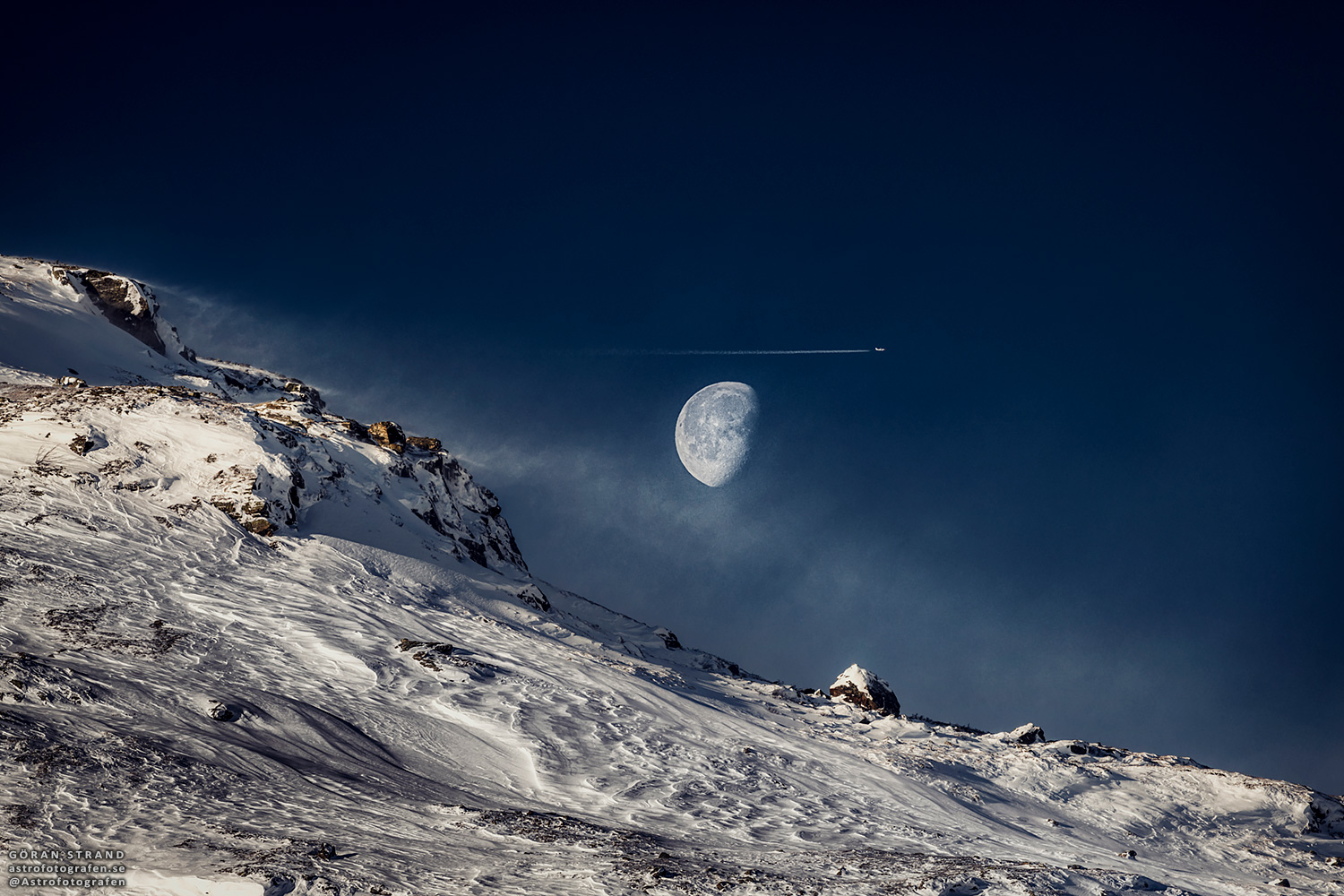
Gibbous Moon beyond Swedish Mountain
12/11/2023
This is a gibbous Moon. More Earthlings are familiar with a full moon, when the entire face of Luna is lit by the Sun, and a crescent moon, when only a sliver of the Moon's face is lit. When more than half of the Moon is illuminated, though, but still short of full illumination, the phase is called gibbous. Rarely seen in television and movies, gibbous moons are quite common in the actual night sky. The featured image was taken in Jämtland, Sweden near the end of 2018 October. That gibbous moon turned, in a few days, into a crescent moon, and then a new moon, then back to a crescent, and a few days past that, back to gibbous. Setting up to capture a picturesque gibbous moonscape, the photographer was quite surprised to find an airplane, surely well in the foreground, appearing to fly past it. Almost Hyperspace: Random APOD Generator
Copyright: Göran Strand
Η Αστρονομική Εικόνα της Ημέρας από τη NASA (NASA Astronomy Picture of the Day) είναι μια δωρεάν υπηρεσία που παρέχει καθημερινά μια εντυπωσιακή εικόνα από το σύμπαν, την λήψη της οποίας έχει πραγματοποιήσει κάποιος από τους αστρονόμους της NASA ή από κάποιον από τους δορυφόρους ή τα τηλεσκόπια που η NASA λειτουργεί. Οι εικόνες που εμφανίζονται καλύπτουν μια ευρεία γκάμα από θέματα, συμπεριλαμβανομένων των αστερισμών, των γαλαξιών, των πλανητικών συστημάτων, των κομητών, των αστρικών σωμάτων και των παρατηρητηρίων. Κάθε εικόνα συνοδεύεται από μια σύντομη εξήγηση και πληροφορίες σχετικά με το τι παρατηρείται στην εικόνα.