Η Αστρονομική Εικόνα της Ημέρας από τη NASA
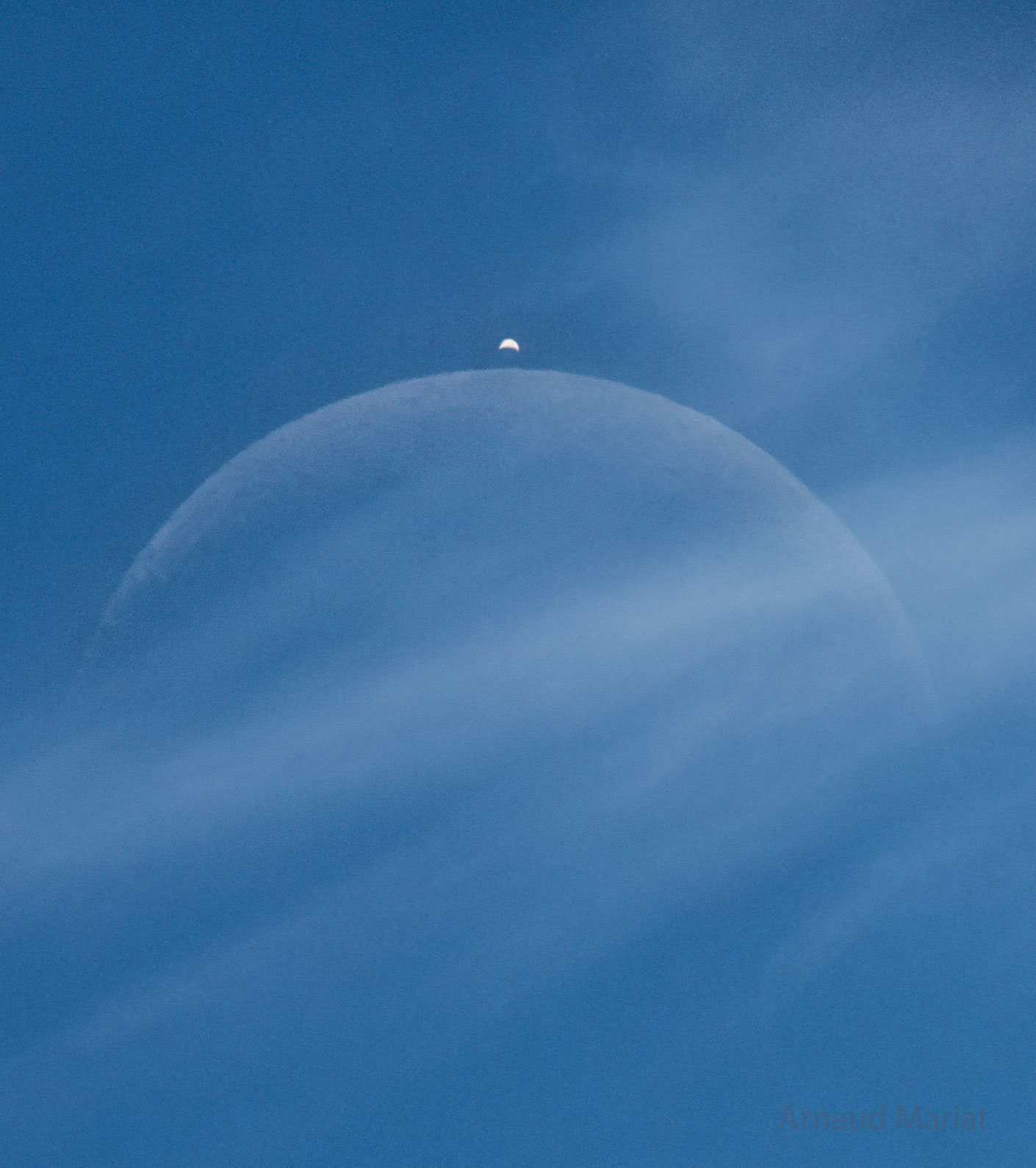
A Daytime Eclipse: Moon Occults Venus
15/09/2026
There was something behind the clouds. Upon close inspection, it was the Moon, which was hard to see yesterday around noon above the small village of Cessy, France. But soon, it was not only the Moon. As expected, a bright dot suddenly appeared from behind the Moon -- the planet Venus far in the distance. Captured in the single featured exposure, both appeared to show a crescent phase. The Moon's crescent was quite slight -- with only about 10 percent of its face illuminated by the Sun. In contrast, Venus's crescent was more full -- showing about 25 percent illumination. Venus appeared brighter because it is nearer the Sun and because its clouds are more reflective than the dark lunar surface. An occultation of Venus by the Moon is visible to only about 10 percent of the Earth, but in yesterday's event even most of that was experiencing daytime. APOD's main NASA site is moving: From apod.nasa.gov to science.nasa.gov/apod
Copyright: Arnaud Mariat
Προηγούμενες Αστρονομικές Εικόνες της Ημέρας από τη NASA
The SAR and the Milky Way
11/11/2023
This broad, luminous red arc was a surprising visitor to partly cloudy evening skies over northern France. Captured extending toward the zenith in a west-to-east mosaic of images from November 5, the faint atmospheric ribbon of light is an example of a Stable Auroral Red (SAR) arc. The rare night sky phenomenon was also spotted at unusually low latitudes around world, along with more dynamic auroral displays during an intense geomagnetic storm. SAR arcs and their relation to auroral emission have been explored by citizen science and satellite investigations. From altitudes substantially above the normal auroral glow, the deep red SAR emission is thought to be caused by strong heating due to currents flowing in planet Earth's inner magnetosphere. Beyond this SAR, the Milky Way arcs above the cloud banks along the horizon, a regular visitor to night skies over northern France.
Copyright: Julien Looten
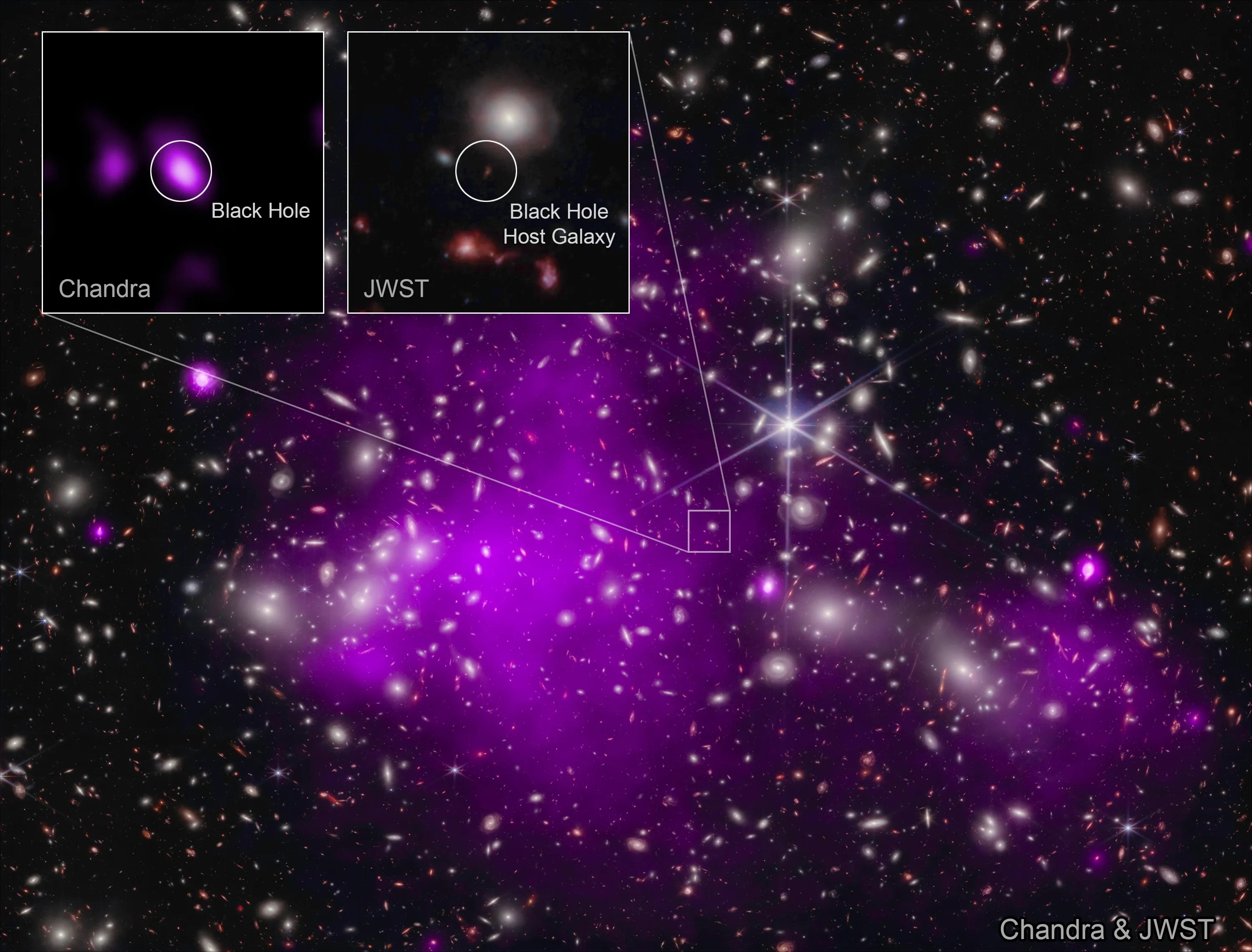
UHZ1: Distant Galaxy and Black Hole
10/11/2023
Dominated by dark matter, massive cluster of galaxies Abell 2744 is known to some as Pandora's Cluster. It lies 3.5 billion light-years away toward the constellation Sculptor. Using the galaxy cluster's enormous mass as a gravitational lens to warp spacetime and magnify even more distant objects directly behind it, astronomers have found a background galaxy, UHZ1, at a remarkable redshift of Z=10.1. That puts UHZ1 far beyond Abell 2744, at a distance of 13.2 billion light-years, seen when our universe was about 3 percent of its current age. UHZ1 is identified in the insets of this composited image combining X-rays (purple hues) from the spacebased Chandra X-ray Observatory and infrared light from the James Webb Space Telescope. The X-ray emission from UHZ1 detected in the Chandra data is the telltale signature of a growing supermassive black hole at the center of the ultra high redshift galaxy. That makes UHZ1's growing black hole the most distant black hole ever detected in X-rays, a result that now hints at how and when the first supermassive black holes in the universe formed.
Copyright: NASA
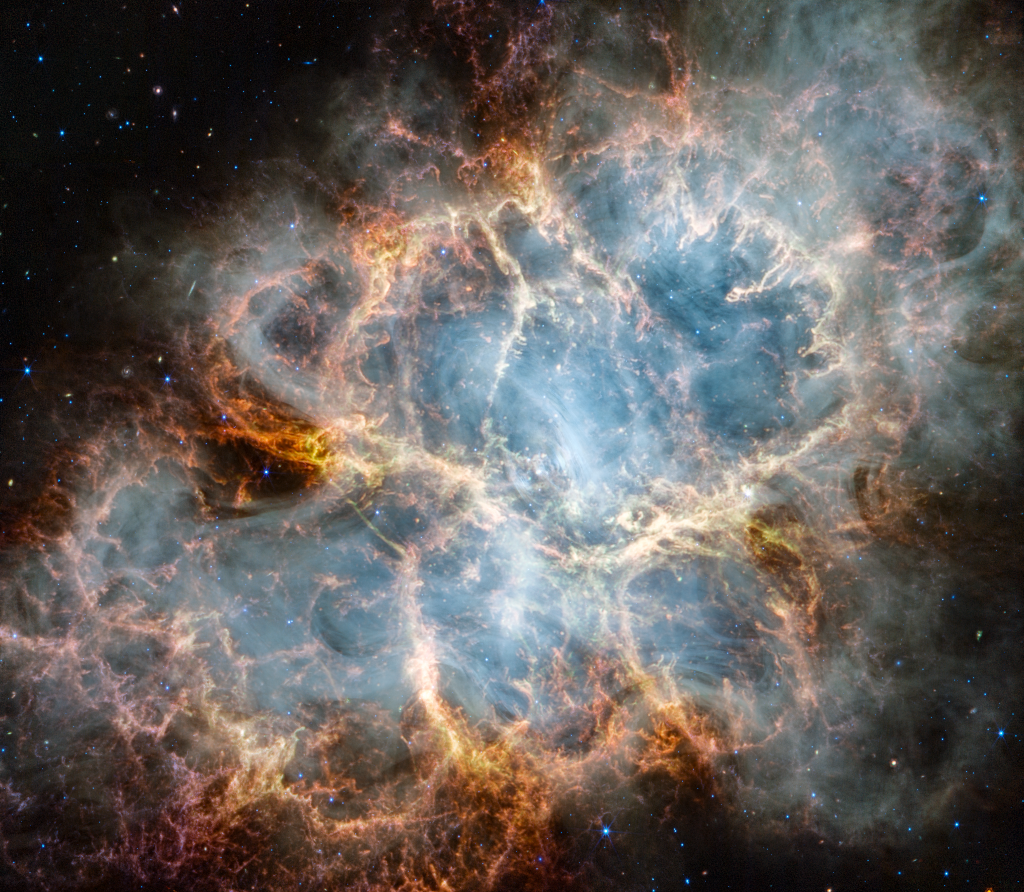
M1: The Crab Nebula
09/11/2023
The Crab Nebula is cataloged as M1, the first object on Charles Messier's famous 18th century list of things which are not comets. In fact, the Crab is now known to be a supernova remnant, debris from the death explosion of a massive star witnessed by astronomers in the year 1054. This sharp image from the James Webb Space Telescope’s NIRCam (Near-Infrared Camera) and MIRI (Mid-Infrared Instrument) explores the eerie glow and fragmented strands of the still expanding cloud of interstellar debris in infrared light. One of the most exotic objects known to modern astronomers, the Crab Pulsar, a neutron star spinning 30 times a second, is visible as a bright spot near the nebula's center. Like a cosmic dynamo, this collapsed remnant of the stellar core powers the Crab's emission across the electromagnetic spectrum. Spanning about 12 light-years, the Crab Nebula is a mere 6,500 light-years away in the head-strong constellation Taurus.
Copyright: NASA
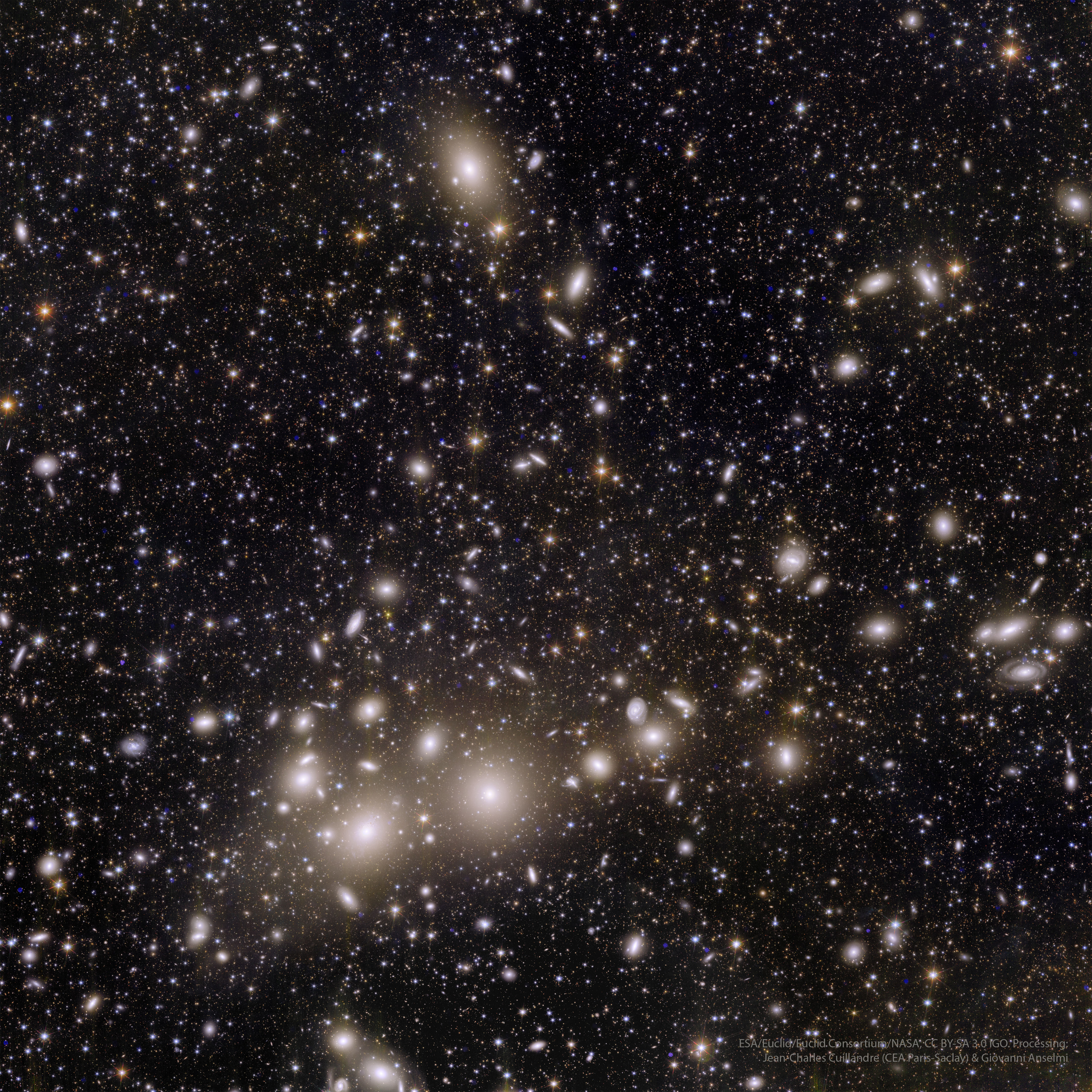
Perseus Galaxy Cluster from Euclid
08/11/2023
There's a new space telescope in the sky: Euclid. Equipped with two large panoramic cameras, Euclid captures light from the visible to the near-infrared. It took five hours of observing for Euclid's 1.2-meter diameter primary mirror to capture, through its sharp optics, the 1000+ galaxies in the Perseus cluster, which lies 250 million light years away. More than 100,000 galaxies are visible in the background, some as far away as 10 billion light years. The revolutionary nature of Euclid lies in the combination of its wide field of view (twice the area of the full moon), its high angular resolution (thanks to its 620 Megapixel camera), and its infrared vision, which captures both images and spectra. Euclid's initial surveys, covering a third of the sky and recording over 2 billion galaxies, will enable a study of how dark matter and dark energy have shaped our universe.
Copyright: NASA
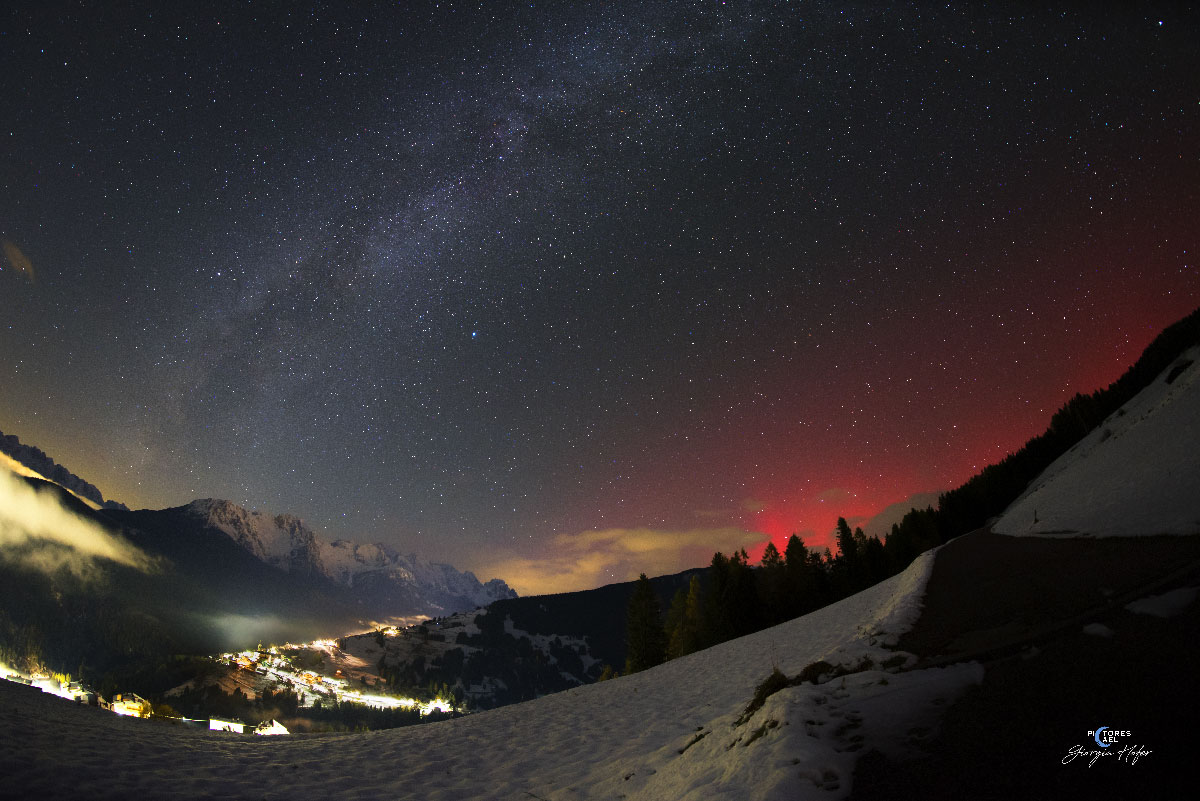
Red Aurora over Italy
06/11/2023
What was that red glow on the horizon last night? Aurora. Our unusually active Sun produced a surface explosion a few days ago that sent out a burst of electrons, protons, and more massive charged nuclei. This coronal mass ejection (CME) triggered auroras here on Earth that are being reported unusually far south in Earth's northern hemisphere. For example, this was the first time that the astrophotographer captured aurora from her home country of Italy. Additionally, many images from these auroras appear quite red in color. In the featured image, the town of Comelico Superiore in the Italian Alps is visible in the foreground, with the central band of our Milky Way galaxy seen rising from the lower left. What draws the eye the most, though, is the bright red aurora on the far right. The featured image is a composite with the foreground and background images taken consecutively with the same camera and from the same location. Aurora Album: Selected images sent in to APOD
Copyright: Giorgia Hofer
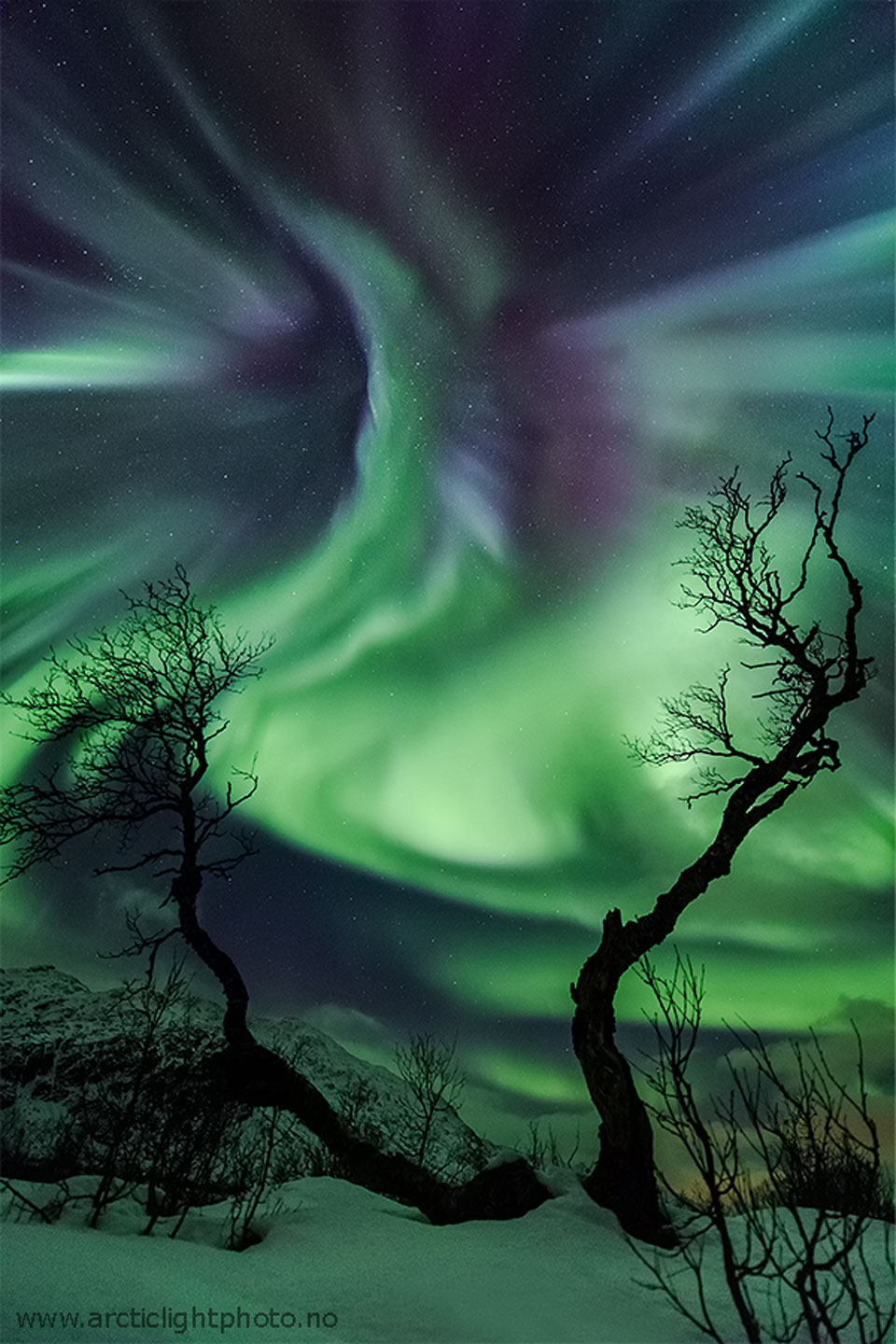
Creature Aurora Over Norway
05/11/2023
It was Halloween and the sky looked like a creature. Exactly which creature, the astrophotographer was unsure (but possibly you can suggest one). Exactly what caused this eerie apparition in 2013 was sure: one of the best auroral displays that year. This spectacular aurora had an unusually high degree of detail. Pictured here, the vivid green and purple auroral colors are caused by high atmospheric oxygen and nitrogen reacting to a burst of incoming electrons. Birch trees in Tromsø, Norway formed an also eerie foreground. Frequently, new photogenic auroras accompany new geomagnetic storms. Almost Hyperspace: Random APOD Generator
Copyright: Ole C. Salomonsen (Arctic Light Photo)
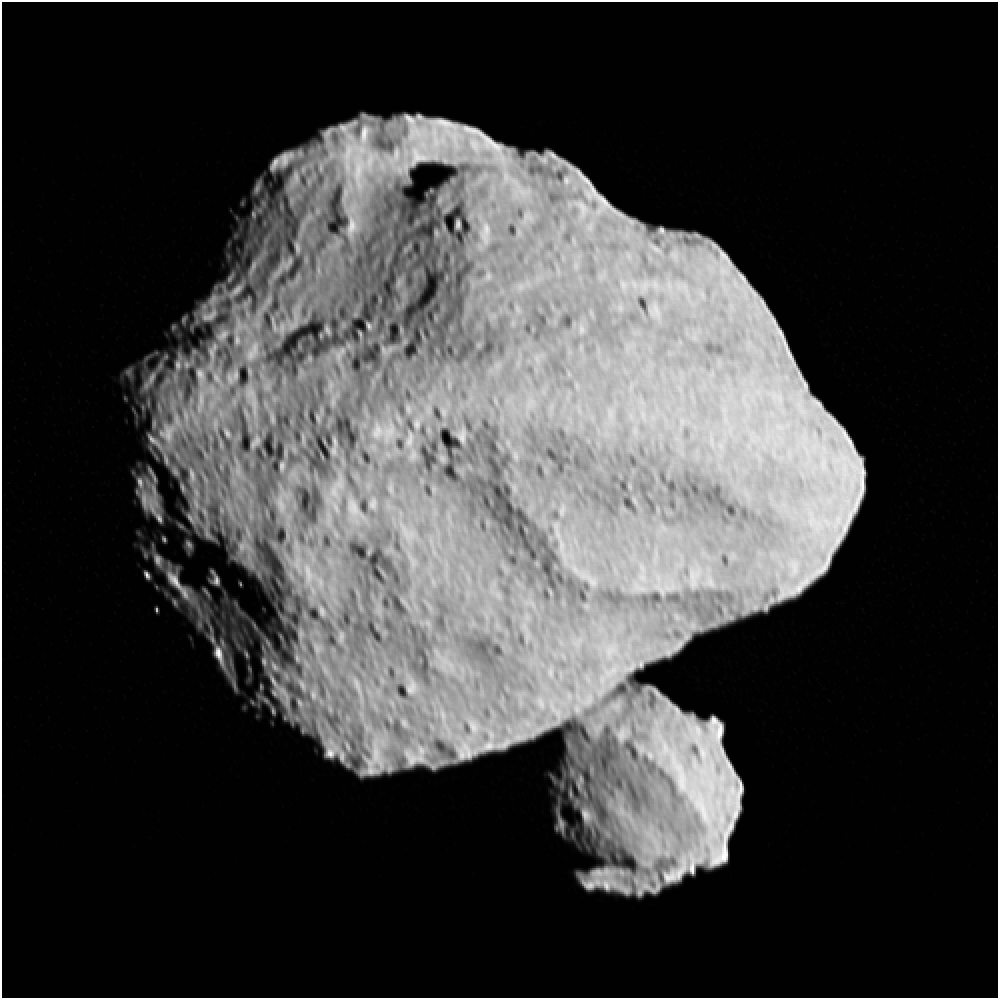
Dinkinesh Moonrise
04/11/2023
Last Wednesday the voyaging Lucy spacecraft encountered its first asteroid, 152830 Dinkinesh, and discovered the inner-main belt asteroid has a moon. From a distance of just over 400 kilometers, Lucy's Long-Range Reconnaissance Imager captured this close-up of the binary system during a flyby at 4.5 kilometer per second or around 10,000 miles per hour. A marvelous world, Dinkinesh itself is small, less than 800 meters (about 0.5 miles) across at its widest. Its satellite is seen from the spacecraft's perspective to emerge from behind the primary asteroid. The asteroid moon is estimated to be only about 220 meters wide.
Copyright: NASA
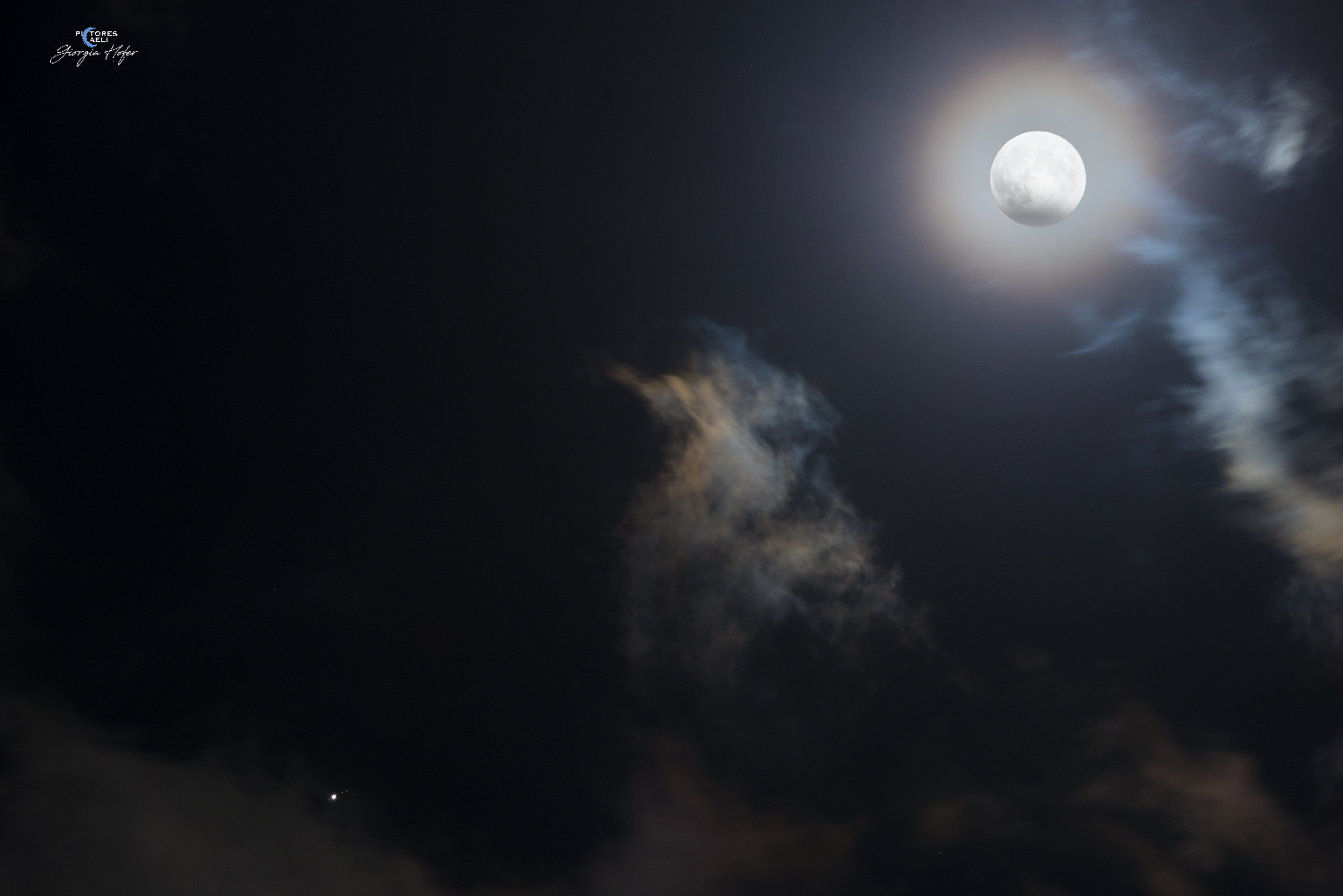
Jupiter by Moonlight
03/11/2023
That bright beacon you've seen rising in the east just after sunset is Jupiter. Climbing high in midnight skies, our Solar System's ruling gas giant was at its 2023 opposition, opposite the Sun in planet Earth's sky, on November 2. But only a few days earlier, on October 28, the Moon was at its own opposition. Then both Full Moon and Jupiter could share this telephoto field of view. The celestial scene is composed from two exposures, one long and one short, blended to record bright planet and even brighter Moon during that evening's partial lunar eclipse. Moonlight shining through the thin, high clouds over northern Italy creates the colorful iridescence and lunar corona. Look closely and you'll also spot some of Jupiter's Galilean moons.
Copyright: Giorgia Hofer
Η Αστρονομική Εικόνα της Ημέρας από τη NASA (NASA Astronomy Picture of the Day) είναι μια δωρεάν υπηρεσία που παρέχει καθημερινά μια εντυπωσιακή εικόνα από το σύμπαν, την λήψη της οποίας έχει πραγματοποιήσει κάποιος από τους αστρονόμους της NASA ή από κάποιον από τους δορυφόρους ή τα τηλεσκόπια που η NASA λειτουργεί. Οι εικόνες που εμφανίζονται καλύπτουν μια ευρεία γκάμα από θέματα, συμπεριλαμβανομένων των αστερισμών, των γαλαξιών, των πλανητικών συστημάτων, των κομητών, των αστρικών σωμάτων και των παρατηρητηρίων. Κάθε εικόνα συνοδεύεται από μια σύντομη εξήγηση και πληροφορίες σχετικά με το τι παρατηρείται στην εικόνα.