Η Αστρονομική Εικόνα της Ημέρας από τη NASA
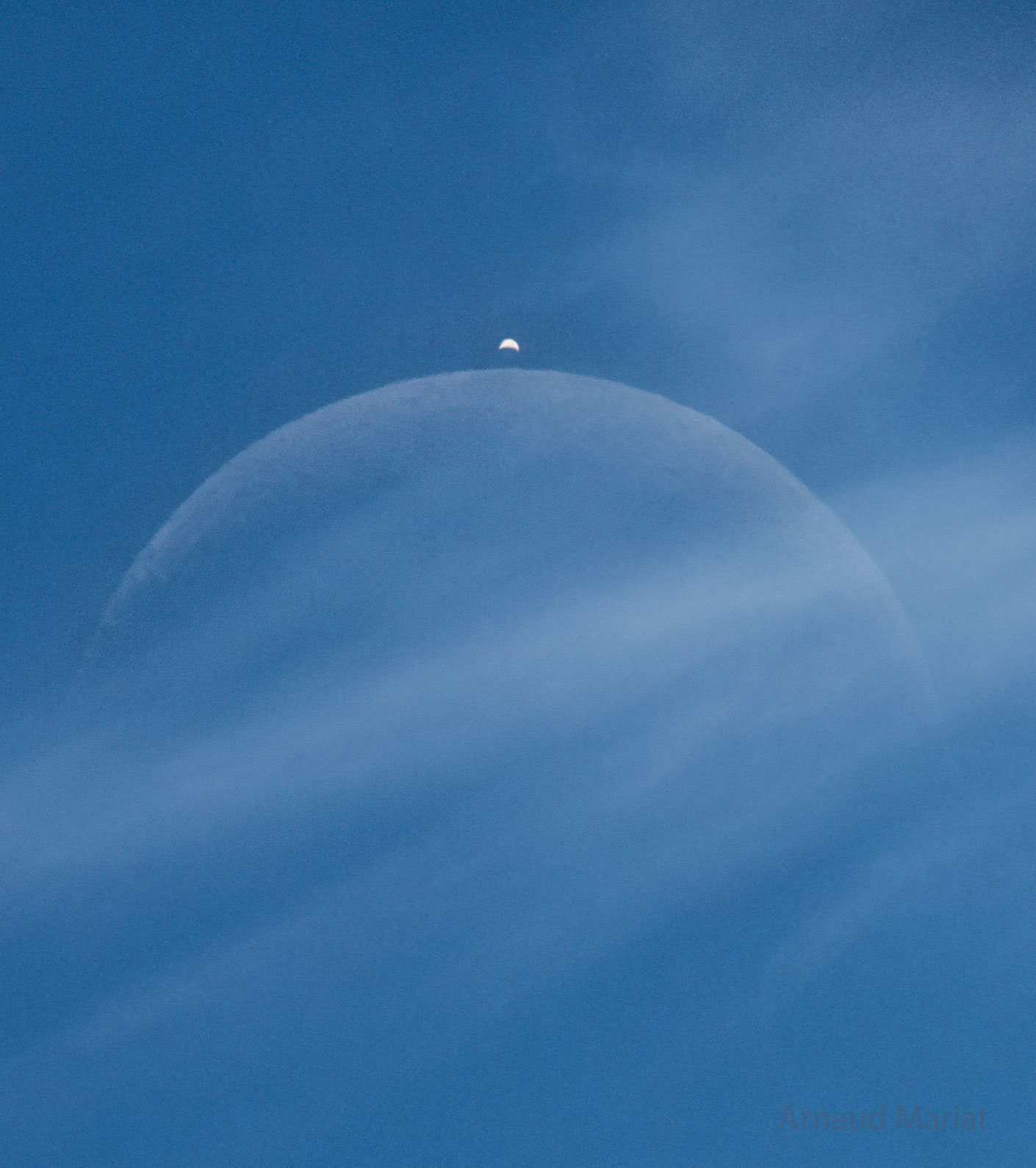
A Daytime Eclipse: Moon Occults Venus
15/09/2026
There was something behind the clouds. Upon close inspection, it was the Moon, which was hard to see yesterday around noon above the small village of Cessy, France. But soon, it was not only the Moon. As expected, a bright dot suddenly appeared from behind the Moon -- the planet Venus far in the distance. Captured in the single featured exposure, both appeared to show a crescent phase. The Moon's crescent was quite slight -- with only about 10 percent of its face illuminated by the Sun. In contrast, Venus's crescent was more full -- showing about 25 percent illumination. Venus appeared brighter because it is nearer the Sun and because its clouds are more reflective than the dark lunar surface. An occultation of Venus by the Moon is visible to only about 10 percent of the Earth, but in yesterday's event even most of that was experiencing daytime. APOD's main NASA site is moving: From apod.nasa.gov to science.nasa.gov/apod
Copyright: Arnaud Mariat
Προηγούμενες Αστρονομικές Εικόνες της Ημέρας από τη NASA
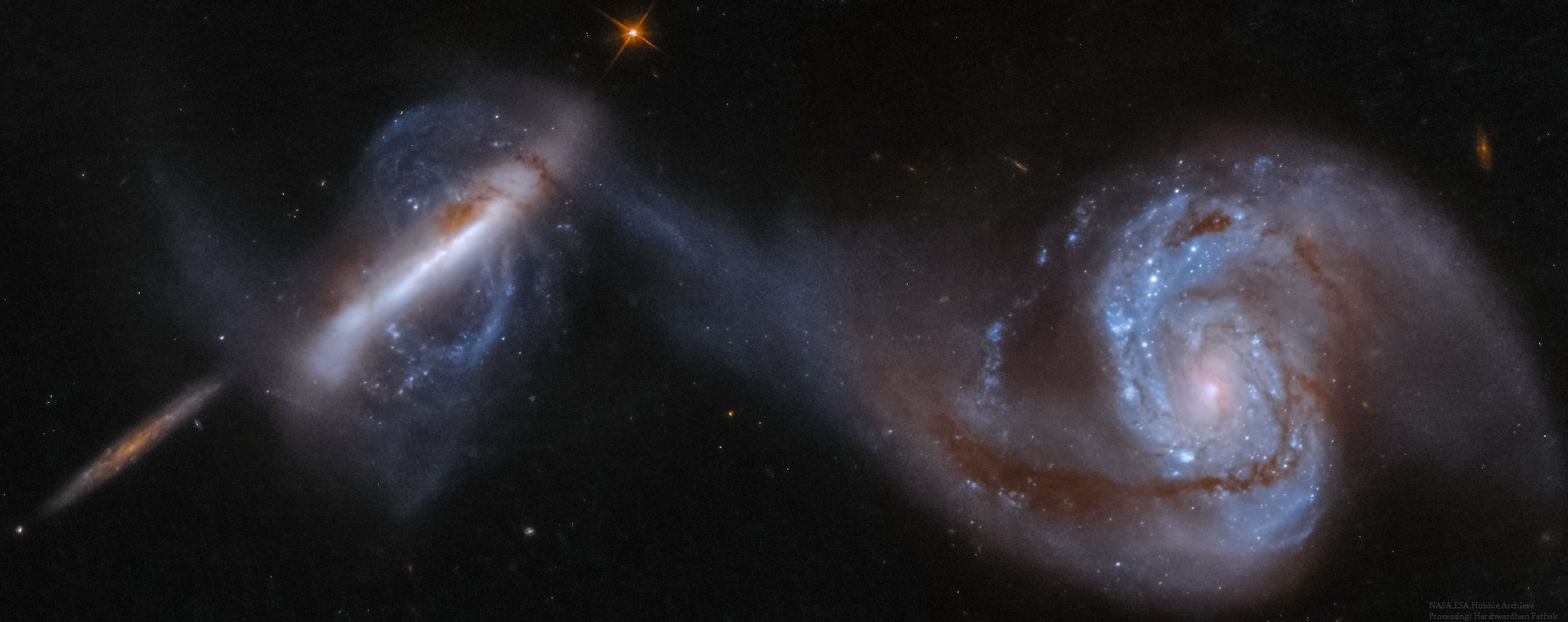
Arp 87: Merging Galaxies from Hubble
24/10/2023
This dance is to the death. As these two large galaxies duel, a cosmic bridge of stars, gas, and dust currently stretches over 75,000 light-years and joins them. The bridge itself is strong evidence that these two immense star systems have passed close to each other and experienced violent tides induced by mutual gravity. As further evidence, the face-on spiral galaxy on the right, also known as NGC 3808A, exhibits many young blue star clusters produced in a burst of star formation. The twisted edge-on spiral on the left (NGC 3808B) seems to be wrapped in the material bridging the galaxies and surrounded by a curious polar ring. Together, the system is known as Arp 87. While such interactions are drawn out over billions of years, repeated close passages will ultimately create one merged galaxy. Although this scenario does look unusual, galactic mergers are thought to be common, with Arp 87 representing a stage in this inevitable process. The Arp 87 dancing pair are about 300 million light-years distant toward the constellation of the Lion (Leo). The prominent edge-on spiral galaxy at the far left appears to be a more distant background galaxy and not involved in the on-going merger.
Copyright: NASA
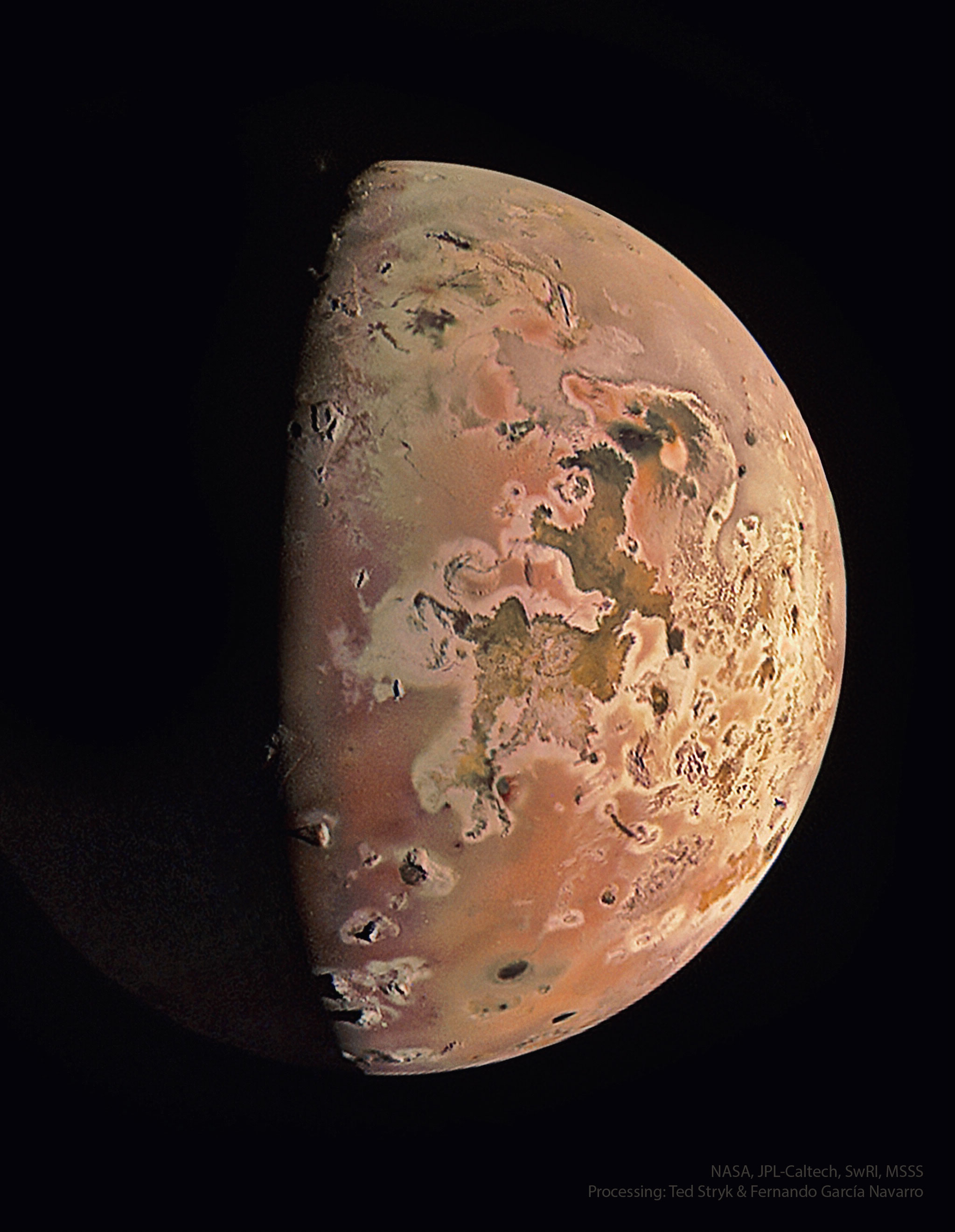
Moon Io from Spacecraft Juno
23/10/2023
There goes another one! Volcanoes on Jupiter's moon Io keep erupting. To investigate, NASA's robotic Juno spacecraft has begun a series of visits to this very strange moon. Io is about the size of Earth's moon, but because of gravitational flexing by Jupiter and other moons, Io's interior gets heated and its surface has become covered with volcanoes. The featured image is from last week's flyby, passing within 12,000 kilometers above the dangerously active world. The surface of Io is covered with sulfur and frozen sulfur dioxide, making it appear yellow, orange and brown. As hoped, Juno flew by just as a volcano was erupting -- with its faint plume visible near the top of the featured image. Studying Io's volcanoes and plumes helps humanity better understand how Jupiter's complex system of moons, rings, and auroras interact. Juno is scheduled to make two flybys of Io during the coming months that are almost 10 times closer: one in December and another in February 2024. Help Wanted: Professional-astronomer level guest writers and assistant editors for APOD
Copyright: NASA
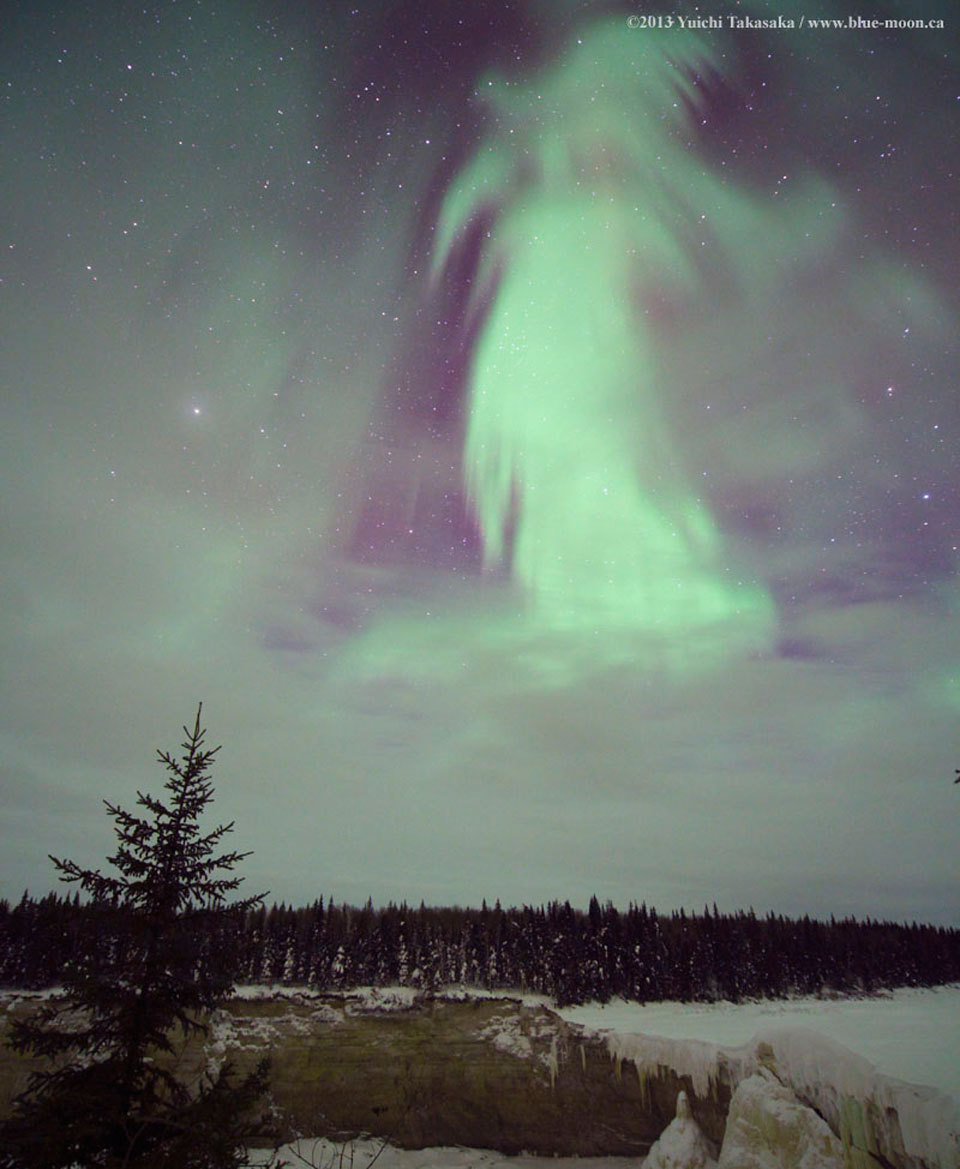
Ghost Aurora over Canada
22/10/2023
What does this aurora look like to you? While braving the cold to watch the skies above northern Canada early one morning in 2013, a most unusual aurora appeared. The aurora definitely appeared to be shaped like something, but what? Two ghostly possibilities recorded by the astrophotographer were "witch" and "goddess of dawn", but please feel free to suggest your own Halloween-enhanced impressions. Regardless of fantastical pareidolic interpretations, the pictured aurora had a typical green color and was surely caused by the scientifically commonplace action of high-energy particles from space interacting with oxygen in Earth's upper atmosphere. In the image foreground, at the bottom, is a frozen Alexandra Falls, while evergreen trees cross the middle. Help Wanted: Professional-astronomer level guest writers and assistant editors for APOD
Copyright: Yuichi Takasaka, TWAN
Quarter Moons
21/10/2023
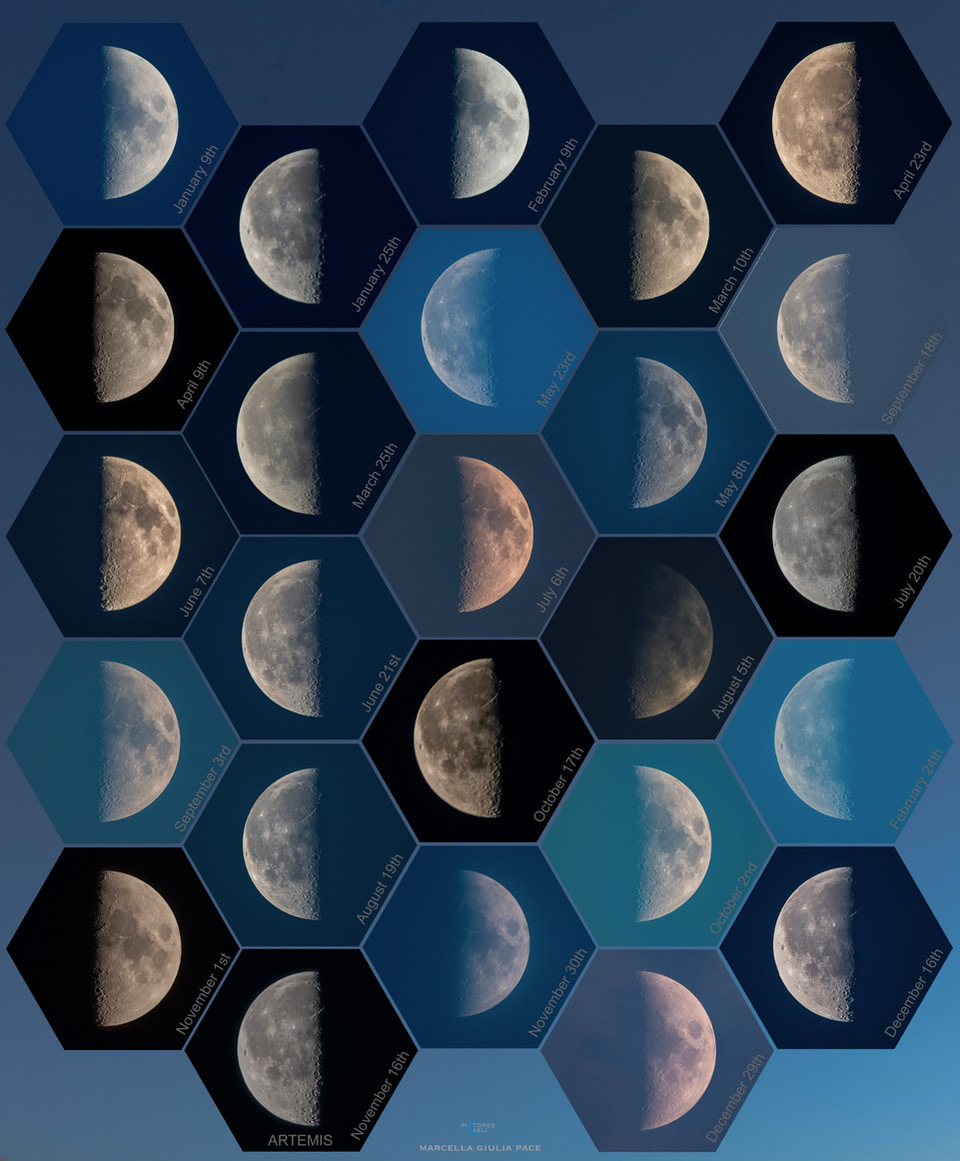
Half way between New Moon and Full Moon is the Moon's first quarter phase. That's a quarter of the way around its moonthly orbit. At the first quarter phase, half the Moon's visible side is illuminated by sunlight. For the Moon's third quarter phase, half way between Full Moon and New Moon, sunlight illuminates the other half of the visible lunar disk. At both first and third quarter phases, the terminator, or shadow line separating the lunar night and day, runs down the middle. Near the terminator, long shadows bring lunar craters and mountains in to sharp relief, making the quarter phases a good time to observe the Moon. But in case you missed some, all the quarter phases of the Moon and their calendar dates during 2022 can be found in this well-planned array of telephoto images. Of course, you can observe a first quarter Moon tonight. International: Observe the Moon Night
Copyright: Marcella Giulia Pace
Galaxies and a Comet
20/10/2023
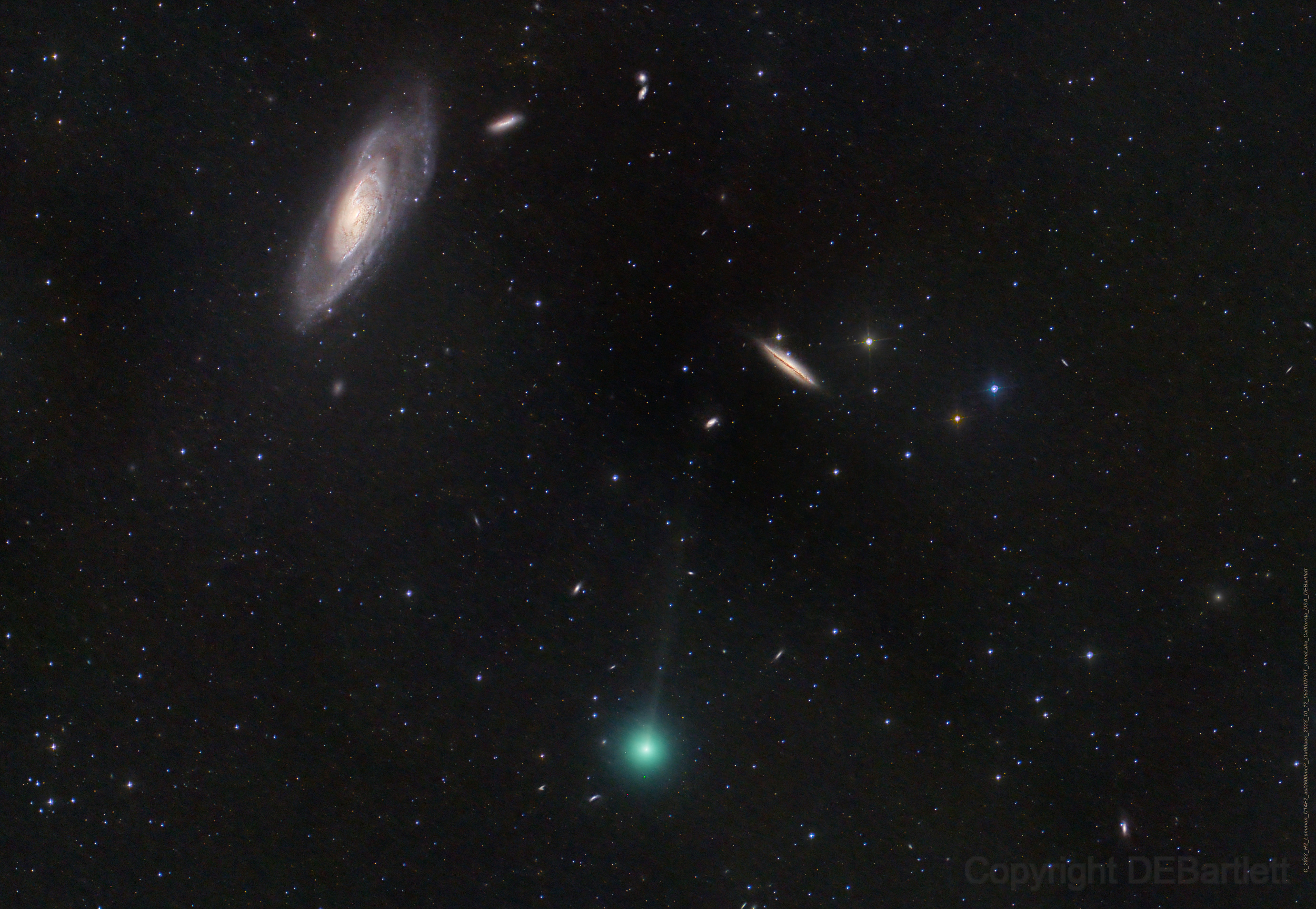
Galaxies abound in this sharp telescopic image recorded on October 12 in dark skies over June Lake, California. The celestial scene spans nearly 2 degrees within the boundaries of the well-trained northern constellation Canes Venatici. Prominent at the upper left 23.5 million light-years distant is big, beautiful spiral galaxy NGC 4258, known to some as Messier 106. Eye-catching edge-on spiral NGC 4217 is above and right of center about 60 million light-years away. Just passing through the pretty field of view is comet C/2023 H2 Lemmon, discovered last April in image data from the Mount Lemmon Survey. Here the comet sports more of a lime green coma though, along with a faint, narrow ion tail stretching toward the top of the frame. This visitor to the inner Solar System is presently less than 7 light-minutes away and still difficult to spot with binoculars, but it's growing brighter. Comet C/2023 H2 Lemmon will reach perihelion, its closest point to the Sun, on October 29 and perigee, its closest to our fair planet, on November 10 as it transitions from morning to evening northern skies.
Copyright: Dan Bartlett
A Sunrise at Sunset Point
19/10/2023
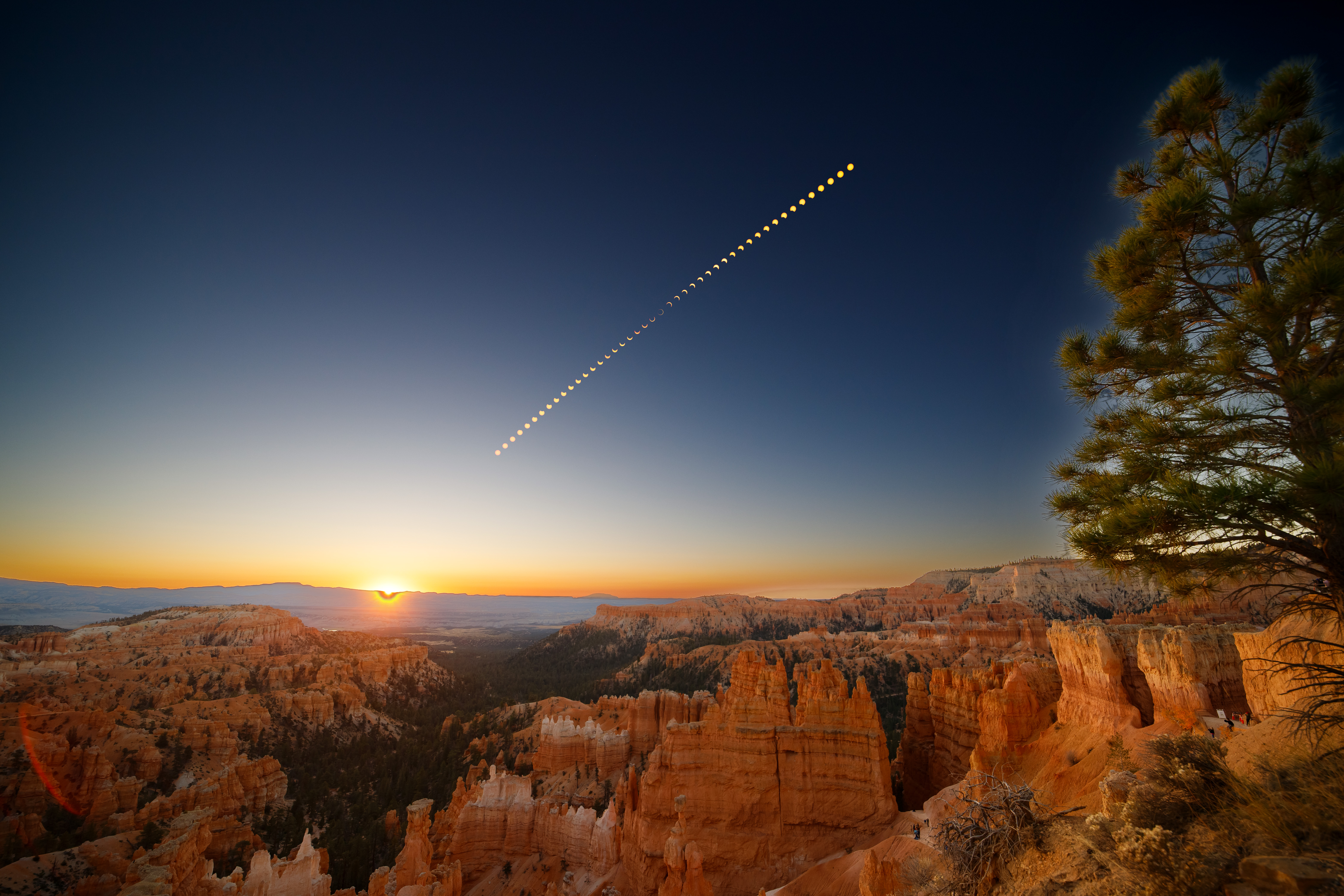
This timelapse series captured on October 14 is set against the sunrise view from Sunset Point, Bryce Canyon, planet Earth. Of course on that date the New Moon caught up with the Sun in the canyon's morning skies. Local temperatures fell as the Moon's shadow swept across the high altitude scene and the brilliant morning sunlight became a more subdued yellow hue cast over the reddish rocky landscape. In the timelapse series, images were taken at 2 minute intervals. The camera and solar filter were fixed to a tripod to follow the phases of the annular solar eclipse. APOD Album: Annular Solar Eclipse of 2023 October
Copyright: Martin Ratcliffe
Dust and the Western Veil Nebula
18/10/2023
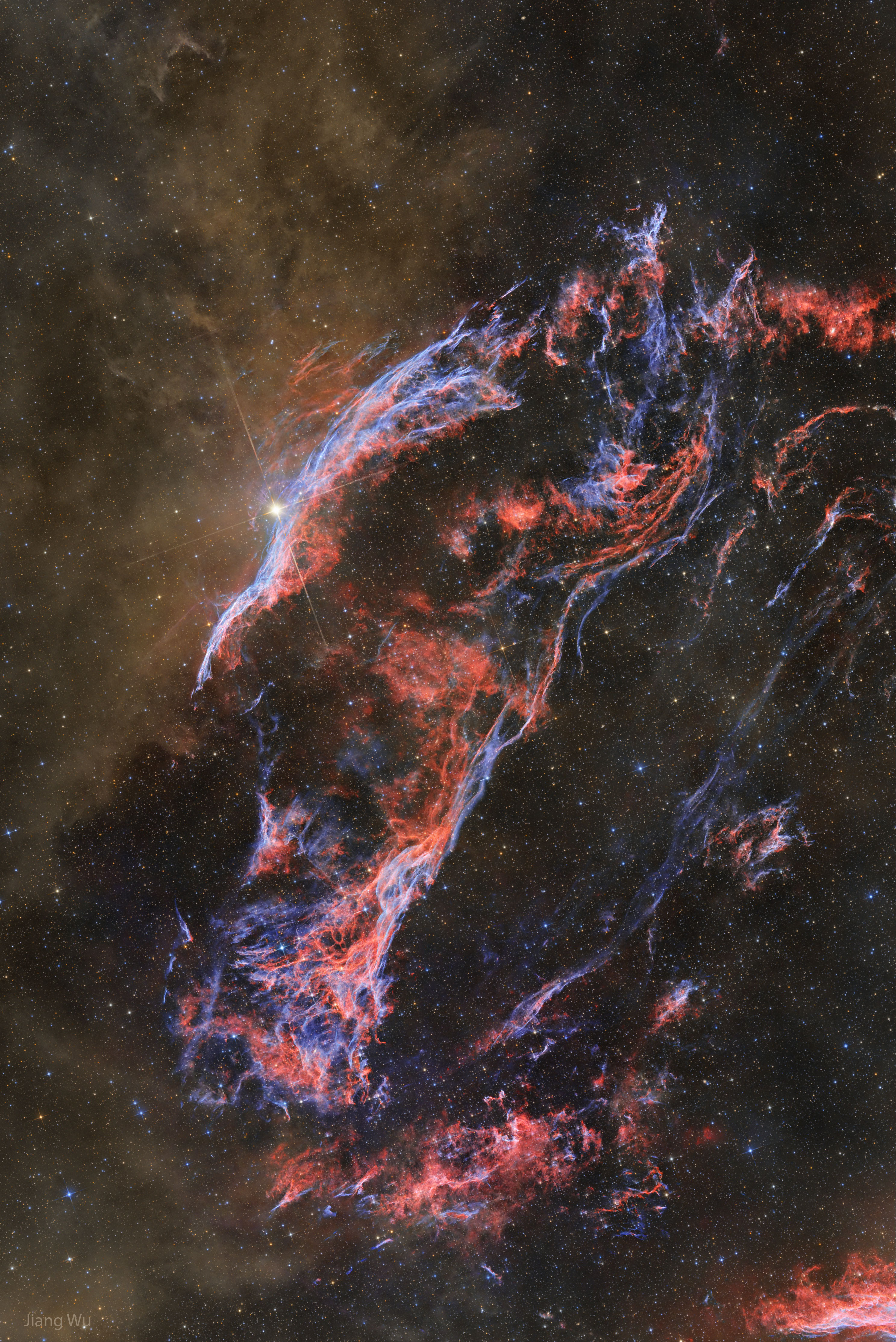
It's so big it is easy to miss. The entire Veil Nebula spans six times the diameter of the full moon, but is so dim you need binoculars to see it. The nebula was created about 15,000 years ago when a star in the constellation of the Swan (Cygnus) exploded. The spectacular explosion would have appeared brighter than even Venus for a week - but there is no known record of it. Pictured is the western edge of the still-expanding gas cloud. Notable gas filaments include the Witch's Broom Nebula on the upper left near the bright foreground star 52 Cygni, and Fleming's Triangular Wisp (formerly known as Pickering's Triangle) running diagonally up the image middle. What is rarely imaged -- but seen in the featured long exposure across many color bands -- is the reflecting brown dust that runs vertically up the image left, dust likely created in the cool atmospheres of massive stars.
Copyright: Jiang Wu
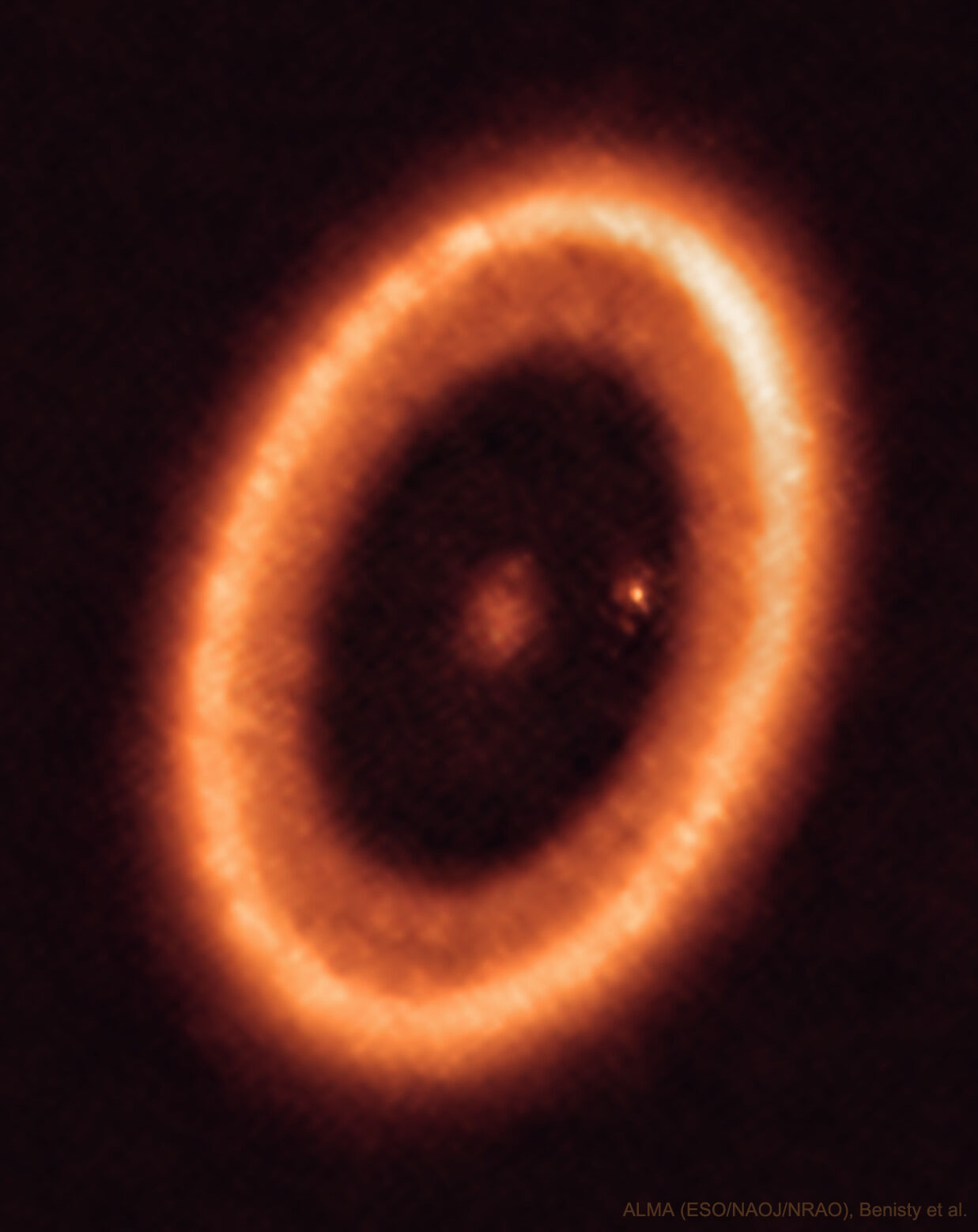
PDS 70: Disk, Planets, and Moons
17/10/2023
It's not the big ring that's attracting the most attention. Although the big planet-forming ring around the star PDS 70 is clearly imaged and itself quite interesting. It's also not the planet on the right, just inside the big disk, that’s being talked about the most. Although the planet PDS 70c is a newly formed and, interestingly, similar in size and mass to Jupiter. It's the fuzzy patch around the planet PDS 70c that's causing the commotion. That fuzzy patch is thought to be a dusty disk that is now forming into moons -- and that had never been seen before. The featured image was taken in 2021 by the Atacama Large Millimeter Array (ALMA) of 66 radio telescopes in the high Atacama Desert of northern Chile. Based on ALMA data, astronomers infer that the moon-forming exoplanetary disk has a radius similar to our Earth's orbit, and may one day form three or so Luna-sized moons -- not very different from our Jupiter's four.
Copyright: NASA
Η Αστρονομική Εικόνα της Ημέρας από τη NASA (NASA Astronomy Picture of the Day) είναι μια δωρεάν υπηρεσία που παρέχει καθημερινά μια εντυπωσιακή εικόνα από το σύμπαν, την λήψη της οποίας έχει πραγματοποιήσει κάποιος από τους αστρονόμους της NASA ή από κάποιον από τους δορυφόρους ή τα τηλεσκόπια που η NASA λειτουργεί. Οι εικόνες που εμφανίζονται καλύπτουν μια ευρεία γκάμα από θέματα, συμπεριλαμβανομένων των αστερισμών, των γαλαξιών, των πλανητικών συστημάτων, των κομητών, των αστρικών σωμάτων και των παρατηρητηρίων. Κάθε εικόνα συνοδεύεται από μια σύντομη εξήγηση και πληροφορίες σχετικά με το τι παρατηρείται στην εικόνα.