Η Αστρονομική Εικόνα της Ημέρας από τη NASA
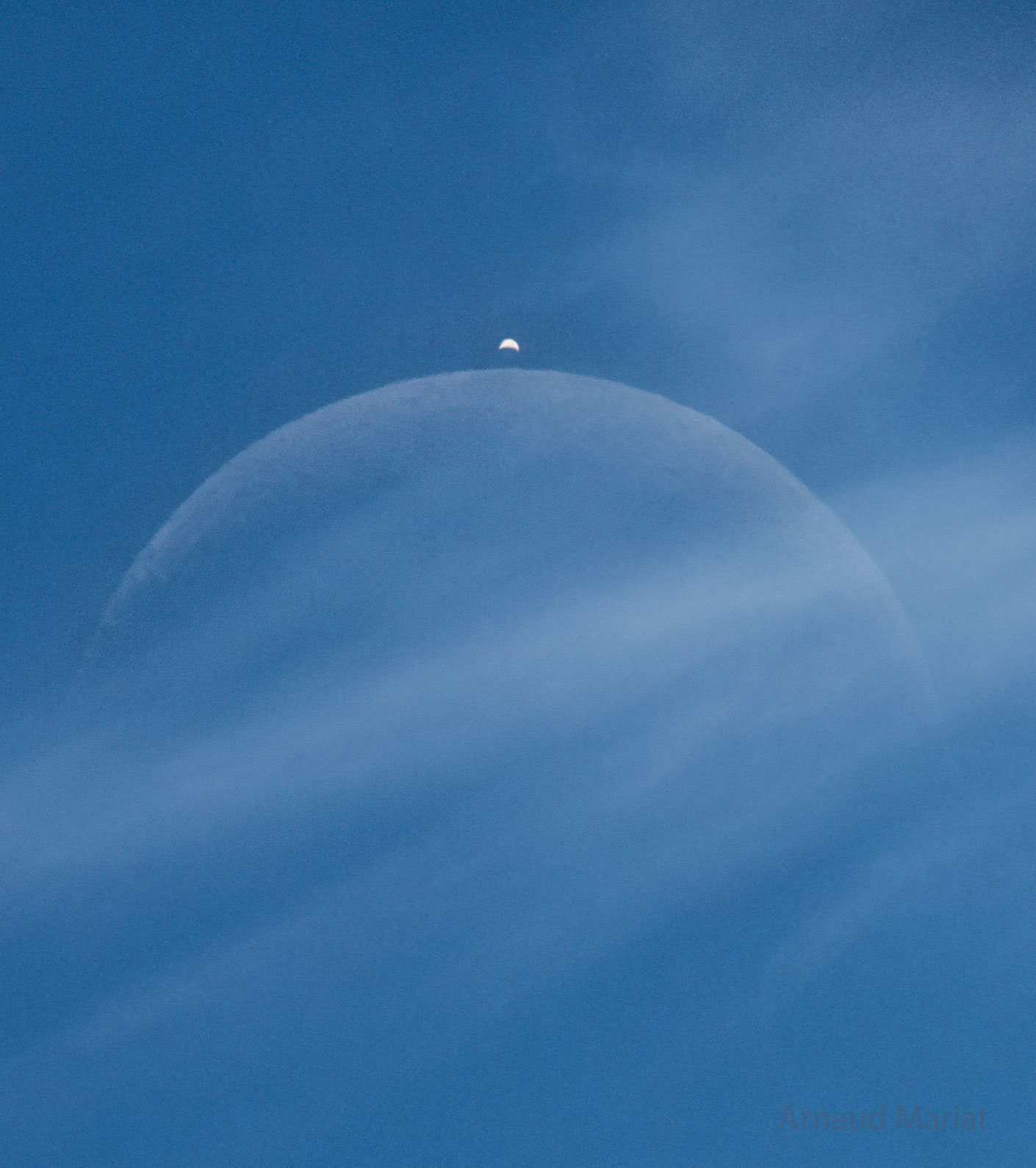
A Daytime Eclipse: Moon Occults Venus
15/09/2026
There was something behind the clouds. Upon close inspection, it was the Moon, which was hard to see yesterday around noon above the small village of Cessy, France. But soon, it was not only the Moon. As expected, a bright dot suddenly appeared from behind the Moon -- the planet Venus far in the distance. Captured in the single featured exposure, both appeared to show a crescent phase. The Moon's crescent was quite slight -- with only about 10 percent of its face illuminated by the Sun. In contrast, Venus's crescent was more full -- showing about 25 percent illumination. Venus appeared brighter because it is nearer the Sun and because its clouds are more reflective than the dark lunar surface. An occultation of Venus by the Moon is visible to only about 10 percent of the Earth, but in yesterday's event even most of that was experiencing daytime. APOD's main NASA site is moving: From apod.nasa.gov to science.nasa.gov/apod
Copyright: Arnaud Mariat
Προηγούμενες Αστρονομικές Εικόνες της Ημέρας από τη NASA
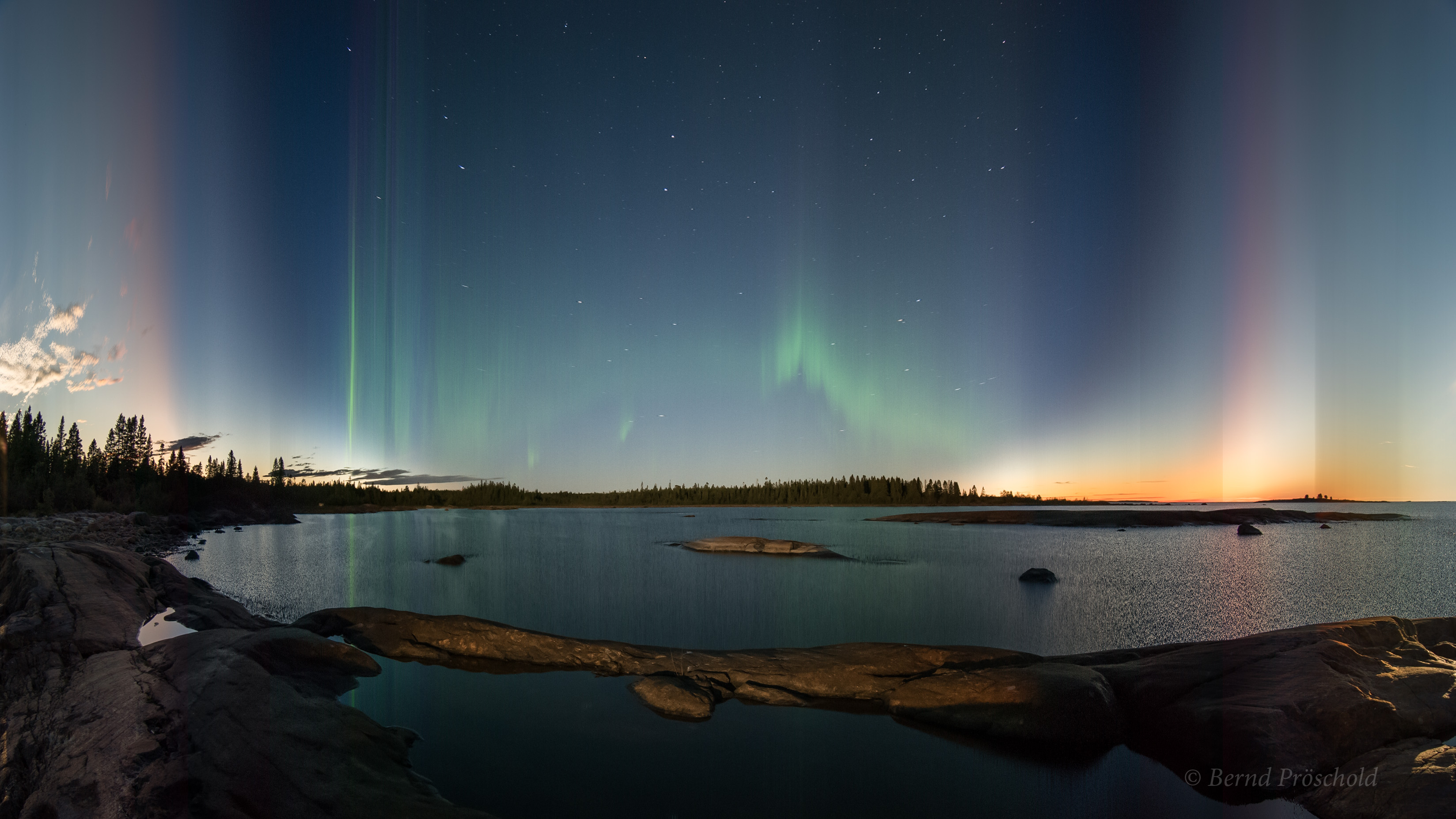
Sunset to Sunrise over the Baltic Sea
16/06/2023
This serene view from the coast of Sweden looks across the Baltic sea and compresses time, presenting the passage of one night in a single photograph. From sunset to sunrise, moonlight illuminates the creative sea and skyscape. Fleeting clouds, fixed stars, and flowing northern lights leave their traces in planet Earth's sky. To construct the timelapse image, 3296 video frames were recorded on the night of June's Full Moon between 7:04pm and 6:35am local time. As time progresses from left to right, a single column of pixels was taken from the corresponding individual frame and combined in sequence into a single digital image 3296 pixels wide. Happy Birthday APOD
Copyright: Bernd Pröschold
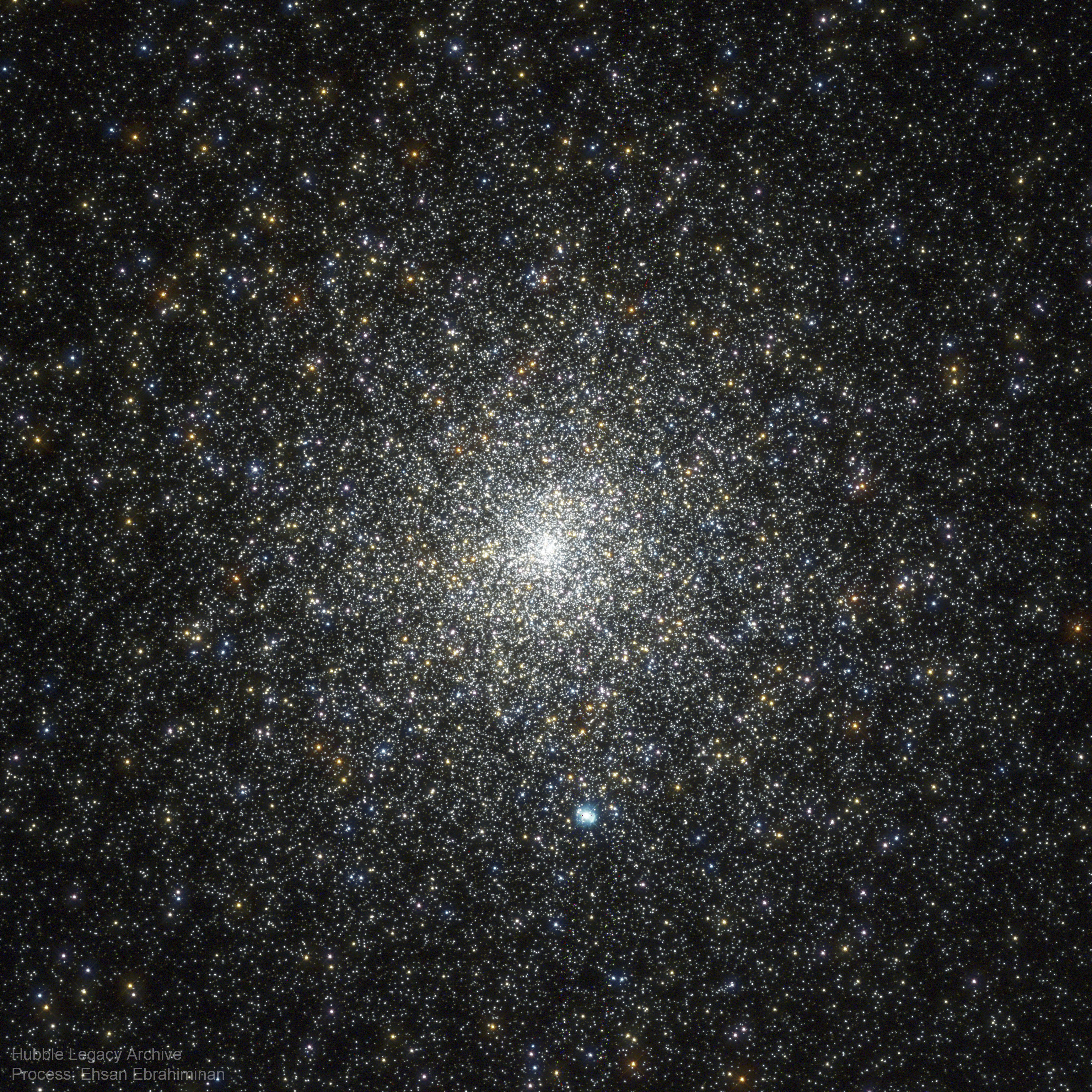
M15: Dense Globular Star Cluster
15/06/2023
Messier 15 is an immense swarm of over 100,000 stars. A 13 billion year old relic of the early formative years of our galaxy it's one of about 170 globular star clusters that still roam the halo of the Milky Way. Centered in this sharp reprocessed Hubble image, M15 lies some 35,000 light-years away toward the constellation Pegasus. Its diameter is about 200 light-years, but more than half its stars are packed into the central 10 light-years or so, making one of the densest concentrations of stars known. Hubble-based measurements of the increasing velocities of M15's central stars are evidence that a massive black hole resides at the center of the dense cluster. M15 is also known to harbour a planetary nebula. Called Pease 1 (aka PN Ps 1), it can be seen in this image as a small blue blob below and just right of center.
Copyright: NASA
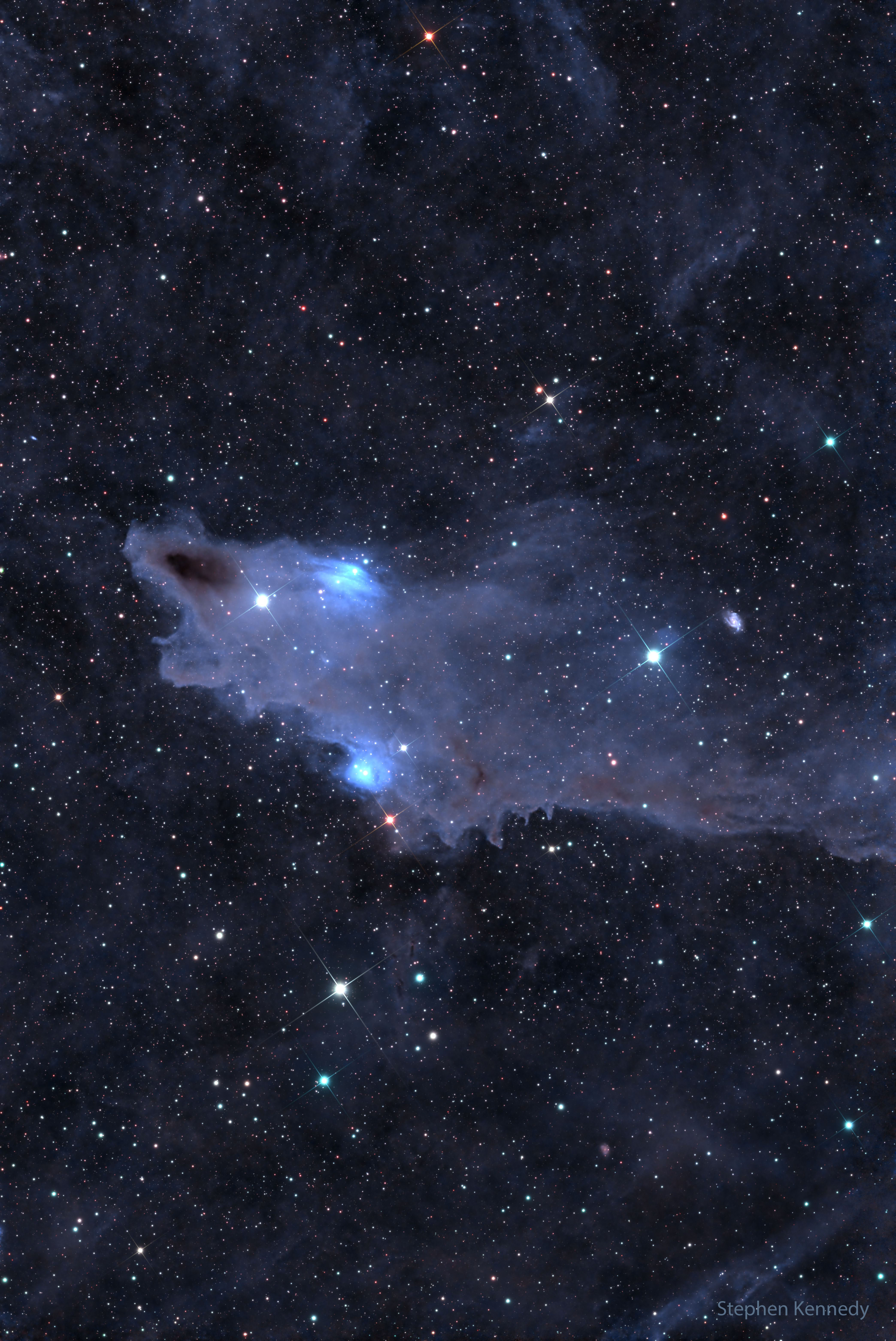
The Shark Nebula
14/06/2023
There is no sea on Earth large enough to contain the Shark nebula. This predator apparition poses us no danger as it is composed only of interstellar gas and dust. Dark dust like that featured here is somewhat like cigarette smoke and created in the cool atmospheres of giant stars. After being expelled with gas and gravitationally recondensing, massive stars may carve intricate structures into their birth cloud using their high energy light and fast stellar winds as sculpting tools. The heat they generate evaporates the murky molecular cloud as well as causing ambient hydrogen gas to disperse and glow red. During disintegration, we humans can enjoy imagining these great clouds as common icons, like we do for water clouds on Earth. Including smaller dust nebulae such as Lynds Dark Nebula 1235 and Van den Bergh 149 & 150, the Shark nebula spans about 15 light years and lies about 650 light years away toward the constellation of the King of Aethiopia (Cepheus).
Copyright: Stephen Kennedy
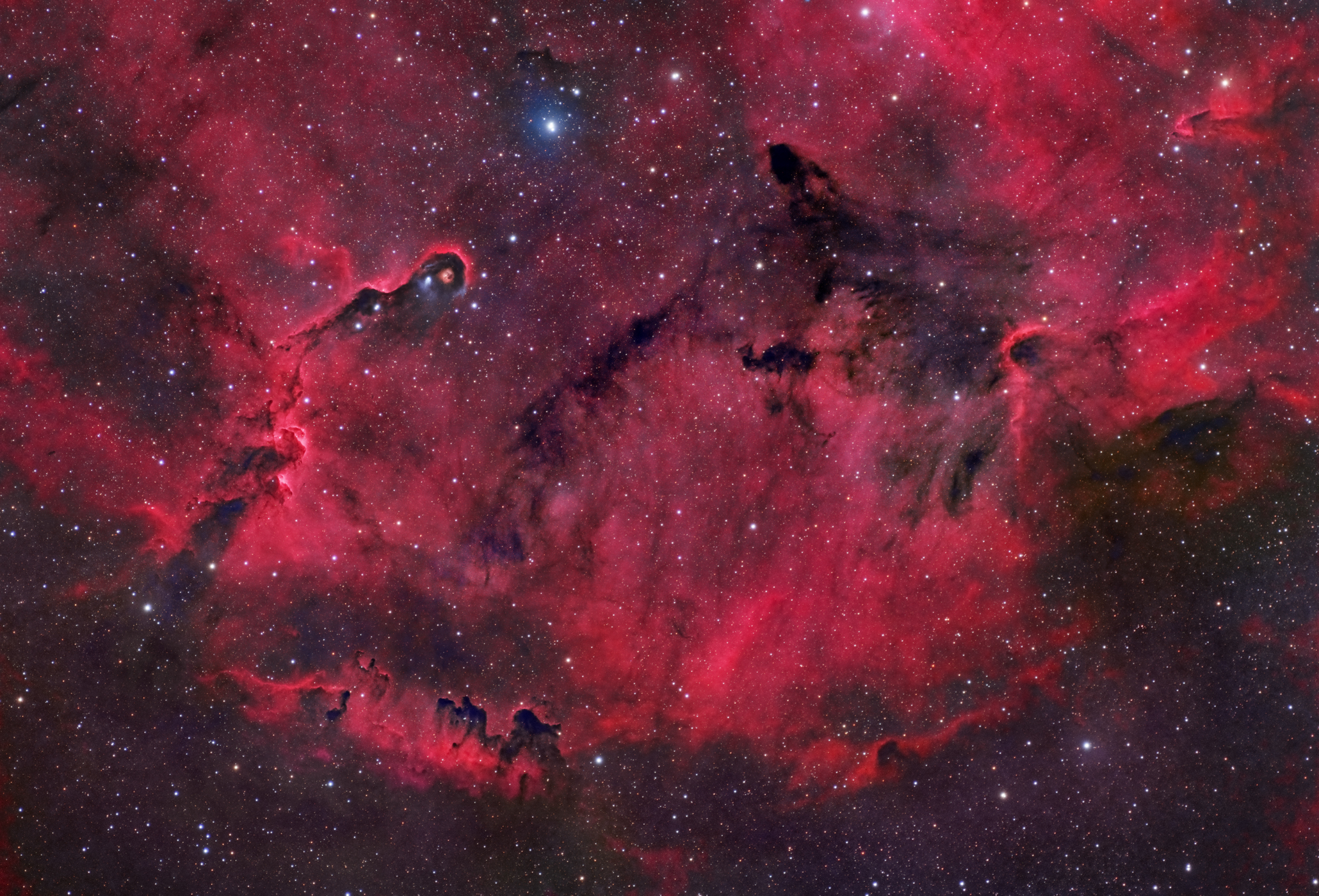
Elephant's Trunk and Caravan
08/06/2023
Like an illustration in a galactic Just So Story, the Elephant's Trunk Nebula winds through the emission region and young star cluster complex IC 1396, in the high and far off constellation of Cepheus. Seen on the left the cosmic elephant's trunk, also known as vdB 142, is over 20 light-years long. This detailed telescopic view features the bright swept-back ridges and pockets of cool interstellar dust and gas that abound in the region. But the dark, tendril-shaped clouds contain the raw material for star formation and hide protostars within. Nearly 3,000 light-years distant, the relatively faint IC 1396 complex covers a large region on the sky, spanning over 5 degrees. This rendition spans a 1 degree wide field of view though, about the angular size of 2 full moons. Of course the dark shapes below and to the right of the outstretched Elephant's Trunk, are known to some as The Caravan.
Copyright: Steve Cannistra
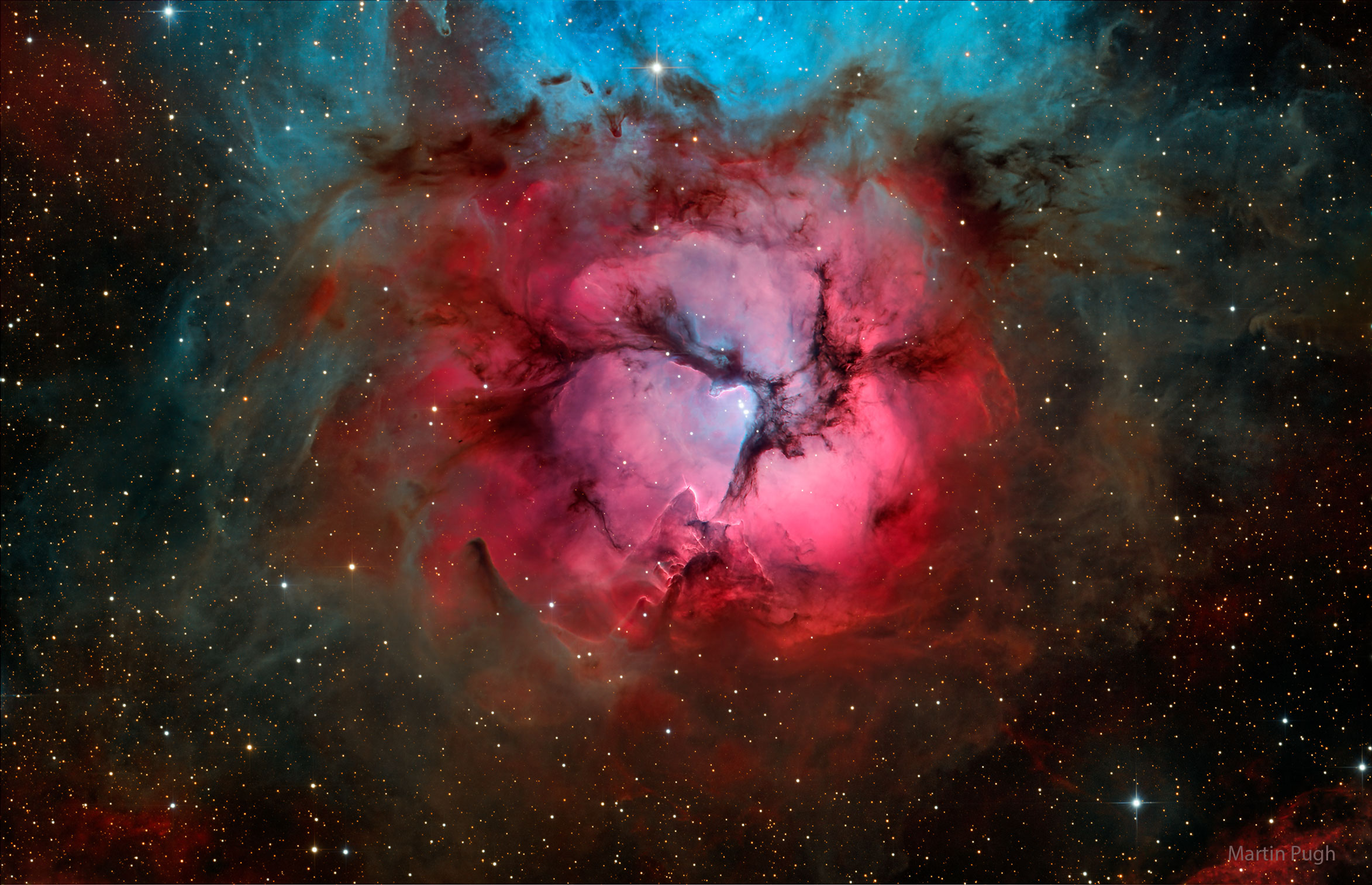
In the Center of the Trifid Nebula
05/06/2023
What's happening at the center of the Trifid Nebula? Three prominent dust lanes that give the Trifid its name all come together. Mountains of opaque dust appear near the bottom, while other dark filaments of dust are visible threaded throughout the nebula. A single massive star visible near the center causes much of the Trifid's glow. The Trifid, cataloged as M20, is only about 300,000 years old, making it among the youngest emission nebulas known. The star forming nebula lies about 9,000 light years away toward the constellation of the Archer (Sagittarius). The region pictured here spans about 20 light years.
Copyright: Martin Pugh
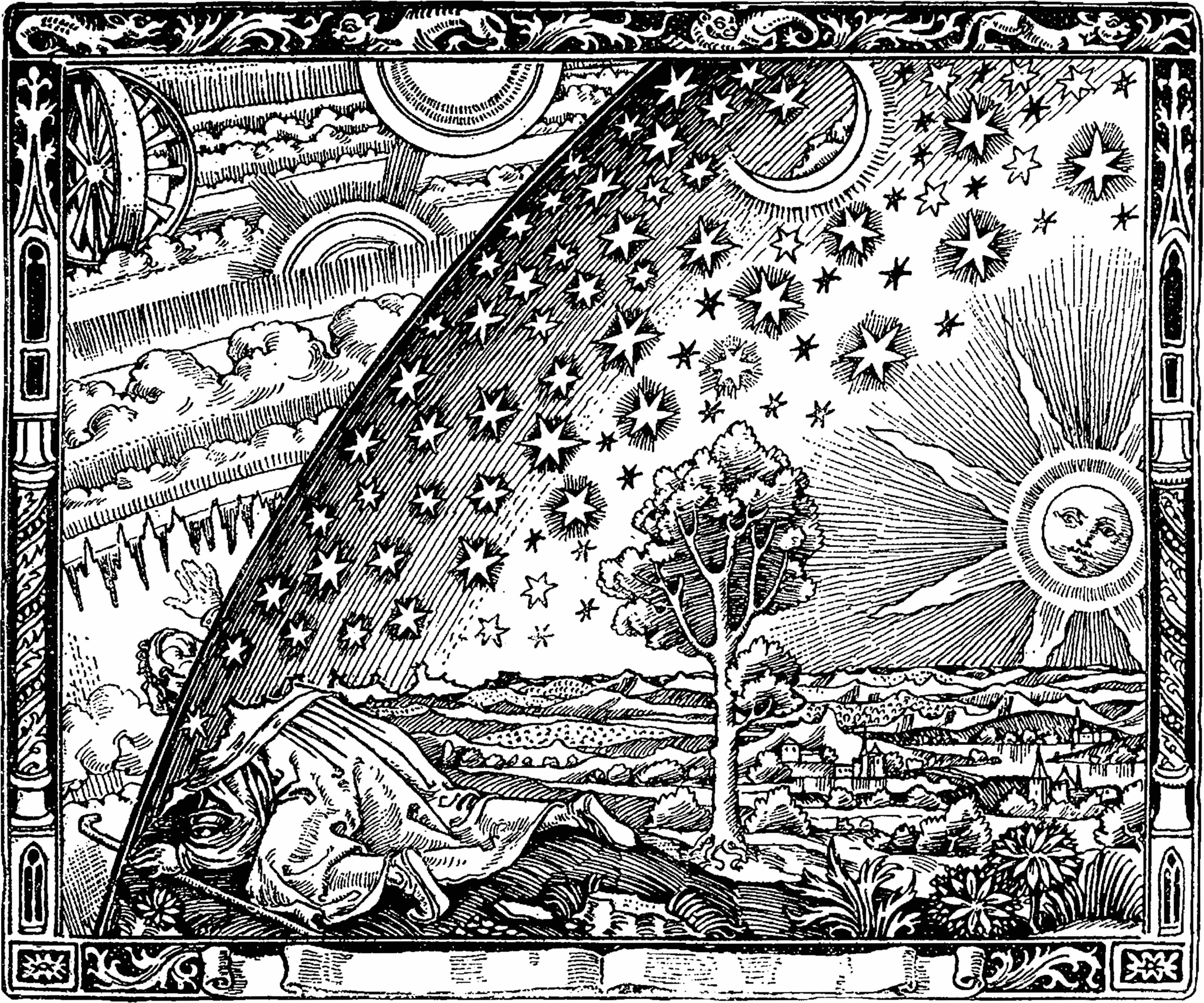
Color the Universe
04/06/2023
Wouldn't it be fun to color in the universe? If you think so, please accept this famous astronomical illustration as a preliminary substitute. You, your friends, your parents or children, can print it out or even color it digitally. While coloring, you might be interested to know that even though this illustration has appeared in numerous places over the past 100 years, the actual artist remains unknown. Furthermore, the work has no accepted name -- can you think of a good one? The illustration, first appearing in a book by Camille Flammarion in 1888, is frequently used to show that humanity's present concepts are susceptible to being supplanted by greater truths.
Copyright: NASA
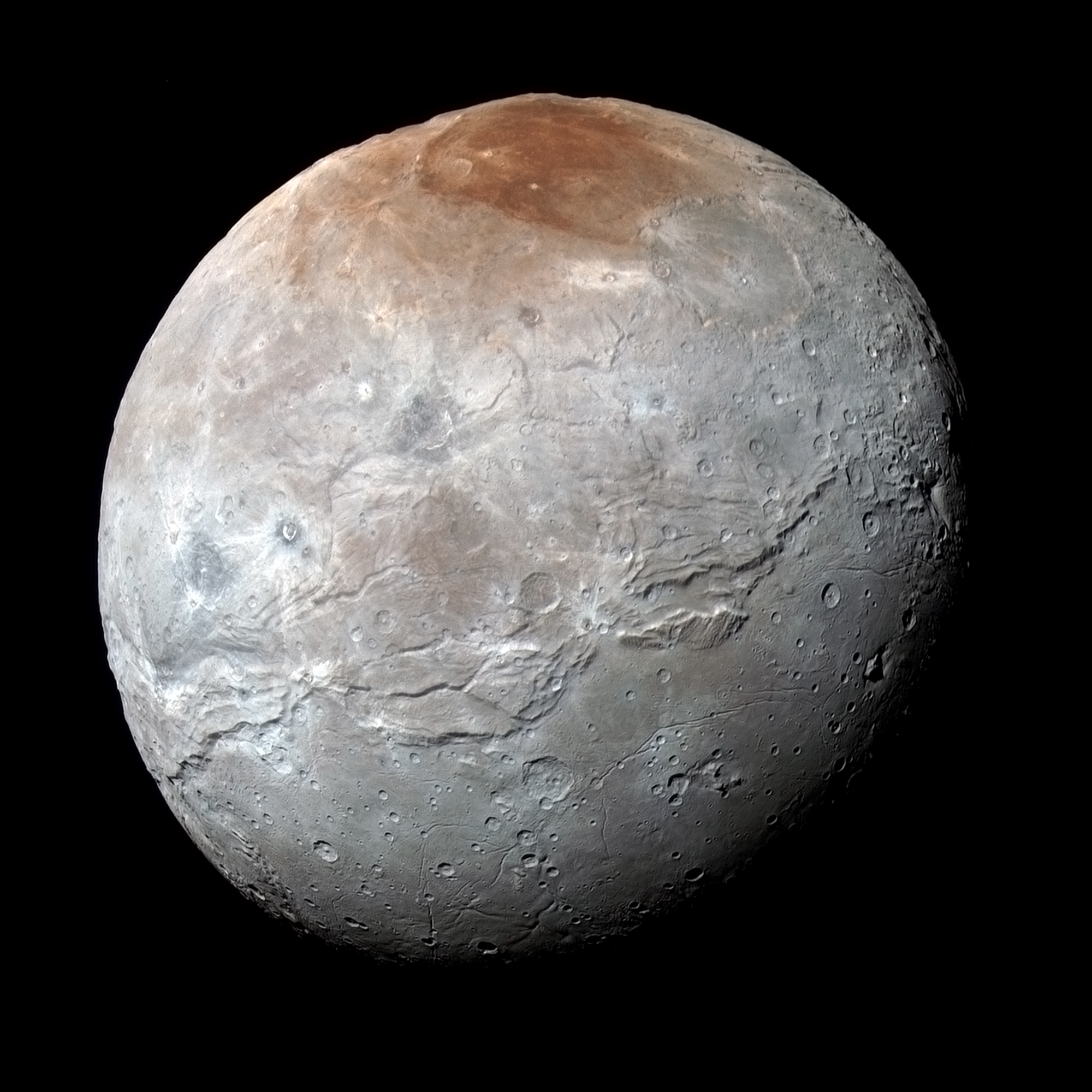
Charon: Moon of Pluto
03/06/2023
A darkened and mysterious north polar region known to some as Mordor Macula caps this premier high-resolution view. The portrait of Charon, Pluto's largest moon, was captured by New Horizons near the spacecraft's closest approach on July 14, 2015. The combined blue, red, and infrared data was processed to enhance colors and follow variations in Charon's surface properties with a resolution of about 2.9 kilometers (1.8 miles). A stunning image of Charon's Pluto-facing hemisphere, it also features a clear view of an apparently moon-girdling belt of fractures and canyons that seems to separate smooth southern plains from varied northern terrain. Charon is 1,214 kilometers (754 miles) across. That's about 1/10th the size of planet Earth but a whopping 1/2 the diameter of Pluto itself, and makes it the largest satellite relative to its parent body in the Solar System. Still, the moon appears as a small bump at about the 1 o'clock position on Pluto's disk in the grainy, negative,telescopic picture inset at upper left. That view was used by James Christy and Robert Harrington at the U.S. Naval Observatory in Flagstaff to discover Charon in June of 1978.
Copyright: NASA
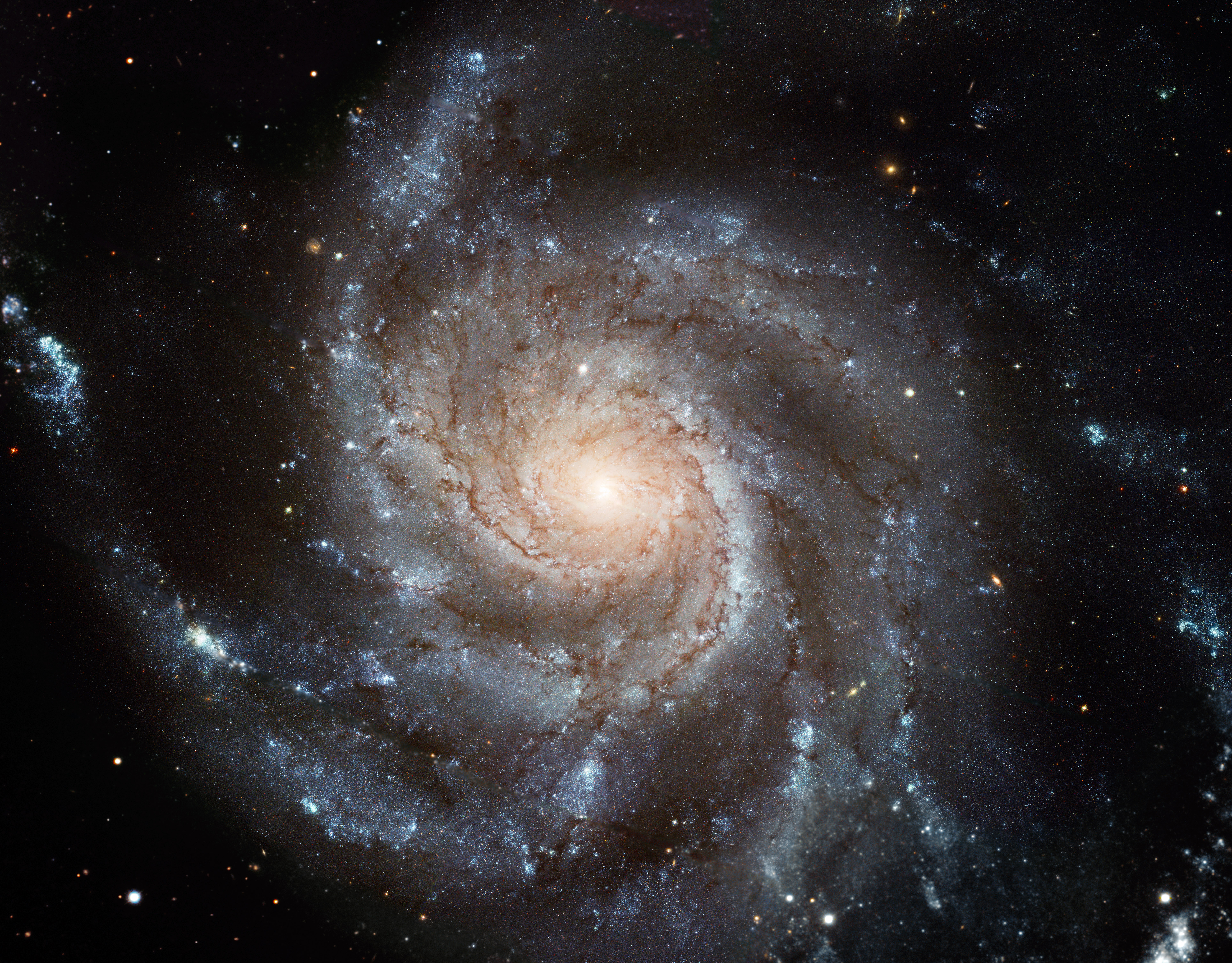
Messier 101
02/06/2023
Big, beautiful spiral galaxy M101 is one of the last entries in Charles Messier's famous catalog, but definitely not one of the least. About 170,000 light-years across, this galaxy is enormous, almost twice the size of our own Milky Way. M101 was also one of the original spiral nebulae observed by Lord Rosse's large 19th century telescope, the Leviathan of Parsontown. Assembled from 51 exposures recorded by the Hubble Space Telescope in the 20th and 21st centuries, with additional data from ground based telescopes, this mosaic spans about 40,000 light-years across the central region of M101 in one of the highest definition spiral galaxy portraits ever released from Hubble. The sharp image shows stunning features of the galaxy's face-on disk of stars and dust along with background galaxies, some visible right through M101 itself. Also known as the Pinwheel Galaxy, M101 lies within the boundaries of the northern constellation Ursa Major, about 25 million light-years away.
Copyright: NASA
Η Αστρονομική Εικόνα της Ημέρας από τη NASA (NASA Astronomy Picture of the Day) είναι μια δωρεάν υπηρεσία που παρέχει καθημερινά μια εντυπωσιακή εικόνα από το σύμπαν, την λήψη της οποίας έχει πραγματοποιήσει κάποιος από τους αστρονόμους της NASA ή από κάποιον από τους δορυφόρους ή τα τηλεσκόπια που η NASA λειτουργεί. Οι εικόνες που εμφανίζονται καλύπτουν μια ευρεία γκάμα από θέματα, συμπεριλαμβανομένων των αστερισμών, των γαλαξιών, των πλανητικών συστημάτων, των κομητών, των αστρικών σωμάτων και των παρατηρητηρίων. Κάθε εικόνα συνοδεύεται από μια σύντομη εξήγηση και πληροφορίες σχετικά με το τι παρατηρείται στην εικόνα.