Η Αστρονομική Εικόνα της Ημέρας από τη NASA
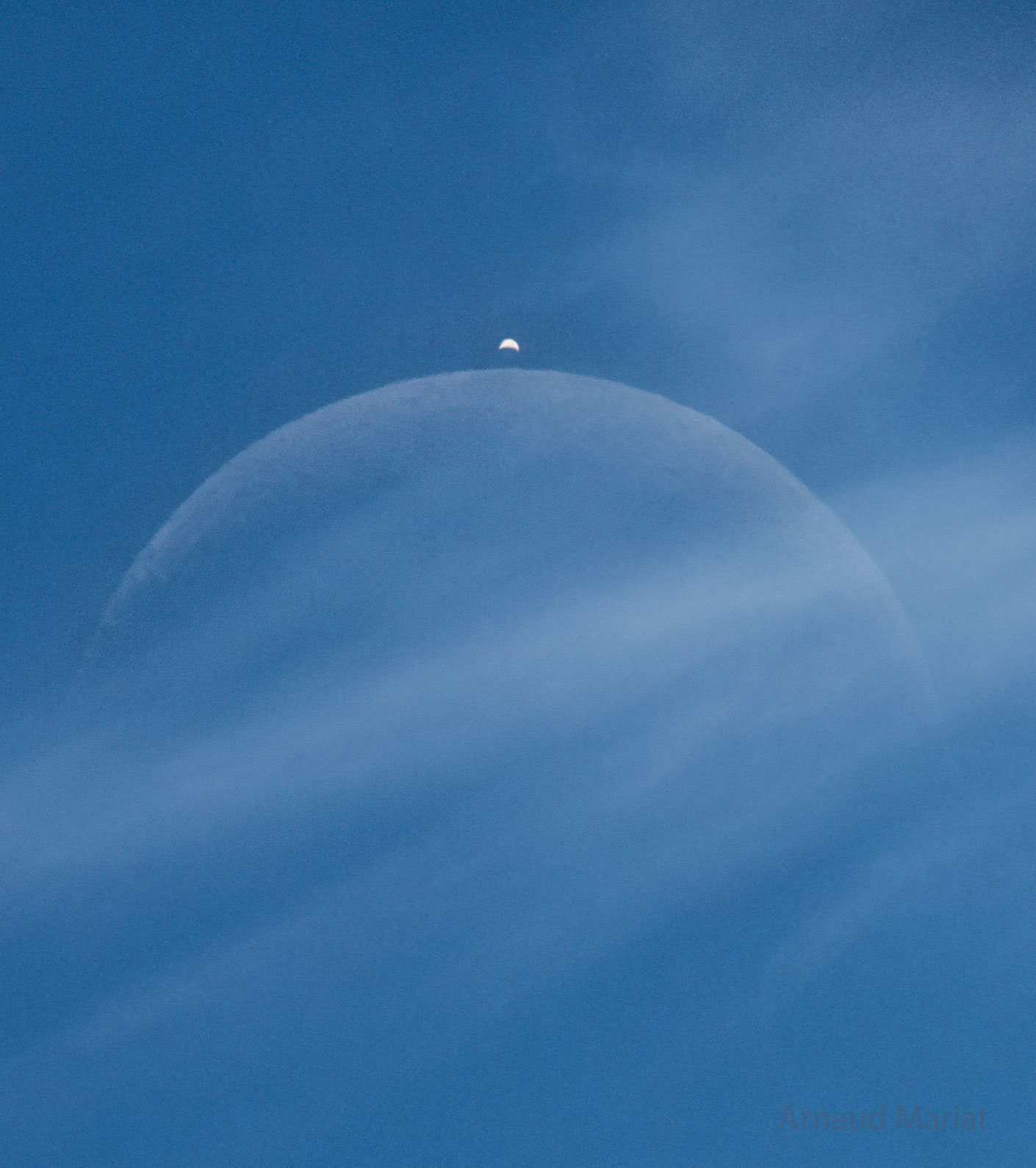
A Daytime Eclipse: Moon Occults Venus
15/09/2026
There was something behind the clouds. Upon close inspection, it was the Moon, which was hard to see yesterday around noon above the small village of Cessy, France. But soon, it was not only the Moon. As expected, a bright dot suddenly appeared from behind the Moon -- the planet Venus far in the distance. Captured in the single featured exposure, both appeared to show a crescent phase. The Moon's crescent was quite slight -- with only about 10 percent of its face illuminated by the Sun. In contrast, Venus's crescent was more full -- showing about 25 percent illumination. Venus appeared brighter because it is nearer the Sun and because its clouds are more reflective than the dark lunar surface. An occultation of Venus by the Moon is visible to only about 10 percent of the Earth, but in yesterday's event even most of that was experiencing daytime. APOD's main NASA site is moving: From apod.nasa.gov to science.nasa.gov/apod
Copyright: Arnaud Mariat
Προηγούμενες Αστρονομικές Εικόνες της Ημέρας από τη NASA
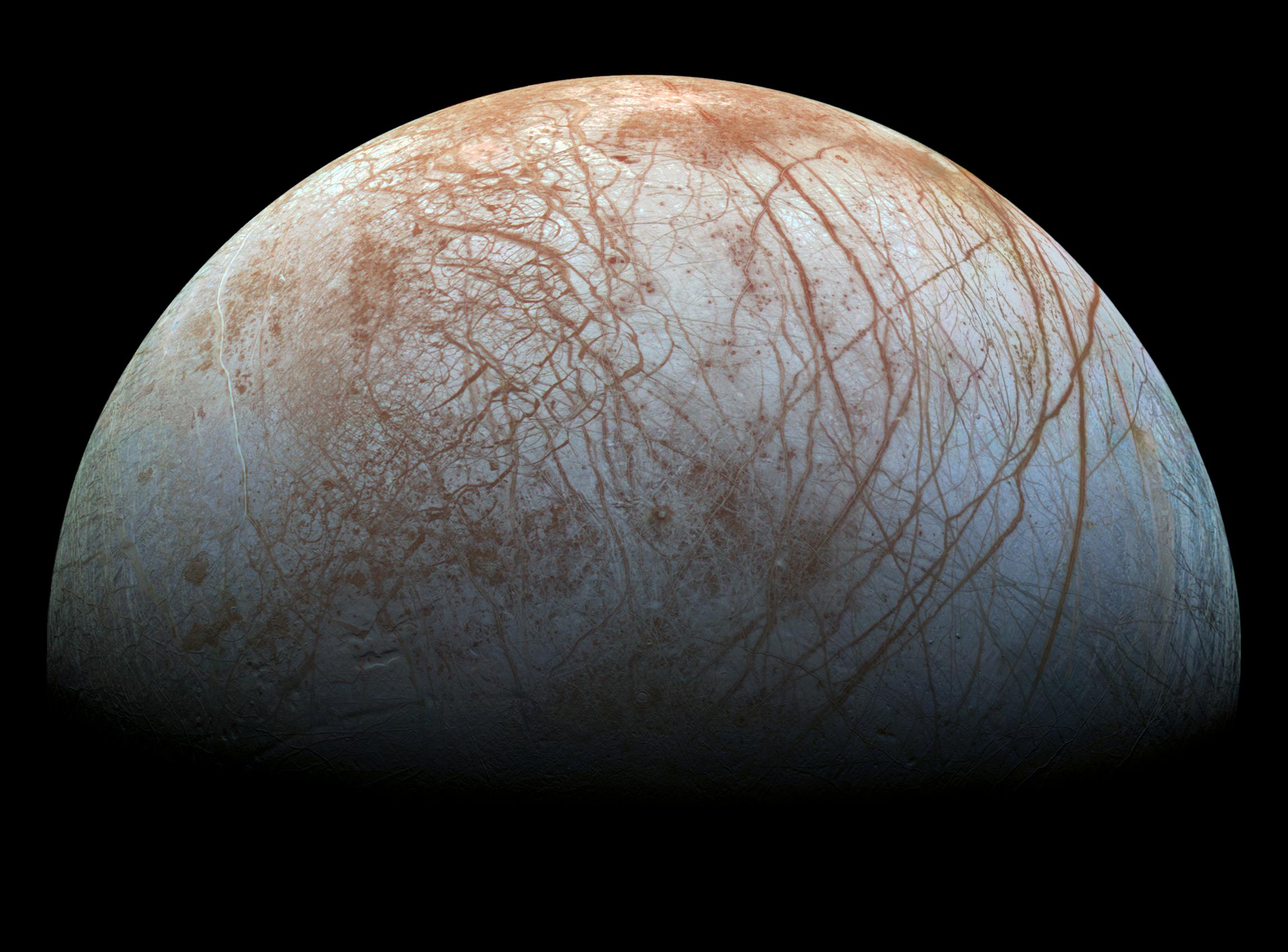
Galileo's Europa
20/05/2023
Looping through the Jovian system in the late 1990s, the Galileo spacecraft recorded stunning views of Europa and uncovered evidence that the moon's icy surface likely hides a deep, global ocean. Galileo's Europa image data has been remastered here, with improved calibrations to produce a color image approximating what the human eye might see. Europa's long curving fractures hint at the subsurface liquid water. The tidal flexing the large moon experiences in its elliptical orbit around Jupiter supplies the energy to keep the ocean liquid. But more tantalizing is the possibility that even in the absence of sunlight that process could also supply the energy to support life, making Europa one of the best places to look for life beyond Earth. What kind of life could thrive in a deep, dark, subsurface ocean? Consider planet Earth's own extreme shrimp.
Copyright: NASA
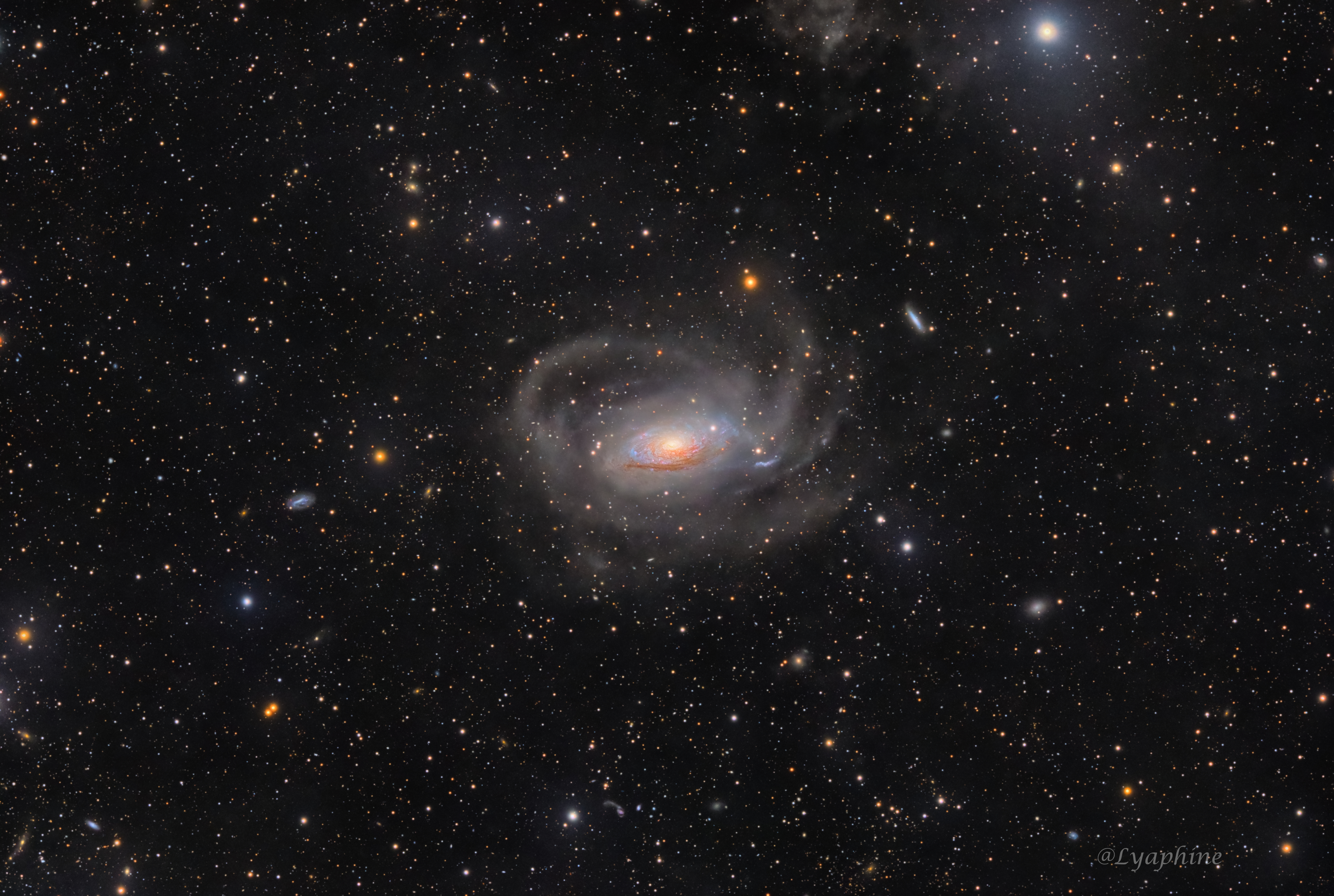
Curly Spiral Galaxy M63
19/05/2023
A bright spiral galaxy of the northern sky, Messier 63 is nearby, about 30 million light-years distant toward the loyal constellation Canes Venatici. Also cataloged as NGC 5055, the majestic island universe is nearly 100,000 light-years across, about the size of our own Milky Way. Its bright core and majestic spiral arms lend the galaxy its popular name, The Sunflower Galaxy. This exceptionally deep exposure also follows faint, arcing star streams far into the galaxy's halo. Extending nearly 180,000 light-years from the galactic center, the star streams are likely remnants of tidally disrupted satellites of M63. Other satellite galaxies of M63 can be spotted in the remarkable wide-field image, including faint dwarf galaxies, which could contribute to M63's star streams in the next few billion years.
Copyright: Sophie Paulin
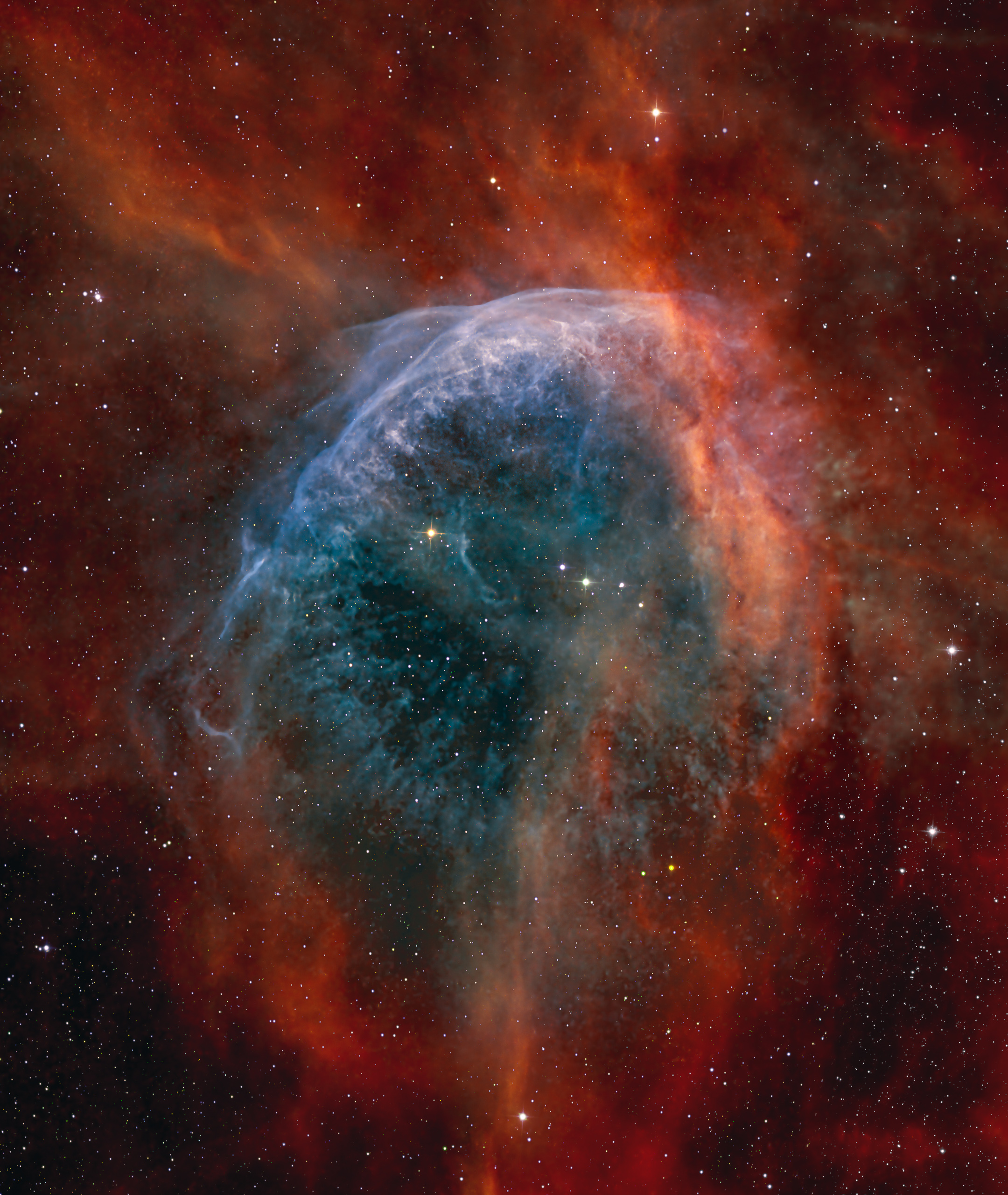
WR 134 Ring Nebula
18/05/2023
Made with narrowband filters, this cosmic snapshot covers a field of view about the size of the full Moon within the boundaries of the constellation Cygnus. It highlights the bright edge of a ring-like nebula traced by the glow of ionized sulfur, hydrogen, and oxygen gas. Embedded in the region's interstellar clouds of gas and dust, the complex, glowing arcs are sections of bubbles or shells of material swept up by the wind from Wolf-Rayet star WR 134, brightest star near the center of the frame. Distance estimates put WR 134 about 6,000 light-years away, making the frame over 50 light-years across. Shedding their outer envelopes in powerful stellar winds, massive Wolf-Rayet stars have burned through their nuclear fuel at a prodigious rate and end this final phase of massive star evolution in a spectacular supernova explosion. The stellar winds and final supernovae enrich the interstellar material with heavy elements to be incorporated in future generations of stars.
Copyright: Craig Stocks
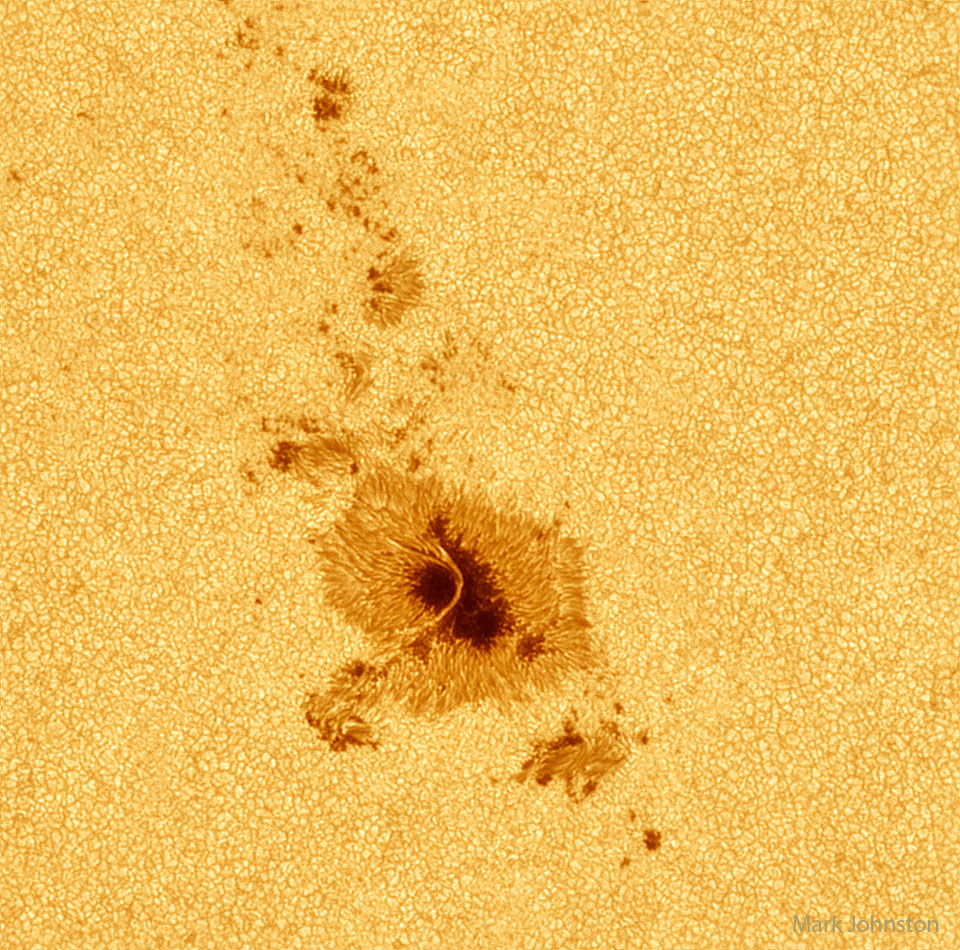
Sunspot with Light Bridge
17/05/2023
Why would a small part of the Sun appear slightly dark? Visible is a close-up picture of sunspots, depressions on the Sun's surface that are slightly cooler and less bright than the rest of the Sun. The Sun's complex magnetic field creates these cool regions by inhibiting hot material from entering the spots. Sunspots can be larger than the Earth and typically last for about a week. Part of active region AR 3297 crossing the Sun in early May, the large lower sunspot is spanned by an impressive light bridge of hot and suspended solar gas. This high-resolution picture also shows clearly that the Sun's surface is a bubbling carpet of separate cells of hot gas. These cells are known as granules. A solar granule is about 1000 kilometers across and lasts for only about 15 minutes. Your Sky Surprise: What picture did APOD feature on your birthday? (post 1995)
Copyright: Mark Johnston
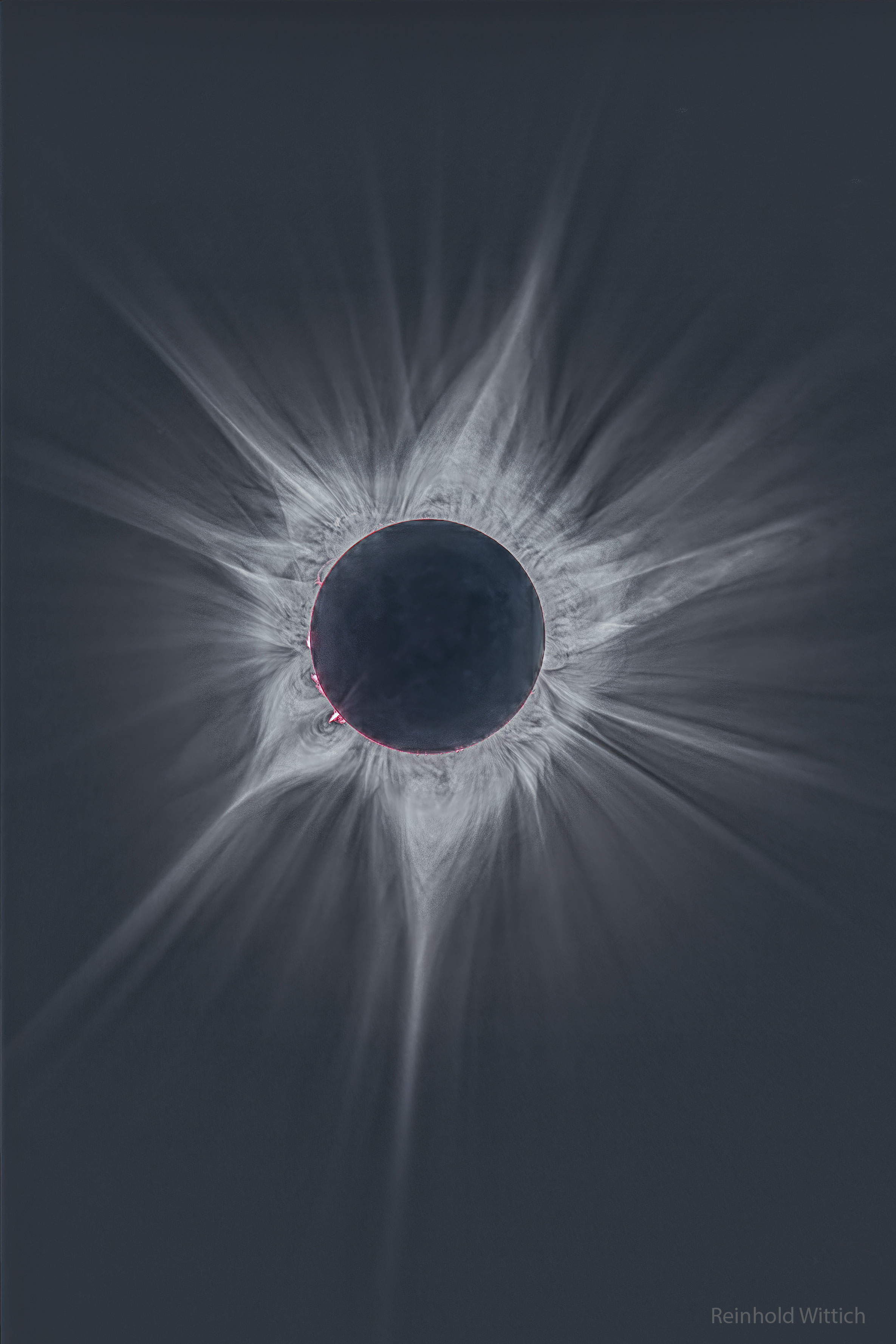
Total Eclipse: The Big Corona
16/05/2023
Most photographs don't adequately portray the magnificence of the Sun's corona. Seeing the corona first-hand during a total solar eclipse is unparalleled. The human eye can adapt to see coronal features and extent that average cameras usually cannot. Welcome, however, to the digital age. The featured image digitally combined short and long exposures taken in Exmouth, Australia that were processed to highlight faint and extended features in the corona during the total solar eclipse that occurred in April of 2023. Clearly visible are intricate layers and glowing caustics of an ever changing mixture of hot gas and magnetic fields in the Sun's corona. Looping prominences appear bright pink just past the Sun's edge. Images taken seconds before and after the total eclipse show glimpses of the background Sun known as Baily's Beads and diamond ring effect. The next total solar eclipse will cross North America in April of 2024. Total Solar Eclipse of 2023 April Gallery: Notable Submissions to APOD
Copyright: Reinhold Wittich
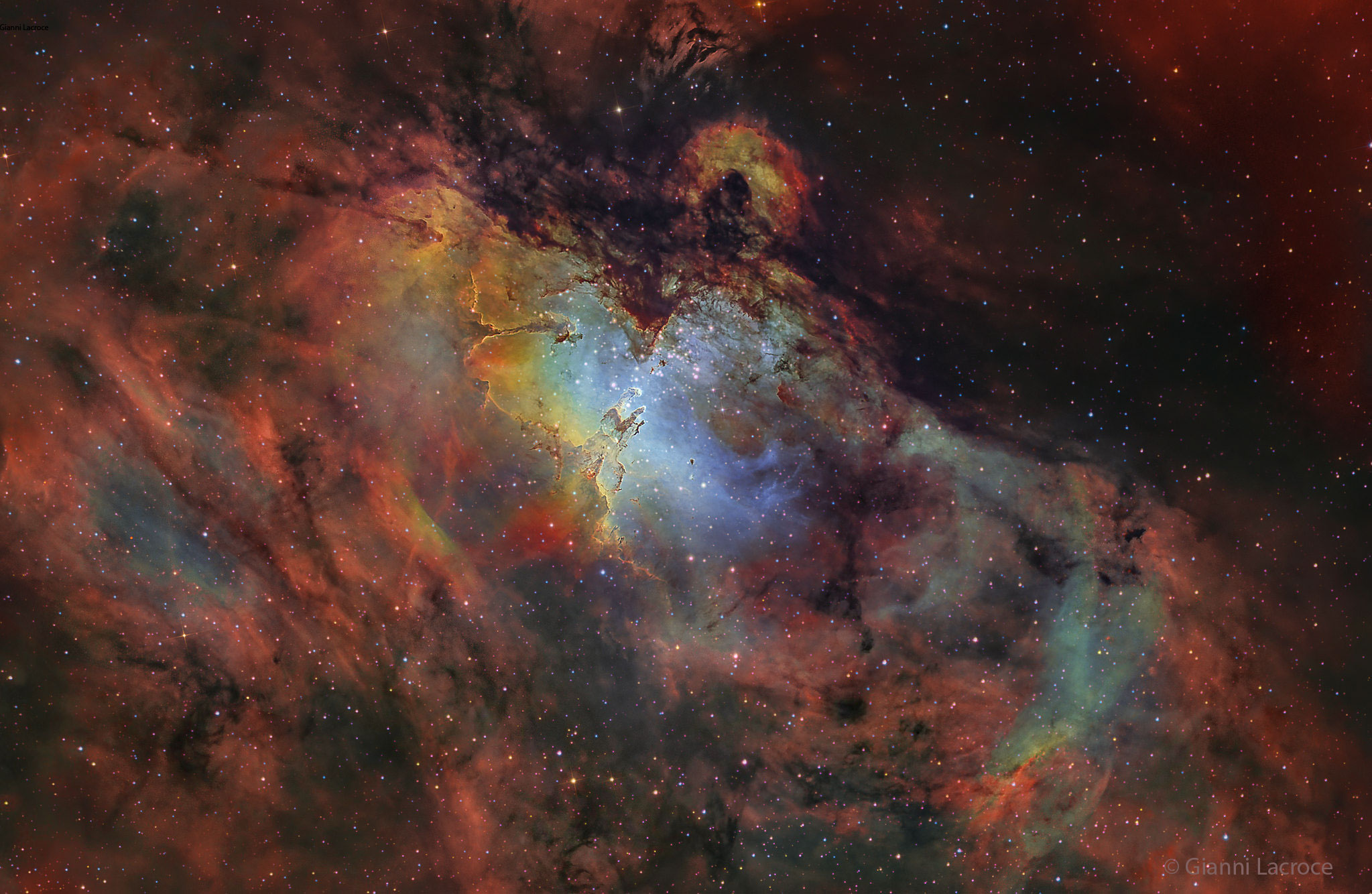
M16: Eagle Nebula Deep Field
15/05/2023
From afar, the whole thing looks like an eagle. A closer look at the Eagle Nebula, however, shows the bright region is actually a window into the center of a larger dark shell of dust. Through this window, a brightly-lit workshop appears where a whole open cluster of stars is being formed. In this cavity, tall pillars and round globules of dark dust and cold molecular gas remain where stars are still forming. Already visible are several young bright blue stars whose light and winds are burning away and pushing back the remaining filaments and walls of gas and dust. The Eagle emission nebula, tagged M16, lies about 6500 light years away, spans about 20 light-years, and is visible with binoculars toward the constellation of the Serpent (Serpens). This picture involved long and deep exposures and combined three specific emitted colors emitted by sulfur (colored as yellow), hydrogen (red), and oxygen (blue).
Copyright: Gianni Lacroce
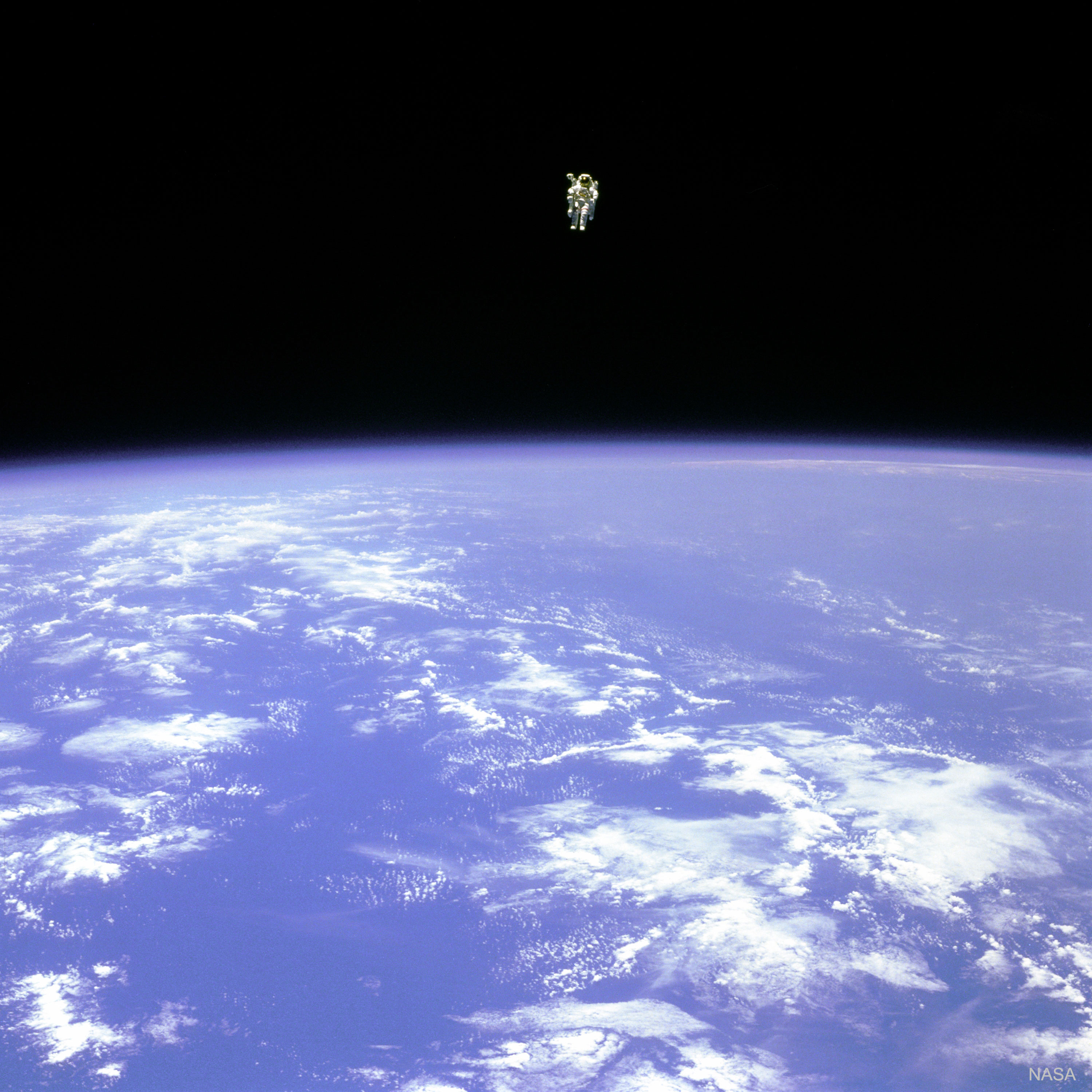
To Fly Free in Space
14/05/2023
What would it be like to fly free in space? At about 100 meters from the cargo bay of the space shuttle Challenger, Bruce McCandless II was living the dream -- floating farther out than anyone had ever been before. Guided by a Manned Maneuvering Unit (MMU), astronaut McCandless, pictured, was floating free in space. During Space Shuttle mission 41-B in 1984, McCandless and fellow NASA astronaut Robert Stewart were the first to experience such an "untethered space walk". The MMU worked by shooting jets of nitrogen and was used to help deploy and retrieve satellites. With a mass over 140 kilograms, an MMU is heavy on Earth, but, like everything, is weightless when drifting in orbit. The MMU was later replaced with the SAFER backpack propulsion unit.
Copyright: NASA
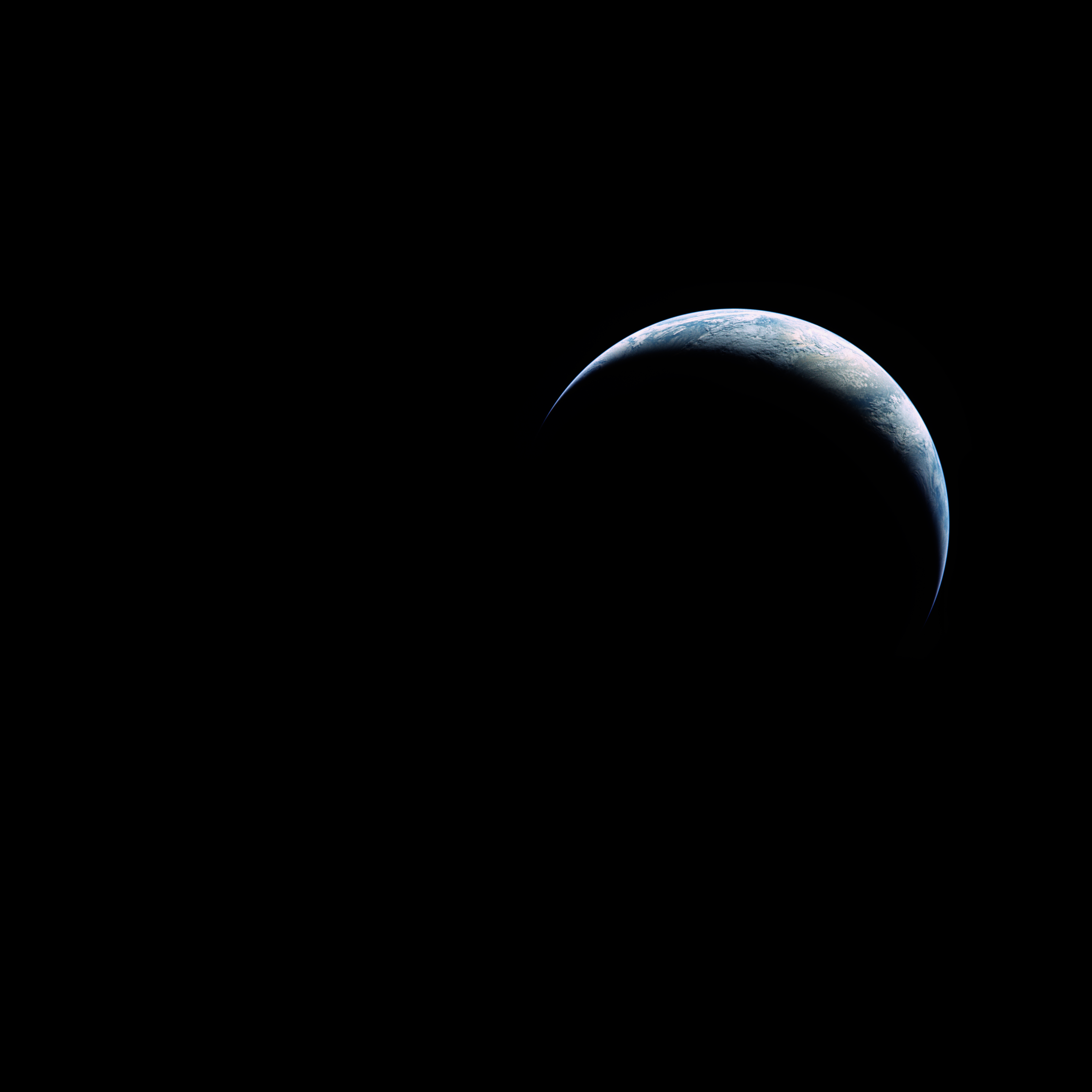
Apollo 17: The Crescent Earth
13/05/2023
Our fair planet sports a curved, sunlit crescent against the black backdrop of space in this stunning photograph. From the unfamiliar perspective, the Earth is small and, like a telescopic image of a distant planet, the entire horizon is completely within the field of view. Enjoyed by crews on board the International Space Station, only much closer views of the planet are possible from low Earth orbit. Orbiting the planet once every 90 minutes, a spectacle of clouds, oceans, and continents scrolls beneath them with the partial arc of the planet's edge in the distance. But this digitally restored image presents a view so far only achieved by 24 humans, Apollo astronauts who traveled to the Moon and back again between 1968 and 1972. The original photograph, AS17-152-23420, was taken by the homeward bound crew of Apollo 17, on December 17, 1972. For now it is the last picture of Earth from this planetary perspective taken by human hands.
Copyright: NASA
Η Αστρονομική Εικόνα της Ημέρας από τη NASA (NASA Astronomy Picture of the Day) είναι μια δωρεάν υπηρεσία που παρέχει καθημερινά μια εντυπωσιακή εικόνα από το σύμπαν, την λήψη της οποίας έχει πραγματοποιήσει κάποιος από τους αστρονόμους της NASA ή από κάποιον από τους δορυφόρους ή τα τηλεσκόπια που η NASA λειτουργεί. Οι εικόνες που εμφανίζονται καλύπτουν μια ευρεία γκάμα από θέματα, συμπεριλαμβανομένων των αστερισμών, των γαλαξιών, των πλανητικών συστημάτων, των κομητών, των αστρικών σωμάτων και των παρατηρητηρίων. Κάθε εικόνα συνοδεύεται από μια σύντομη εξήγηση και πληροφορίες σχετικά με το τι παρατηρείται στην εικόνα.