Η Αστρονομική Εικόνα της Ημέρας από τη NASA
A Daytime Eclipse: Moon Occults Venus
15/09/2026
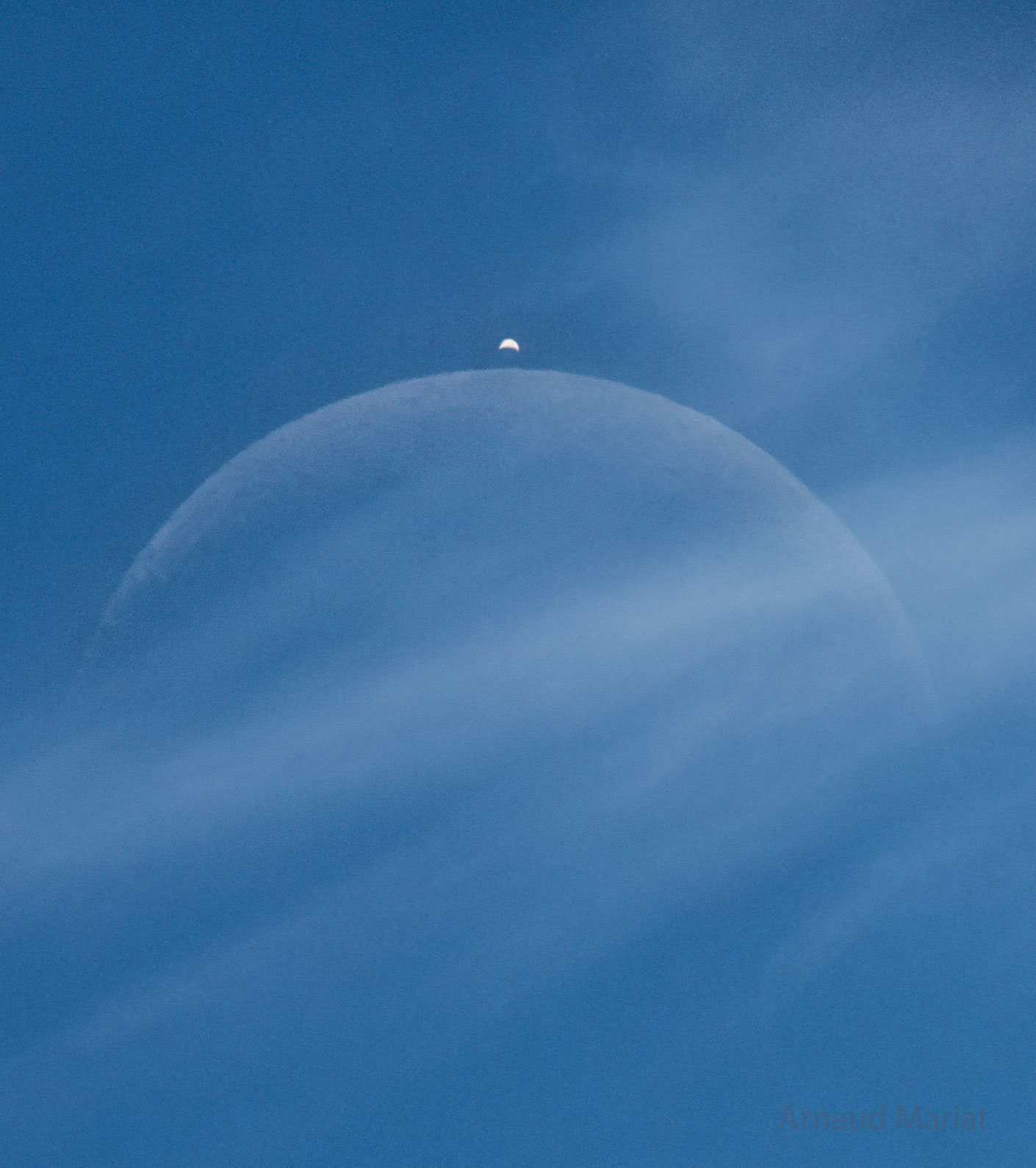
There was something behind the clouds. Upon close inspection, it was the Moon, which was hard to see yesterday around noon above the small village of Cessy, France. But soon, it was not only the Moon. As expected, a bright dot suddenly appeared from behind the Moon -- the planet Venus far in the distance. Captured in the single featured exposure, both appeared to show a crescent phase. The Moon's crescent was quite slight -- with only about 10 percent of its face illuminated by the Sun. In contrast, Venus's crescent was more full -- showing about 25 percent illumination. Venus appeared brighter because it is nearer the Sun and because its clouds are more reflective than the dark lunar surface. An occultation of Venus by the Moon is visible to only about 10 percent of the Earth, but in yesterday's event even most of that was experiencing daytime. APOD's main NASA site is moving: From apod.nasa.gov to science.nasa.gov/apod
Copyright: Arnaud Mariat
Προηγούμενες Αστρονομικές Εικόνες της Ημέρας από τη NASA
Lightning on Jupiter
25/06/2023
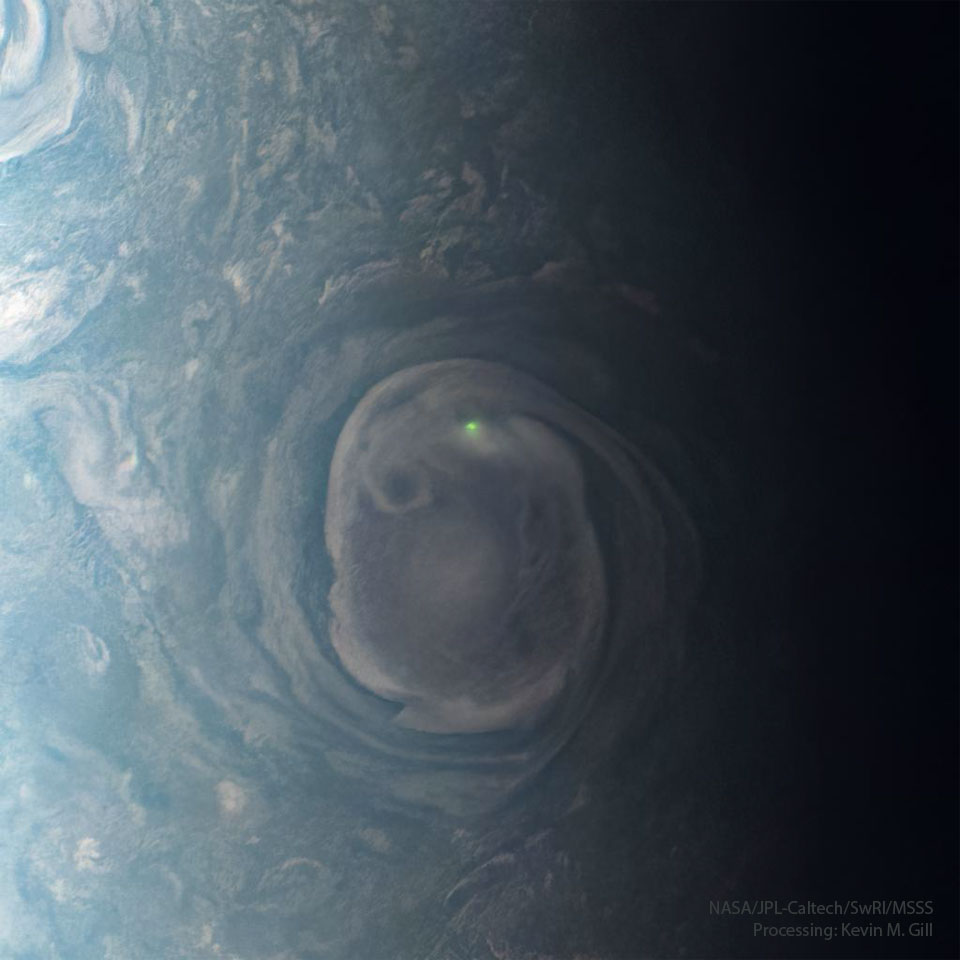
Does lightning occur only on Earth? No. Spacecraft in our Solar System have detected lightning on other planets, including Mars, Jupiter and Saturn, and lightning is likely on Venus, Uranus, and Neptune. Lightning is a sudden rush of electrically charged particles from one location to another. On Earth, drafts of colliding ice and water droplets usually create lightning-generating charge separation, but what happens on Jupiter? Images and data from NASA's Jupiter-orbiting Juno spacecraft bolster previous speculation that Jovian lightning is also created in clouds containing water and ice. In the featured Juno photograph, an optical flash was captured in a large cloud vortex near Jupiter's north pole. During the next few months, Juno will perform several close sweeps over Jupiter's night side, likely allowing the robotic probe to capture more data and images of Jovian lightning.
Copyright: NASA
3D Ingenuity
24/06/2023
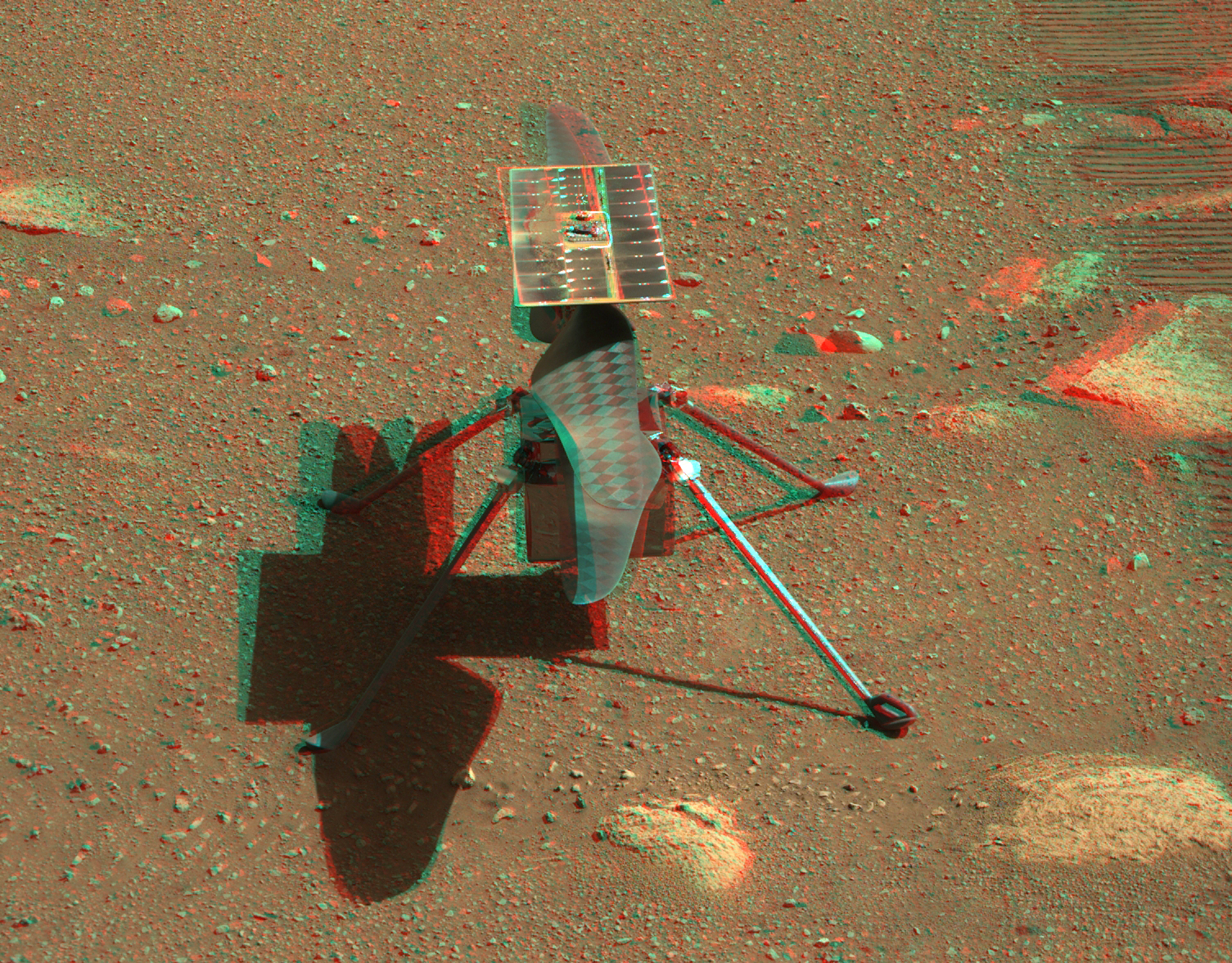
The multicolor, stereo imaging Mastcam-Z on the Perseverance rover zoomed in to capture this 3D close-up (get out your red/blue glasses) of the Mars Ingenuity helicopter on mission sol 45. That's Earth-date 2021 April 5. Casting a shadow on the Martian surface, Ingenuity is standing alone on its four landing legs next to the rover's wheel tracks. The experimental helicopter's solar panel, charging batteries that keep it warm through the cold Martian nights and power its flight, sits just above Ingenuity's two 1.2 meter (4 foot) long counter-rotating blades. Thirteen sols later, on April 19, Ingenuity became the first aircraft to perform powered, controlled flight on another planet. It has since gone on to complete more than 50 flights through the thin atmosphere of Mars.
Copyright: NASA
Giant Galaxies in Pavo
23/06/2023
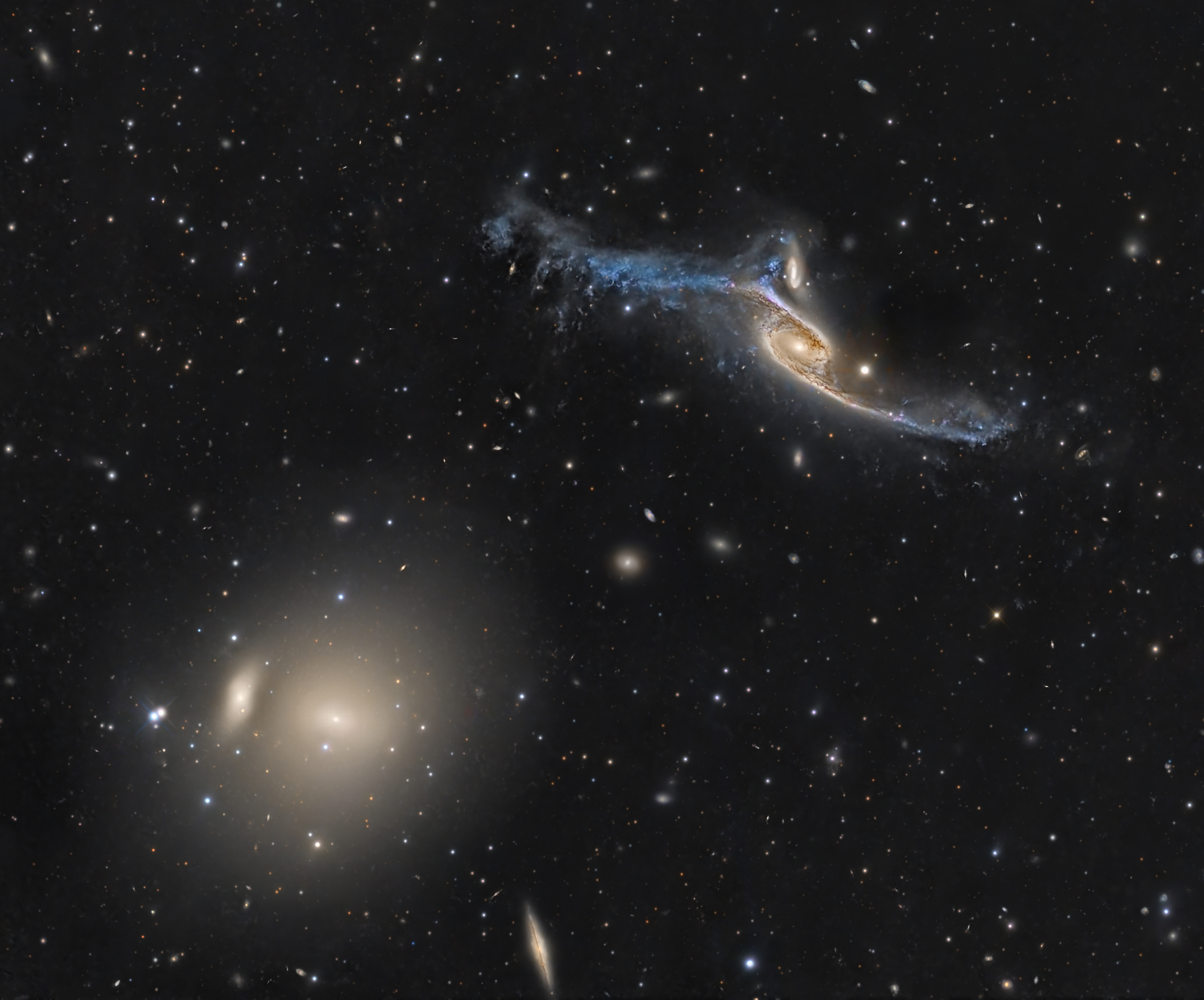
Over 500,000 light years across, NGC 6872 (top right) is a truly enormous barred spiral galaxy, at least 5 times the size of our own very large Milky Way. The appearance of this giant galaxy's distorted and stretched out spiral arms suggests the magnificent wings of a giant bird. Of course its popular moniker is the Condor galaxy. It lies about 200 million light-years distant toward the southern constellation Pavo, the Peacock. Lined with star-forming regions, the distorted spiral arms are due to NGC 6872's gravitational interaction with the nearby smaller galaxy IC 4970, seen just above the giant galaxy's core. The Pavo galaxy group's dominant giant elliptical galaxy, NGC 6876 is below and left of the soaring Condor galaxy.
Copyright: Mike Selby
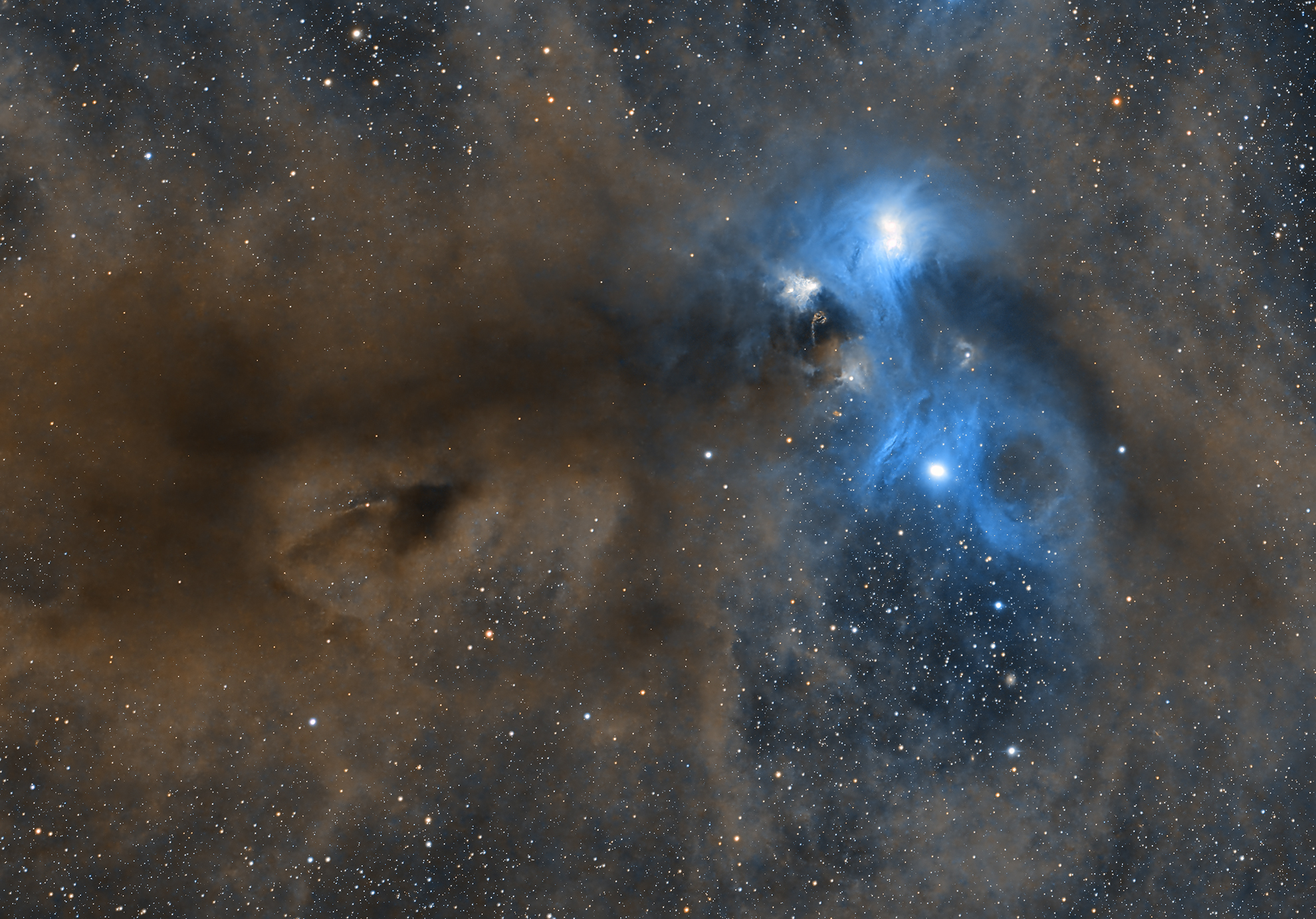
Stars and Dust across Corona Australis
22/06/2023
Cosmic dust clouds cross a rich field of stars in this telescopic vista near the northern boundary of Corona Australis, the Southern Crown. Part of a sprawling molecular cloud complex this star forming region is a mere 500 light-years away. That's about one third the distance of the more famous stellar nursery known as the Orion Nebula. The 2 degree wide frame would span 15 light-years at the clouds' estimated distance. Mixed with bright nebulosities the dust clouds effectively block light from more distant background stars in the Milky Way and obscure from view embedded stars still in the process of formation. Large dark nebula Bernes 157 is on the left. To its right are a group of pretty reflection nebulae cataloged as NGC 6726, 6727, 6729, and IC 4812. Their characteristic blue color is produced as light from hot stars is reflected by the cosmic dust. The more compact NGC 6729 surrounds young variable star R Coronae Australis. Just below it, filamentary arcs and loops are identified as Herbig Haro objects associated with energetic newborn stars. In fact, at the heart of this area lies the Coronet Cluster, one of the nearest and most active star forming regions.
Copyright: Alessandro Cipolat Bares
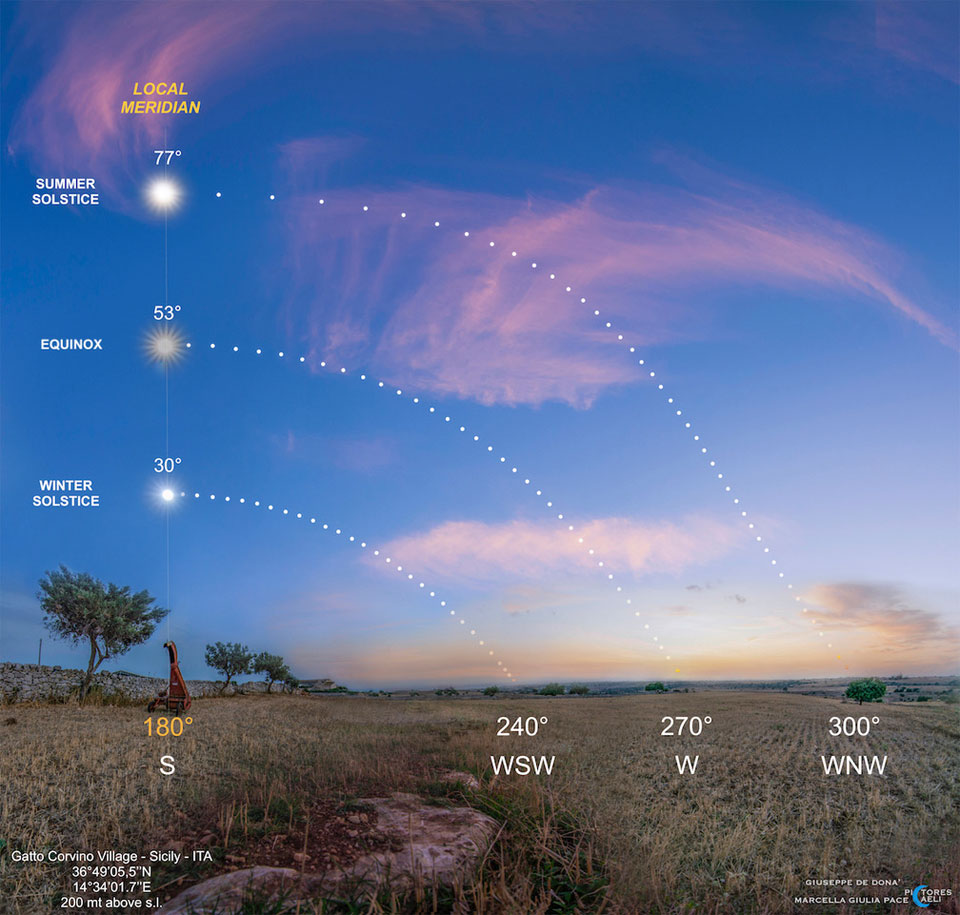
Three Sun Paths
21/06/2023
Does the Sun follow the same path every day? No. The Sun's path changes during the year, tracing a longer route during the summer than the winter. Pictured here, the Sun's arc was captured from noon to sunset on three days, from highest in the sky to lowest: summer solstice, equinox, and winter solstice. The images were taken near Gatto Corvino Village in Sicily, Italy in 2020 and 2021. The path and time the Sun spends in the sky is more important in determining the season than how close the Earth is to the Sun. In fact, the Earth is closest to the Sun in January, during northern winter. Today is a solstice, so today the Sun is taking its longest path of the year across the sky in Earth's northern hemisphere, but the shortest path in the southern hemisphere.
Copyright: Marcella Giulia Pace & Giuseppe De Donà
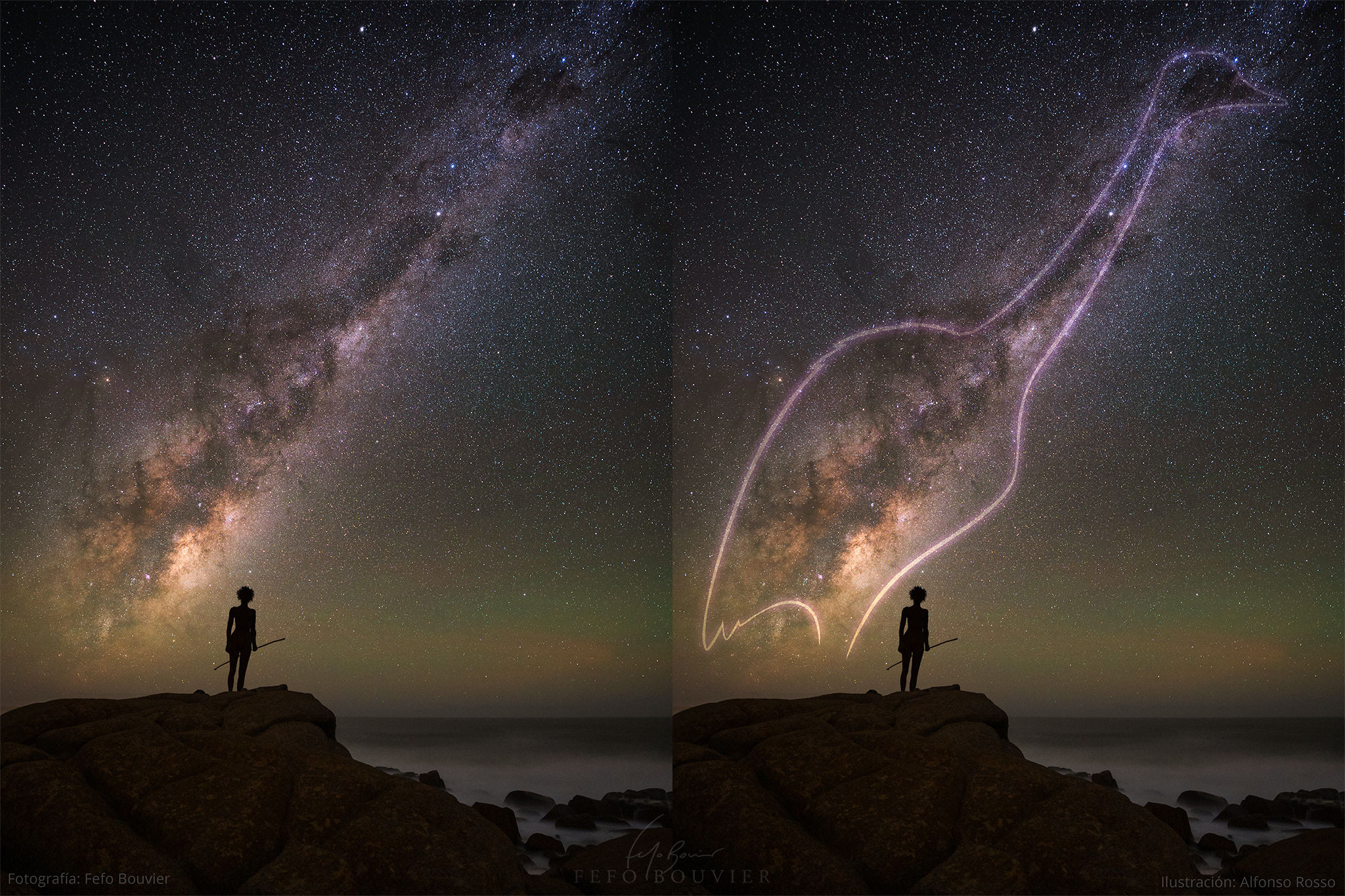
The Ñandú in the Milky Way
20/06/2023
Have you seen the bird in the Milky Way? Beyond the man in the Moon, the night sky is filled with stories, and cultures throughout history have projected some of their most enduring legends onto the stars and dust above. Generations of people see these celestial icons, hear their associated stories, and pass them down. Pictured here is not only a segment of the central band of our Milky Way galaxy, but, according to folklore of several native peoples of Uruguay, the outline of a great bird called Ñandú. Furthermore, Ñandú's footprint is associated with the Southern Cross asterism. In the foreground, in silhouette, is a statue of María Micaela Guyunusa, an indigenous woman of the Charrúa people who lived in the 1800s and endures as a symbol of colonial resistance. The composite image was taken in mid-April in Cabo Polonio, Uruguay, with the Atlantic Ocean in the background.
Copyright: Fefo Bouvier; Line Drawing: Alfonso Rosso
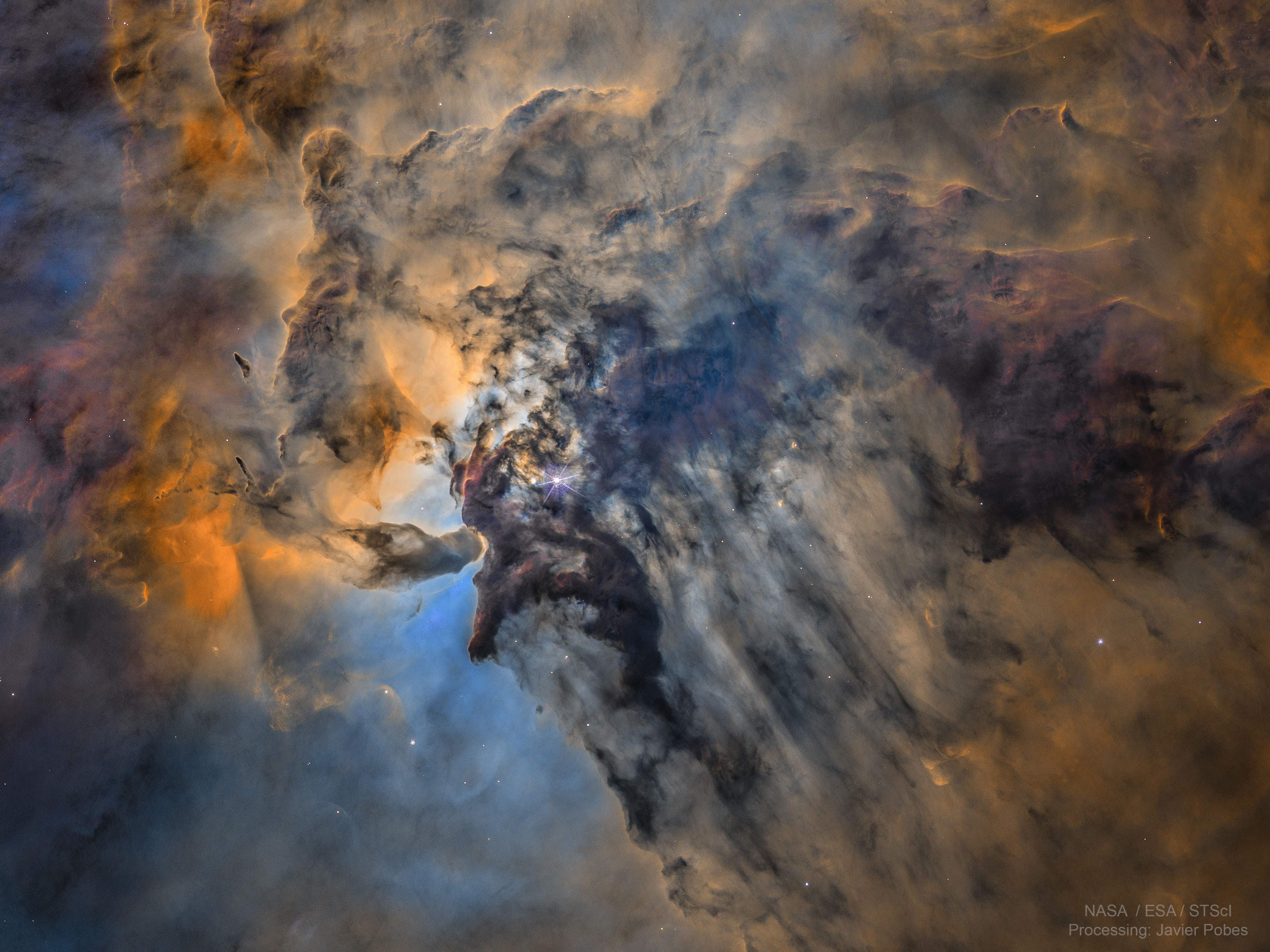
The Busy Center of the Lagoon Nebula
19/06/2023
The center of the Lagoon Nebula is a whirlwind of spectacular star formation. Visible near the image center, at least two long funnel-shaped clouds, each roughly half a light-year long, have been formed by extreme stellar winds and intense energetic starlight. A tremendously bright nearby star, Herschel 36, lights the area. Vast walls of dust hide and redden other hot young stars. As energy from these stars pours into the cool dust and gas, large temperature differences in adjoining regions can be created generating shearing winds which may cause the funnels. This picture, spanning about 15 light years, combines images taken in four colors by the orbiting Hubble Space Telescope. The Lagoon Nebula, also known as M8, lies about 5000 light years distant toward the constellation of the Archer (Sagittarius).
Copyright: NASA
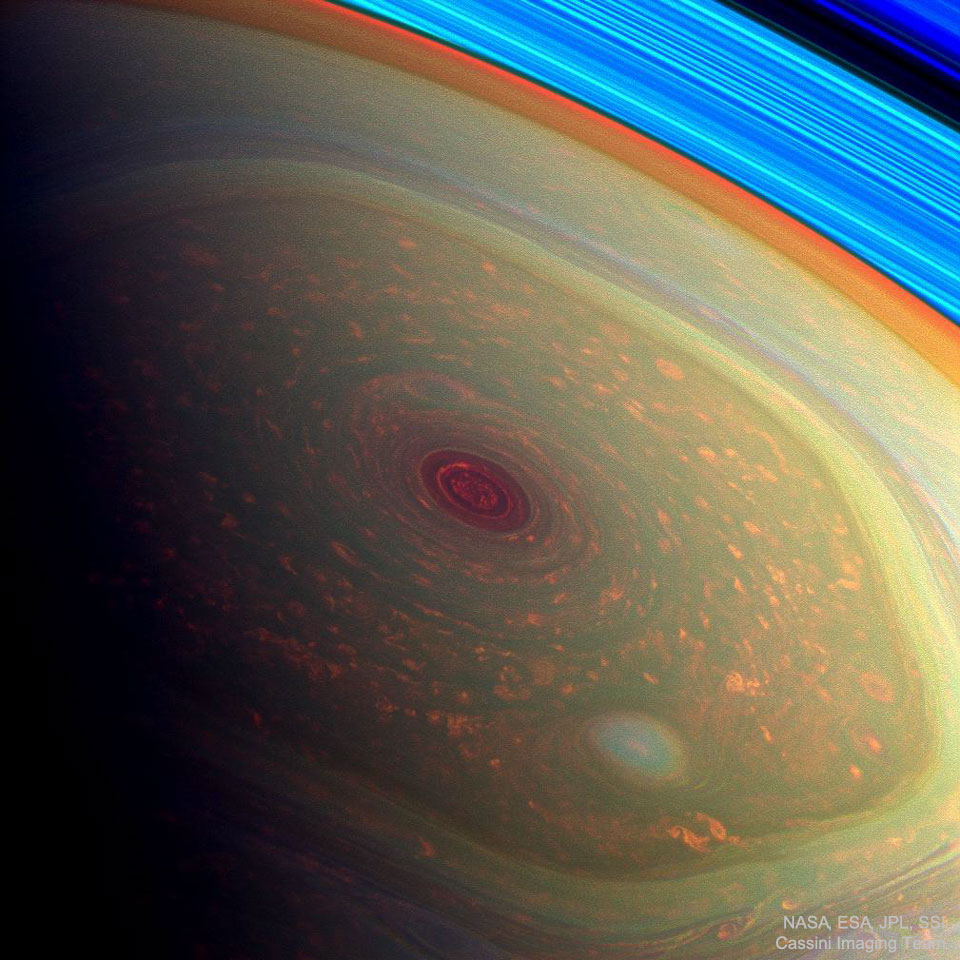
Saturn's Northern Hexagon
18/06/2023
Why would clouds form a hexagon on Saturn? Nobody is sure. Originally discovered during the Voyager flybys of Saturn in the 1980s, nobody has ever seen anything like it anywhere else in the Solar System. Acquiring its first sunlit views of far northern Saturn in late 2012, the Cassini spacecraft's wide-angle camera recorded this stunning, false-color image of the ringed planet's north pole. The composite of near-infrared image data results in red hues for low clouds and green for high ones, giving the Saturnian cloudscape a vivid appearance. This and similar images show the stability of the hexagon even 20+ years after Voyager. Movies of Saturn's North Pole show the cloud structure maintaining its hexagonal structure while rotating. Unlike individual clouds appearing like a hexagon on Earth, the Saturn cloud pattern appears to have six well defined sides of nearly equal length. Four Earths could fit inside the hexagon. Beyond the cloud tops at the upper right, arcs of the planet's eye-catching rings are tinted bright blue.
Copyright: NASA, ESA, JPL, SSI, Cassini Imaging Team
Η Αστρονομική Εικόνα της Ημέρας από τη NASA (NASA Astronomy Picture of the Day) είναι μια δωρεάν υπηρεσία που παρέχει καθημερινά μια εντυπωσιακή εικόνα από το σύμπαν, την λήψη της οποίας έχει πραγματοποιήσει κάποιος από τους αστρονόμους της NASA ή από κάποιον από τους δορυφόρους ή τα τηλεσκόπια που η NASA λειτουργεί. Οι εικόνες που εμφανίζονται καλύπτουν μια ευρεία γκάμα από θέματα, συμπεριλαμβανομένων των αστερισμών, των γαλαξιών, των πλανητικών συστημάτων, των κομητών, των αστρικών σωμάτων και των παρατηρητηρίων. Κάθε εικόνα συνοδεύεται από μια σύντομη εξήγηση και πληροφορίες σχετικά με το τι παρατηρείται στην εικόνα.