Η Αστρονομική Εικόνα της Ημέρας από τη NASA
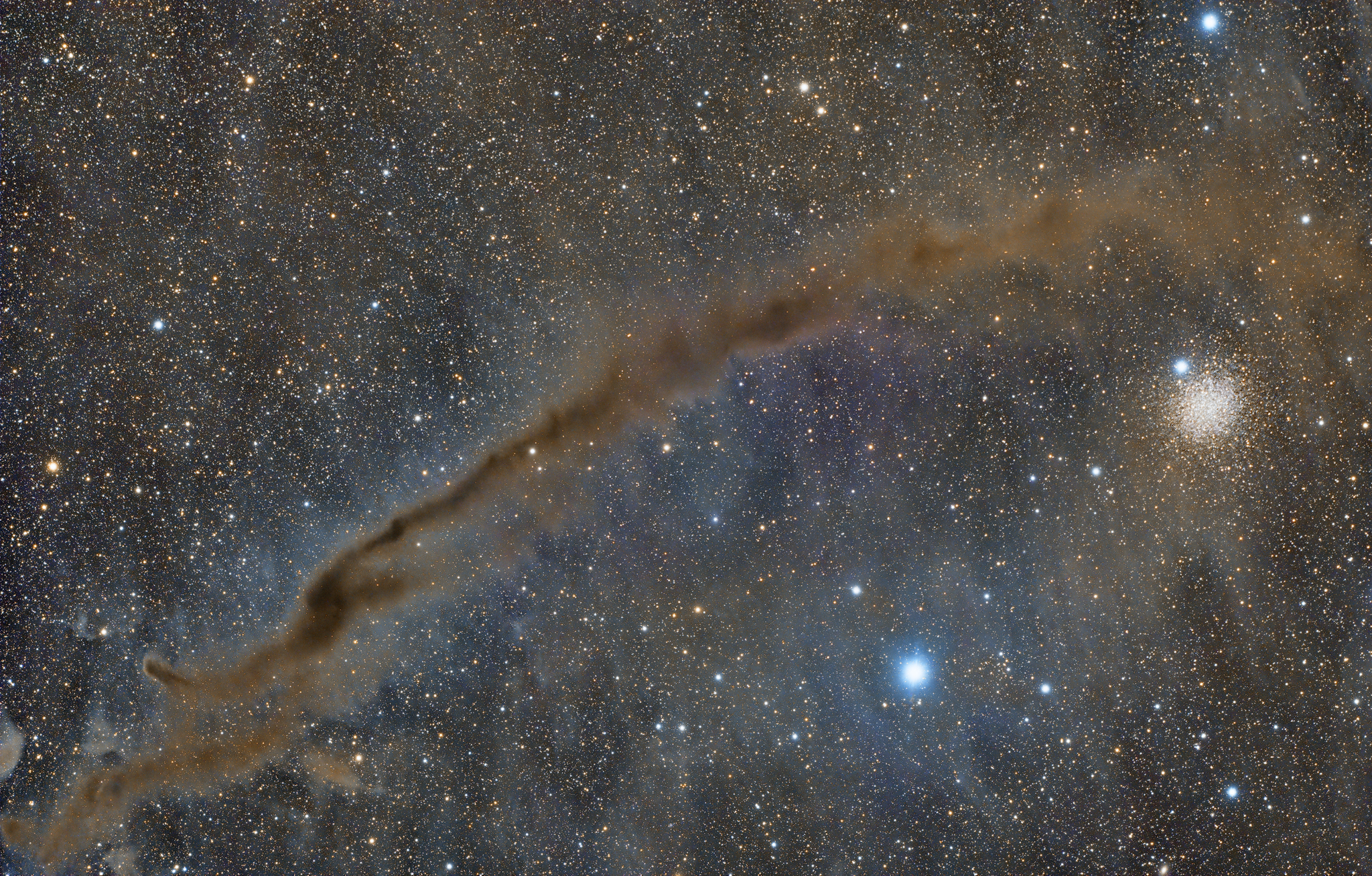
NGC 4372 and the Dark Doodad
31/07/2026
The Dark Doodad Nebula drifts through southern skies, a tantalizing target for binoculars toward the small constellation Musca, The Fly. A dusty interstellar cloud, it's seen against rich starfields just south of the Coalsack Nebula and the Southern Cross. Stretching for about 3 degrees across this telescopic field of view, the Dark Doodad is punctuated near its southern tip (upper right) by yellowish globular star cluster NGC 4372. Of course NGC 4372 roams the halo of our Milky Way galaxy, a background object some 20,000 light-years away and only by chance along our line-of-sight to the Dark Doodad. About 700 light-years distant and over 30 light-years long, the Dark Doodad's well defined silhouette belongs to the potentially star-forming Musca molecular cloud. The dusty Dark Doodad's delightfully alliterative moniker was first coined by astro-imager and writer Dennis di Cicco in 1986 while observing Comet Halley from the Australian outback.
Copyright: Alessandro Cipolat Bares
Προηγούμενες Αστρονομικές Εικόνες της Ημέρας από τη NASA

Space Station Silhouette on the Moon
18/06/2025
What's that unusual spot on the Moon? It's the International Space Station. Using precise timing, the Earth-orbiting space platform was photographed in front of a partially lit gibbous Moon in 2019. The featured image was taken from Palo Alto, California, USA with an exposure time of only 1/667 of a second. In contrast, the duration of the transit of the ISS across the entire Moon was about half a second. A close inspection of this unusually crisp ISS silhouette will reveal the outlines of numerous solar panels and trusses. The bright crater Tycho is visible on the lower left, as well as comparatively rough, light colored terrain known as highlands and relatively smooth, dark colored areas known as maria. Downloadable apps can tell you when the International Space Station will be visible from your area. APOD Turns 30!: Free Public Lecture in Cork, Ireland on June 24
Copyright: Eric Holland

Rosette Nebula Deep Field
17/06/2025
Can you find the Rosette Nebula? The red flowery-looking nebula just above the image center may seem a good choice, but that's not it. The famous Rosette Nebula is really located on the lower right, here colored blue and white, and connected to the other nebulas by gold-colored filaments. Because the featured image of Rosette's field is so wide, and because of its deep red exposure, it seems to contain other flowers. Designated NGC 2237, the center of the Rosette Nebula is populated by the bright blue stars of open cluster NGC 2244, whose winds and energetic light are evacuating the nebula's center. The Rosette Nebula is about 5,000 light years distant and, just by itself, spans about three times the diameter of a full moon. This flowery field can be found toward the constellation of the Unicorn (Monoceros). Explore Your Universe: Random APOD Generator
Copyright: NASA

APOD is 30 Years Old Today
16/06/2025
APOD is 30 years old today. In celebration, today's picture uses past APODs as tiles arranged to create a single pixelated image that might remind you of one of the most well-known and evocative depictions of planet Earth's night sky. In fact, this Starry Night consists of 1,836 individual images contributed to APOD over the last 5 years in a mosaic of 32,232 tiles. Today, APOD would like to offer a sincere thank you to our contributors, volunteers, and readers. Over the last 30 years your continuing efforts have allowed us to enjoy, inspire, and share a discovery of the cosmos.
Copyright: NASA

Two Worlds, One Sun
15/06/2025
How different does sunset appear from Mars than from Earth? For comparison, two images of our common star were taken at sunset, one from Earth and one from Mars. These images were scaled to have the same angular width and are featured here side-by-side. A quick inspection will reveal that the Sun appears slightly smaller from Mars than from Earth. This makes sense since Mars is 50% further from the Sun than Earth. More striking, perhaps, is that the Martian sunset is noticeably bluer near the Sun than the typically orange colors near the setting Sun from Earth. The reason for the blue hues from Mars is not fully understood, but thought to be related to forward scattering properties of Martian dust. The terrestrial sunset was taken in 2012 March from Marseille, France, while the Martian sunset was captured in 2015 by NASA's robotic Curiosity rover from Gale crater on Mars. APOD Turns 30!: Free Public Lecture in Cork, Ireland on June 24
Copyright: Damia Bouic; Right Image Credit: NASA, JPL-Caltech, MSSS; Digital processing: Damia Bouic

Meteors and Satellite Trails over the Limay River
14/06/2025
What are all those streaks in the sky? A galaxy, many satellite trails, and a few meteors. First, far in the distance, the majestic band of our Milky Way Galaxy runs down the left. Mirroring it on the right are several parallel trails of Earth-orbiting Starlink satellites. Many fainter satellite trails also crisscross the image. The two short and bright streaks are meteors — likely members of the annual Eta Aquariids meteor shower. The planet Venus shines on the lower right. Venus and the satellites shine by reflected sunlight. The featured picture is a composite of exposures all taken in a few hours on May 4 over the Limay River in Argentina.
Copyright: Martín Moliné

Rubin's Galaxy
13/06/2025
In this Hubble Space Telescope image the bright, spiky stars lie in the foreground toward the heroic northern constellation Perseus and well within our own Milky Way galaxy. In sharp focus beyond is UGC 2885, a giant spiral galaxy about 232 million light-years distant. Some 800,000 light-years across compared to the Milky Way's diameter of 100,000 light-years or so, it has around 1 trillion stars. That's about 10 times as many stars as the Milky Way. Part of an investigation to understand how galaxies can grow to such enormous sizes, UGC 2885 was also part of An Interesting Voyage and American astronomer Vera Rubin's pioneering study of the rotation of spiral galaxies. Her work was the first to convincingly demonstrate the dominating presence of dark matter in our universe. A new U.S. coin has been issured to honor Vera Rubin, while the Vera C. Rubin Observatory is scheduled to unveil images from its first look at the cosmos on June 23.
Copyright: NASA

Solar Eclipse
12/06/2025
On April 20, 2023 the shadow of a New Moon raced across planet Earth's southern hemisphere. When viewed along a narrow path that mostly avoided landfall, the Moon in silhouette created a hybrid solar eclipse. Hybrid eclipses are rare and can be seen as a total eclipse or an annular "ring of fire" eclipse depending on the observer's position. Viewers of this much anticipated hybrid event were able to witness a total solar eclipse while anchored in the Indian Ocean near the centerline of the eclipse track off the coast of western Australia. This ship-borne image from renowned eclipse chaser Fred Espenak captured the active Sun's magnificent outer atmosphere, or solar corona, streaming into space. The composite of 11 exposures ranging from 1/2000 to 1/2 second, taken during the 62 seconds of totality, records an extended range of brightness to follow alluring details of the corona not quite visible to the eye. Fred Espenak (1953-2025)
Copyright: Fred Espenak

25 Brightest Stars in the Night Sky
11/06/2025
Do you know the names of some of the brightest stars? It's likely that you do, even though some bright stars have names so old they date back to near the beginning of written language. Many world cultures have their own names for the brightest stars, and it is culturally and historically important to remember them. In the interest of clear global communication, however, the International Astronomical Union (IAU) has begun to designate standardized star names. Featured here in true color are the 25 brightest stars in the night sky, currently as seen by humans, coupled with their IAU-recognized names. Some star names have interesting meanings, including Sirius ("the scorcher" in Latin), Vega ("falling" in Arabic), and Antares ("rival to Mars" in Greek). You are likely even familiar with the name of at least one star too dim to make this list: Polaris. APOD Turns 30!: Free public lecture in Anchorage TONIGHT (Wednesday) at 7 pm
Copyright: Tragoolchitr Jittasaiyapan
Η Αστρονομική Εικόνα της Ημέρας από τη NASA (NASA Astronomy Picture of the Day) είναι μια δωρεάν υπηρεσία που παρέχει καθημερινά μια εντυπωσιακή εικόνα από το σύμπαν, την λήψη της οποίας έχει πραγματοποιήσει κάποιος από τους αστρονόμους της NASA ή από κάποιον από τους δορυφόρους ή τα τηλεσκόπια που η NASA λειτουργεί. Οι εικόνες που εμφανίζονται καλύπτουν μια ευρεία γκάμα από θέματα, συμπεριλαμβανομένων των αστερισμών, των γαλαξιών, των πλανητικών συστημάτων, των κομητών, των αστρικών σωμάτων και των παρατηρητηρίων. Κάθε εικόνα συνοδεύεται από μια σύντομη εξήγηση και πληροφορίες σχετικά με το τι παρατηρείται στην εικόνα.