Η Αστρονομική Εικόνα της Ημέρας από τη NASA
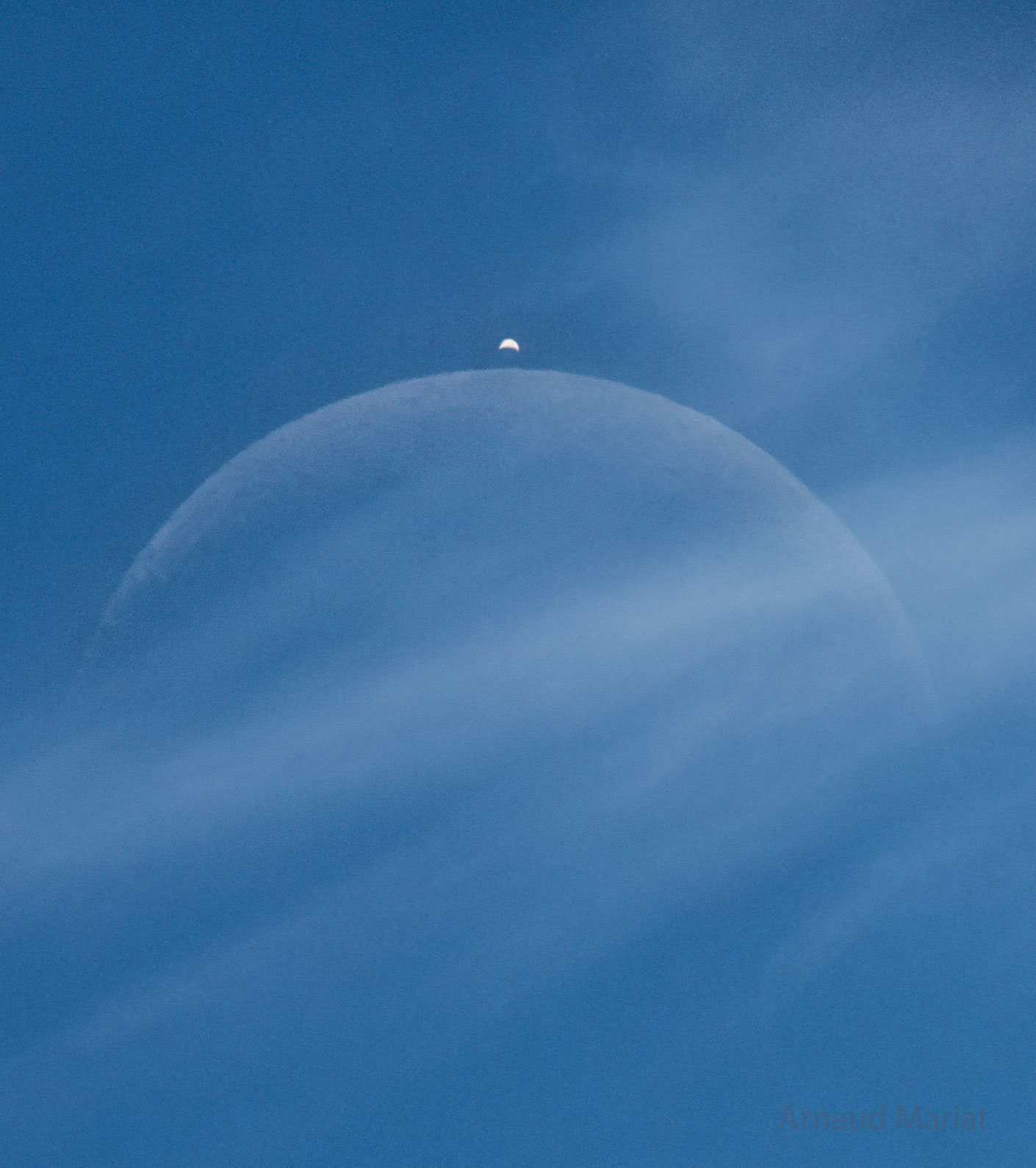
A Daytime Eclipse: Moon Occults Venus
15/09/2026
There was something behind the clouds. Upon close inspection, it was the Moon, which was hard to see yesterday around noon above the small village of Cessy, France. But soon, it was not only the Moon. As expected, a bright dot suddenly appeared from behind the Moon -- the planet Venus far in the distance. Captured in the single featured exposure, both appeared to show a crescent phase. The Moon's crescent was quite slight -- with only about 10 percent of its face illuminated by the Sun. In contrast, Venus's crescent was more full -- showing about 25 percent illumination. Venus appeared brighter because it is nearer the Sun and because its clouds are more reflective than the dark lunar surface. An occultation of Venus by the Moon is visible to only about 10 percent of the Earth, but in yesterday's event even most of that was experiencing daytime. APOD's main NASA site is moving: From apod.nasa.gov to science.nasa.gov/apod
Copyright: Arnaud Mariat
Προηγούμενες Αστρονομικές Εικόνες της Ημέρας από τη NASA
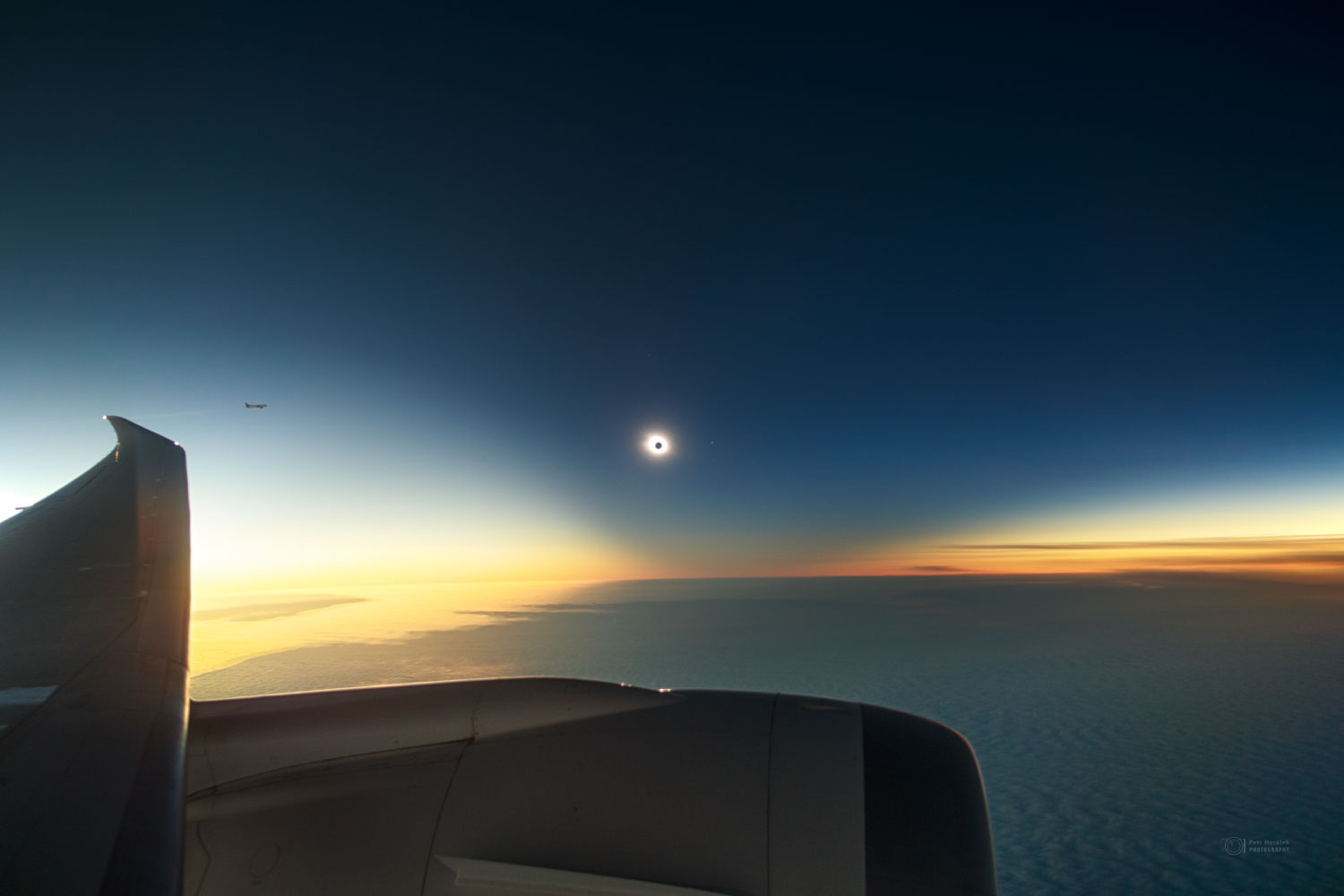
Total Solar Eclipse Below the Bottom of the World
31/03/2024
In late 2021 there was a total solar eclipse visible only at the end of the Earth. To capture the unusual phenomenon, airplanes took flight below the clouded seascape of Southern Ocean. The featured image shows one relatively spectacular capture where the bright spot is the outer corona of the Sun and the eclipsing Moon is seen as the dark spot in the center. A wing and engine of the airplane are visible across the left and bottom of the image, while another airplane observing the eclipse is visible on the far left. The dark area of the sky surrounding the eclipsed Sun is called a shadow cone. It is dark because you are looking down a long corridor of air shadowed by the Moon. A careful inspection of the eclipsed Sun will reveal the planet Mercury just to the right. You won't have to travel to the end of the Earth to see the next total solar eclipse. The total eclipse path will cross North America on 2024 April 8, just over one week from today. NASA Coverage: Total Solar Eclipse of 2024 April 8
Copyright: Petr Horálek (ESO Photo Ambassador, Inst. of Physics in Opava) ; Acknowledgement: Xavier Jubier
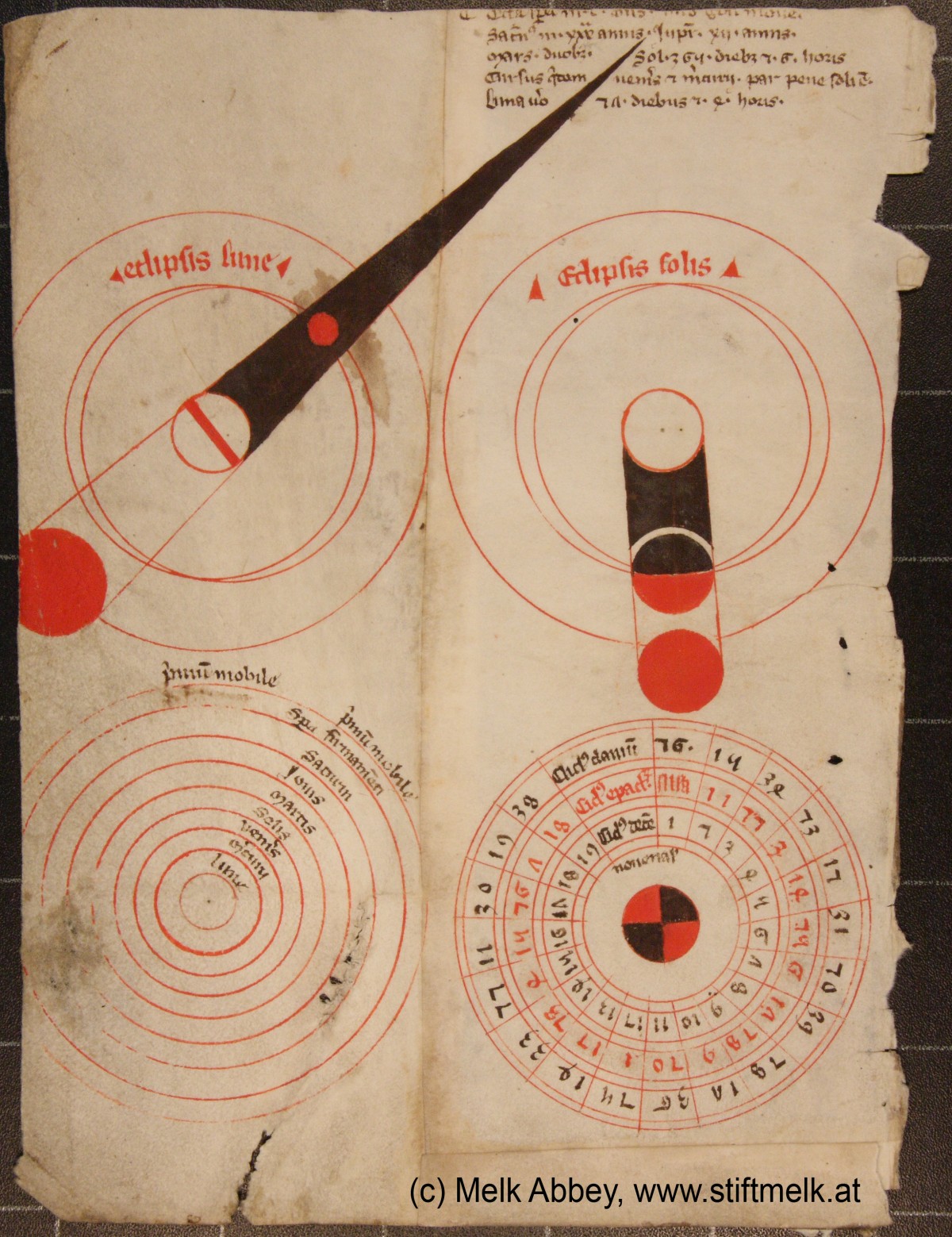
Medieval Astronomy from Melk Abbey
30/03/2024
Discovered by accident, this manuscript page provides graphical insight to astronomy in medieval times, before the Renaissance and the influence of Nicolaus Copernicus, Tycho Brahe, Johannes Kepler, and Galileo. The intriguing page is from lecture notes on astronomy compiled by the monk Magister Wolfgang de Styria before the year 1490. The top panels clearly illustrate the necessary geometry for a lunar (left) and solar eclipse in the Earth-centered Ptolemaic system. At lower left is a diagram of the Ptolemaic view of the Solar System with text at the upper right to explain the movement of the planets according to Ptolemy's geocentric model. At the lower right is a chart to calculate the date of Easter Sunday in the Julian calendar. The illustrated manuscript page was found at historic Melk Abbey in Austria.
Copyright: Library of Melk Abbey, Frag. 229
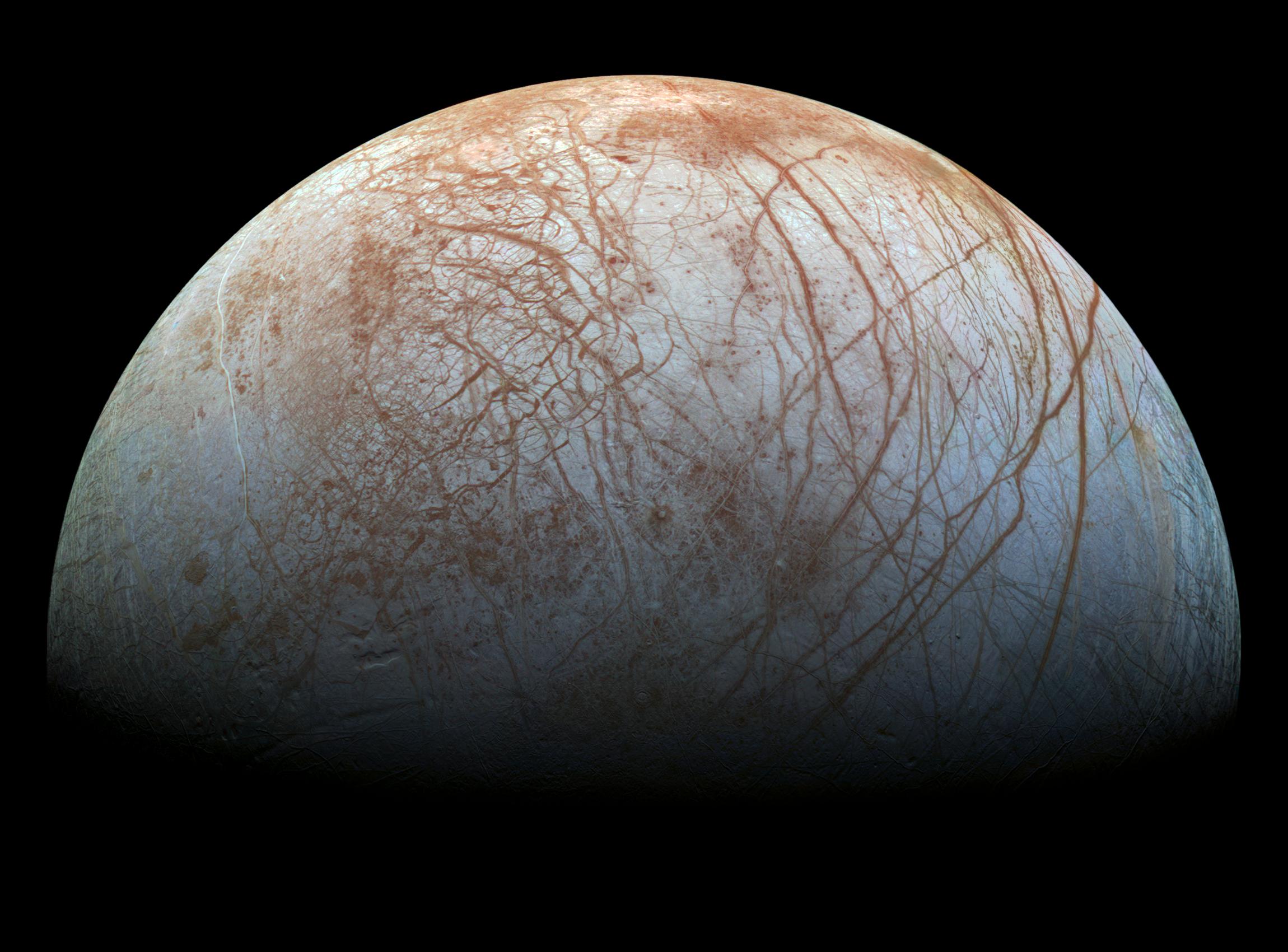
Galileo's Europa
29/03/2024
Looping through the Jovian system in the late 1990s, the Galileo spacecraft recorded stunning views of Europa and uncovered evidence that the moon's icy surface likely hides a deep, global ocean. Galileo's Europa image data has been remastered here, with improved calibrations to produce a color image approximating what the human eye might see. Europa's long curving fractures hint at the subsurface liquid water. The tidal flexing the large moon experiences in its elliptical orbit around Jupiter supplies the energy to keep the ocean liquid. But more tantalizing is the possibility that even in the absence of sunlight that process could also supply the energy to support life, making Europa one of the best places to look for life beyond Earth. The Juno spacecraft currently in Jovian orbit has also made repeated flybys of the water world, returning images along with data exploring Europa's habitability. This October will see the launch of the NASA's Europa Clipper on a voyage of exploration. The spacecraft will make nearly 50 flybys, approaching to within 25 kilometers of Europa's icy surface.
Copyright: NASA
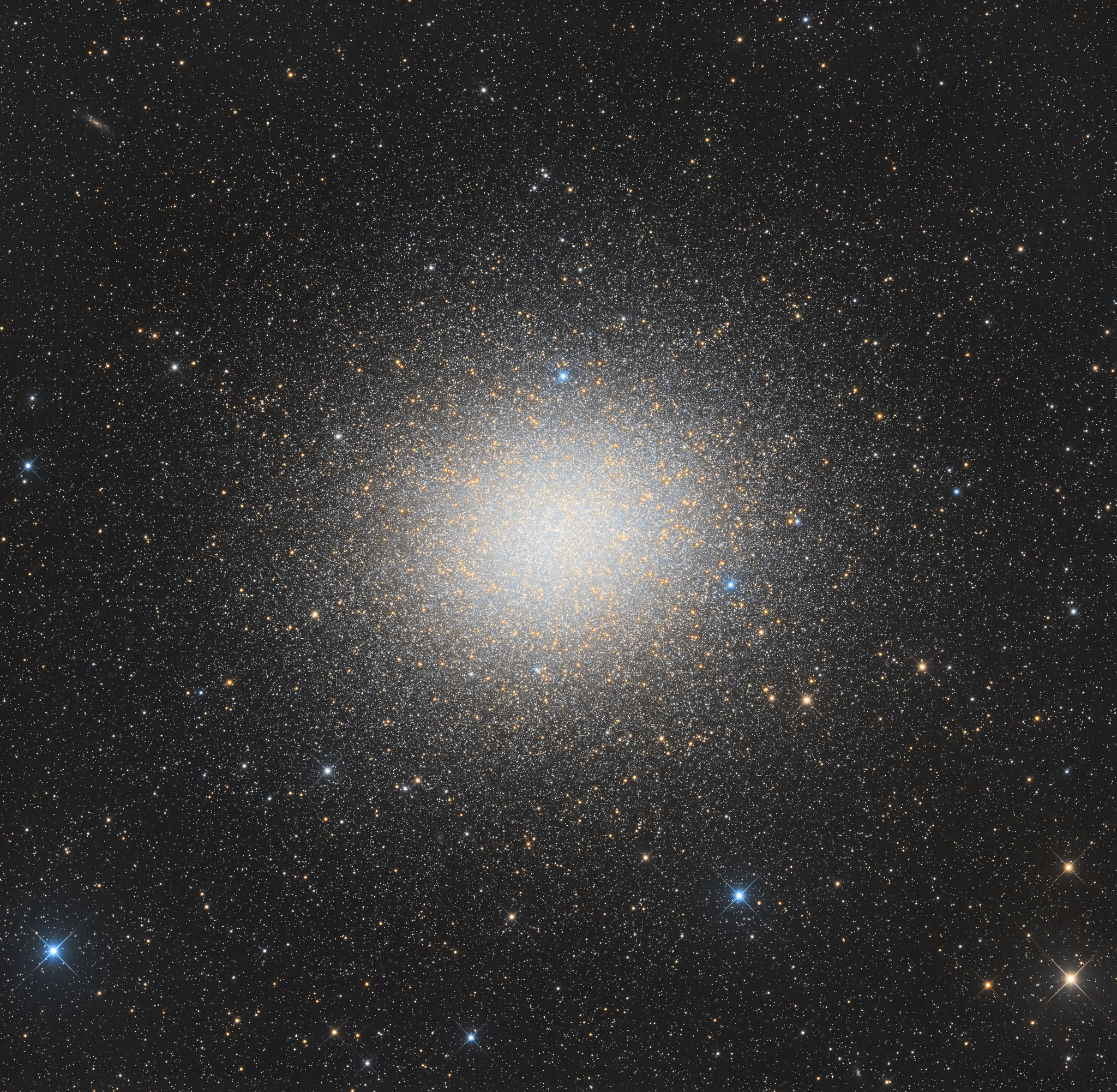
Millions of Stars in Omega Centauri
28/03/2024
Globular star cluster Omega Centauri, also known as NGC 5139, is 15,000 light-years away. The cluster is packed with about 10 million stars much older than the Sun within a volume about 150 light-years in diameter. It's the largest and brightest of 200 or so known globular clusters that roam the halo of our Milky Way galaxy. Though most star clusters consist of stars with the same age and composition, the enigmatic Omega Cen exhibits the presence of different stellar populations with a spread of ages and chemical abundances. In fact, Omega Cen may be the remnant core of a small galaxy merging with the Milky Way. With a yellowish hue, Omega Centauri's red giant stars are easy to pick out in this sharp, color telescopic view.
Copyright: Massimo Di Fusco
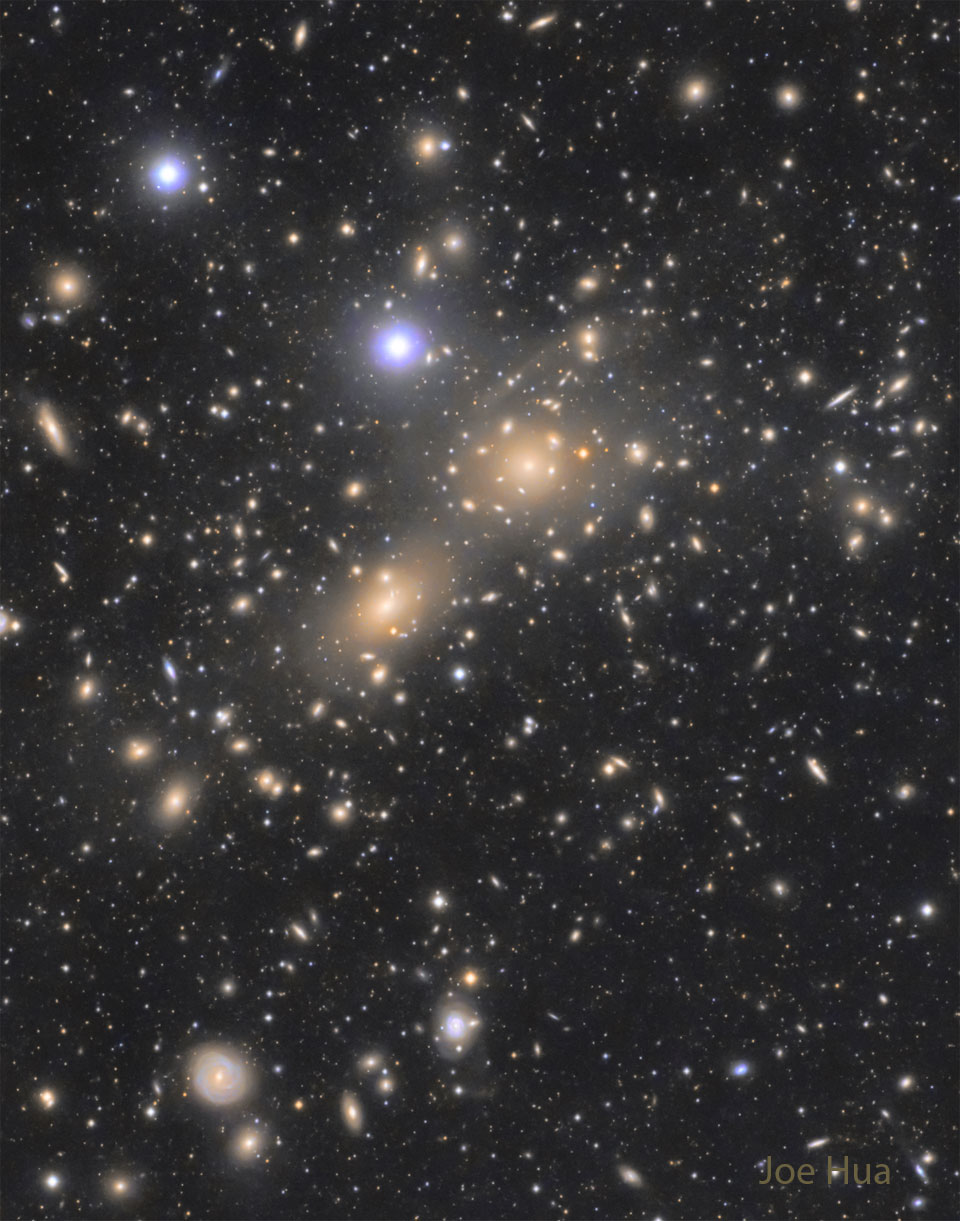
The Coma Cluster of Galaxies
27/03/2024
Almost every object in the featured photograph is a galaxy. The Coma Cluster of Galaxies pictured here is one of the densest clusters known - it contains thousands of galaxies. Each of these galaxies houses billions of stars - just as our own Milky Way Galaxy does. Although nearby when compared to most other clusters, light from the Coma Cluster still takes hundreds of millions of years to reach us. In fact, the Coma Cluster is so big it takes light millions of years just to go from one side to the other. Most galaxies in Coma and other clusters are ellipticals, while most galaxies outside of clusters are spirals. The nature of Coma's X-ray emission is still being investigated.
Copyright: Joe Hua
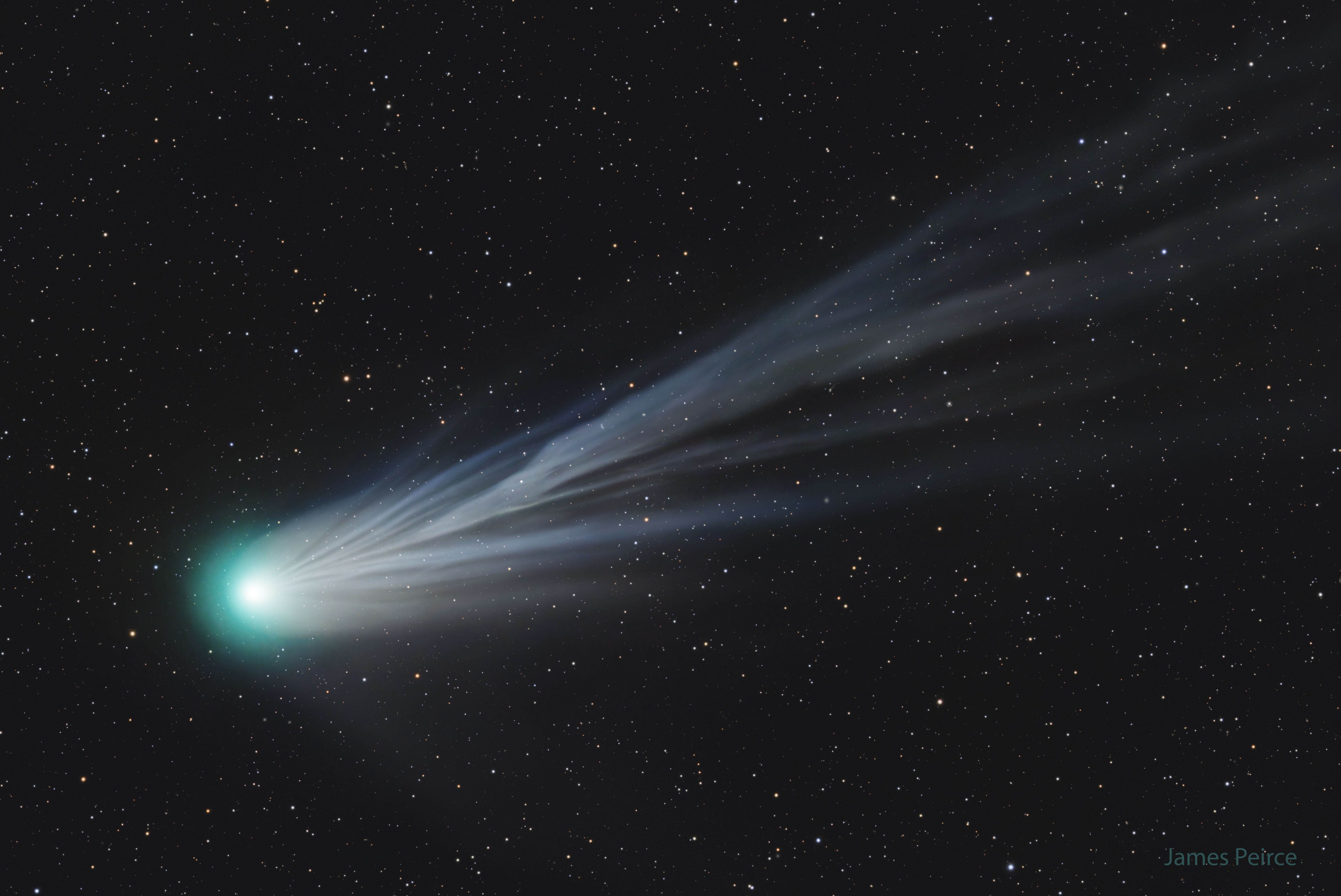
Comet Pons-Brooks' Ion Tail
26/03/2024
Comet Pons-Brooks has quite a tail to tell. First discovered in 1385, this erupting dirty snowball loops back into our inner Solar System every 71 years and, this time, is starting to put on a show for deep camera exposures. In the featured picture, the light blue stream is the ion tail which consists of charged molecules pushed away from the comet's nucleus by the solar wind. The ion tail, shaped by the Sun's wind and the comet's core's rotation, always points away from the Sun. Comet 12P/Pons–Brooks is now visible with binoculars in the early evening sky toward the northwest, moving perceptibly from night to night. The frequently flaring comet is expected to continue to brighten, on the average, and may even become visible with the unaided eye -- during the day -- to those in the path of totality of the coming solar eclipse on April 8.
Copyright: NASA
Sonified: The Jellyfish Nebula Supernova Remnant
25/03/2024
What does a supernova remnant sound like? Although sound is a compression wave in matter and does not carry into empty space, interpretive sound can help listeners appreciate and understand a visual image of a supernova remnant in a new way. Recently, the Jellyfish Nebula (IC 443) has been sonified quite creatively. In the featured sound-enhanced video, when an imaginary line passes over a star, the sound of a drop falling into water is played, a sound particularly relevant to the nebula's aquatic namesake. Additionally, when the descending line crosses gas that glows red, a low tone is played, while green sounds a middle tone, and blue produces a tone with a relatively high pitch. Light from the supernova that created the Jellyfish Nebula left approximately 35,000 years ago, when humanity was in the stone age. The nebula will slowly disperse over the next million years, although the explosion also created a dense neutron star which will remain indefinitely.
Copyright: NASA
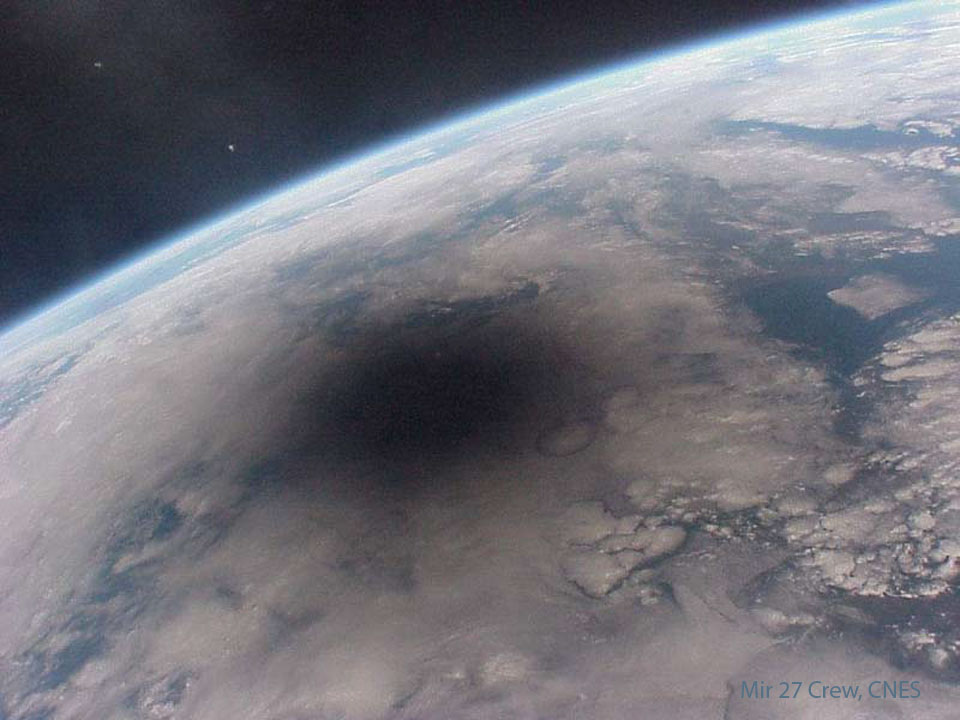
Looking Back at an Eclipsed Earth
24/03/2024
Here is what the Earth looks like during a solar eclipse. The shadow of the Moon can be seen darkening part of Earth. This shadow moved across the Earth at nearly 2000 kilometers per hour. Only observers near the center of the dark circle see a total solar eclipse - others see a partial eclipse where only part of the Sun appears blocked by the Moon. This spectacular picture of the 1999 August 11 solar eclipse was one of the last ever taken from the Mir space station. The two bright spots that appear on the upper left are thought to be Jupiter and Saturn. Mir was deorbited in a controlled re-entry in 2001. A new solar eclipse will occur over North America in about two weeks.
Copyright: CNES
Η Αστρονομική Εικόνα της Ημέρας από τη NASA (NASA Astronomy Picture of the Day) είναι μια δωρεάν υπηρεσία που παρέχει καθημερινά μια εντυπωσιακή εικόνα από το σύμπαν, την λήψη της οποίας έχει πραγματοποιήσει κάποιος από τους αστρονόμους της NASA ή από κάποιον από τους δορυφόρους ή τα τηλεσκόπια που η NASA λειτουργεί. Οι εικόνες που εμφανίζονται καλύπτουν μια ευρεία γκάμα από θέματα, συμπεριλαμβανομένων των αστερισμών, των γαλαξιών, των πλανητικών συστημάτων, των κομητών, των αστρικών σωμάτων και των παρατηρητηρίων. Κάθε εικόνα συνοδεύεται από μια σύντομη εξήγηση και πληροφορίες σχετικά με το τι παρατηρείται στην εικόνα.