Η Αστρονομική Εικόνα της Ημέρας από τη NASA
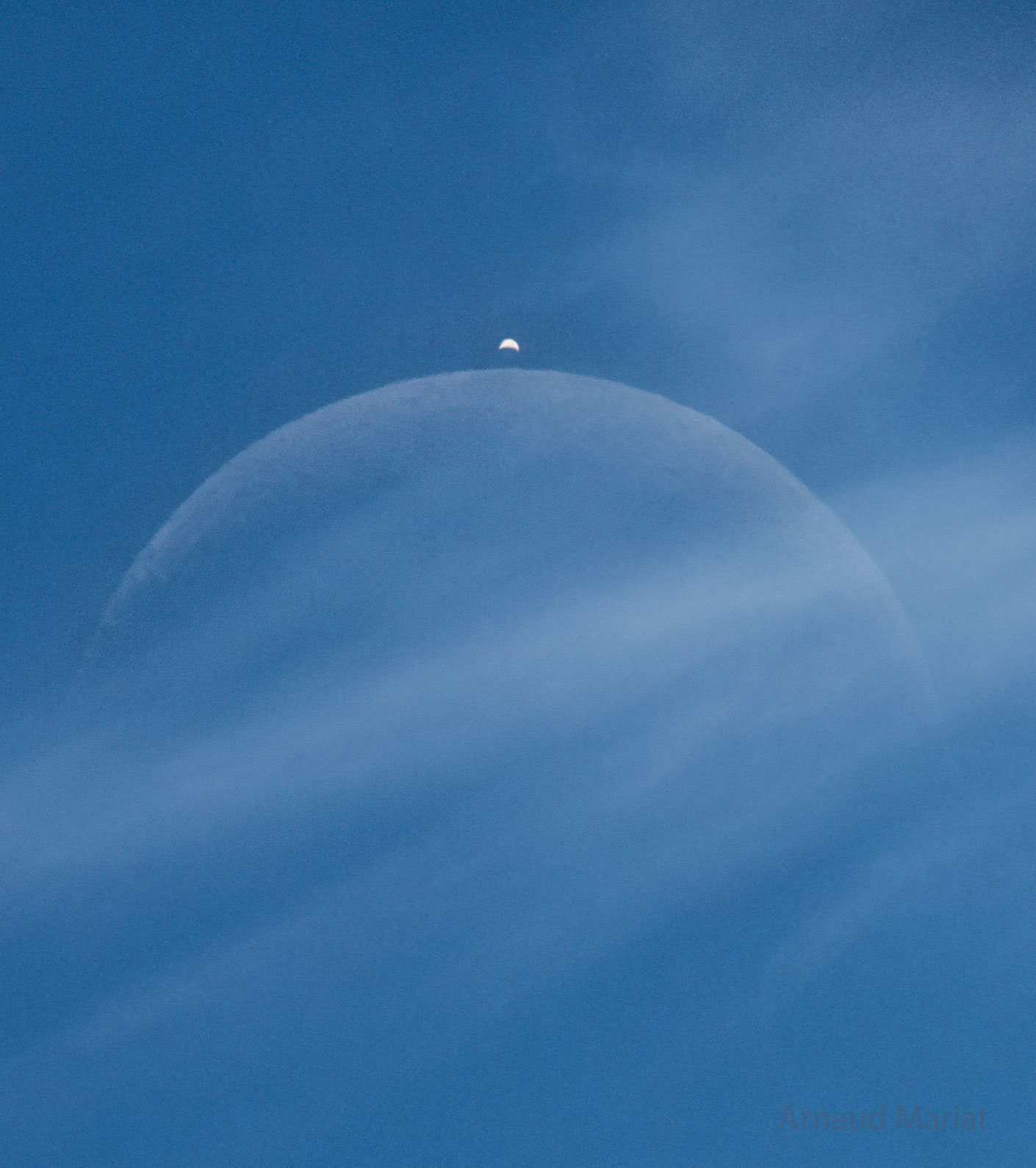
A Daytime Eclipse: Moon Occults Venus
15/09/2026
There was something behind the clouds. Upon close inspection, it was the Moon, which was hard to see yesterday around noon above the small village of Cessy, France. But soon, it was not only the Moon. As expected, a bright dot suddenly appeared from behind the Moon -- the planet Venus far in the distance. Captured in the single featured exposure, both appeared to show a crescent phase. The Moon's crescent was quite slight -- with only about 10 percent of its face illuminated by the Sun. In contrast, Venus's crescent was more full -- showing about 25 percent illumination. Venus appeared brighter because it is nearer the Sun and because its clouds are more reflective than the dark lunar surface. An occultation of Venus by the Moon is visible to only about 10 percent of the Earth, but in yesterday's event even most of that was experiencing daytime. APOD's main NASA site is moving: From apod.nasa.gov to science.nasa.gov/apod
Copyright: Arnaud Mariat
Προηγούμενες Αστρονομικές Εικόνες της Ημέρας από τη NASA
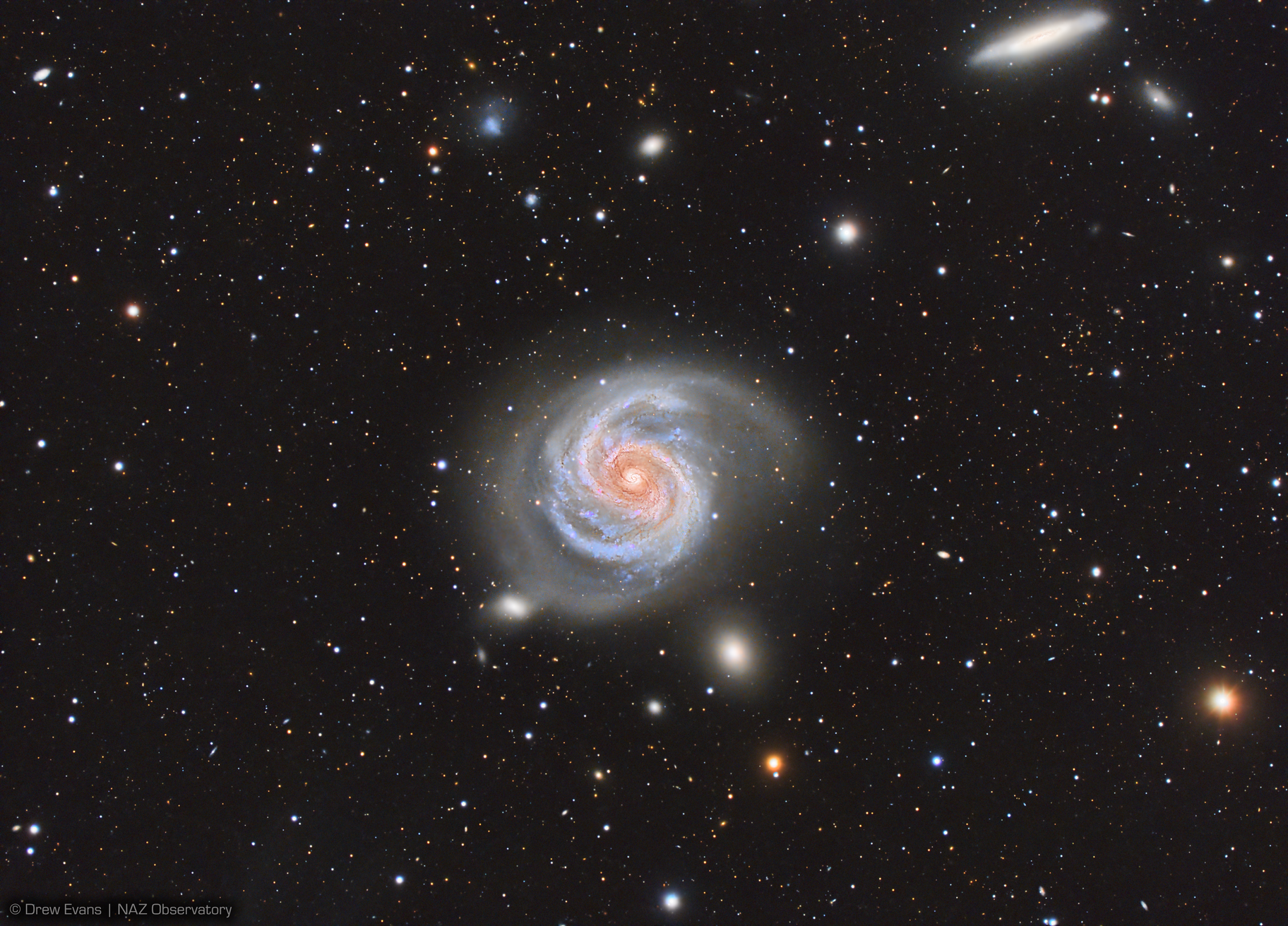
M100: A Grand Design Spiral Galaxy
02/05/2024
Majestic on a truly cosmic scale, M100 is appropriately known as a grand design spiral galaxy. The large galaxy of over 100 billion stars has well-defined spiral arms, similar to our own Milky Way. One of the brightest members of the Virgo Cluster of galaxies, M100, also known as NGC 4321 is 56 million light-years distant toward the well-groomed constellation Coma Berenices. In this telescopic image, the face-on grand design spiral shares a nearly 1 degree wide field-of-view with slightly less conspicuous edge-on spiral NGC 4312 (at upper right). The 21 hour long equivalent exposure from a dark sky site near Flagstaff, Arizona, planet Earth, reveals M100's bright blue star clusters and intricate winding dust lanes which are hallmarks of this class of galaxies. Measurements of variable stars in M100 have played an important role in determining the size and age of the Universe.
Copyright: Drew Evans
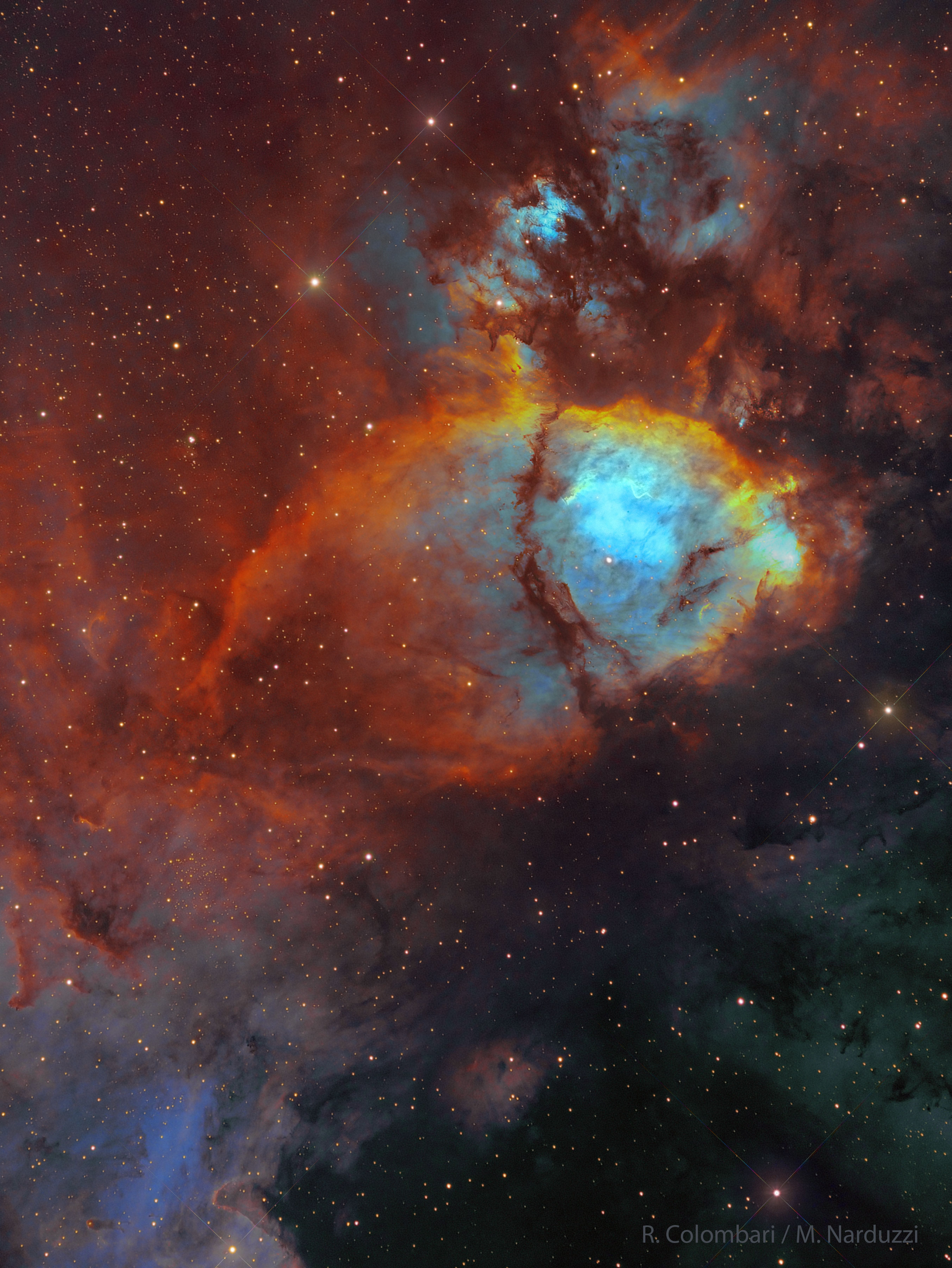
IC 1795: The Fishhead Nebula
01/05/2024
To some, this nebula looks like the head of a fish. However, this colorful cosmic portrait really features glowing gas and obscuring dust clouds in IC 1795, a star forming region in the northern constellation Cassiopeia. The nebula's colors were created by adopting the Hubble color palette for mapping narrowband emissions from oxygen, hydrogen, and sulfur atoms to blue, green and red colors, and further blending the data with images of the region recorded through broadband filters. Not far on the sky from the famous Double Star Cluster in Perseus, IC 1795 is itself located next to IC 1805, the Heart Nebula, as part of a complex of star forming regions that lie at the edge of a large molecular cloud. Located just over 6,000 light-years away, the larger star forming complex sprawls along the Perseus spiral arm of our Milky Way Galaxy. At that distance, IC 1795 would span about 70 light-years across. Open Science: Browse 3,300+ codes in the Astrophysics Source Code Library
Copyright: Roberto Colombari & Mauro Narduzzi
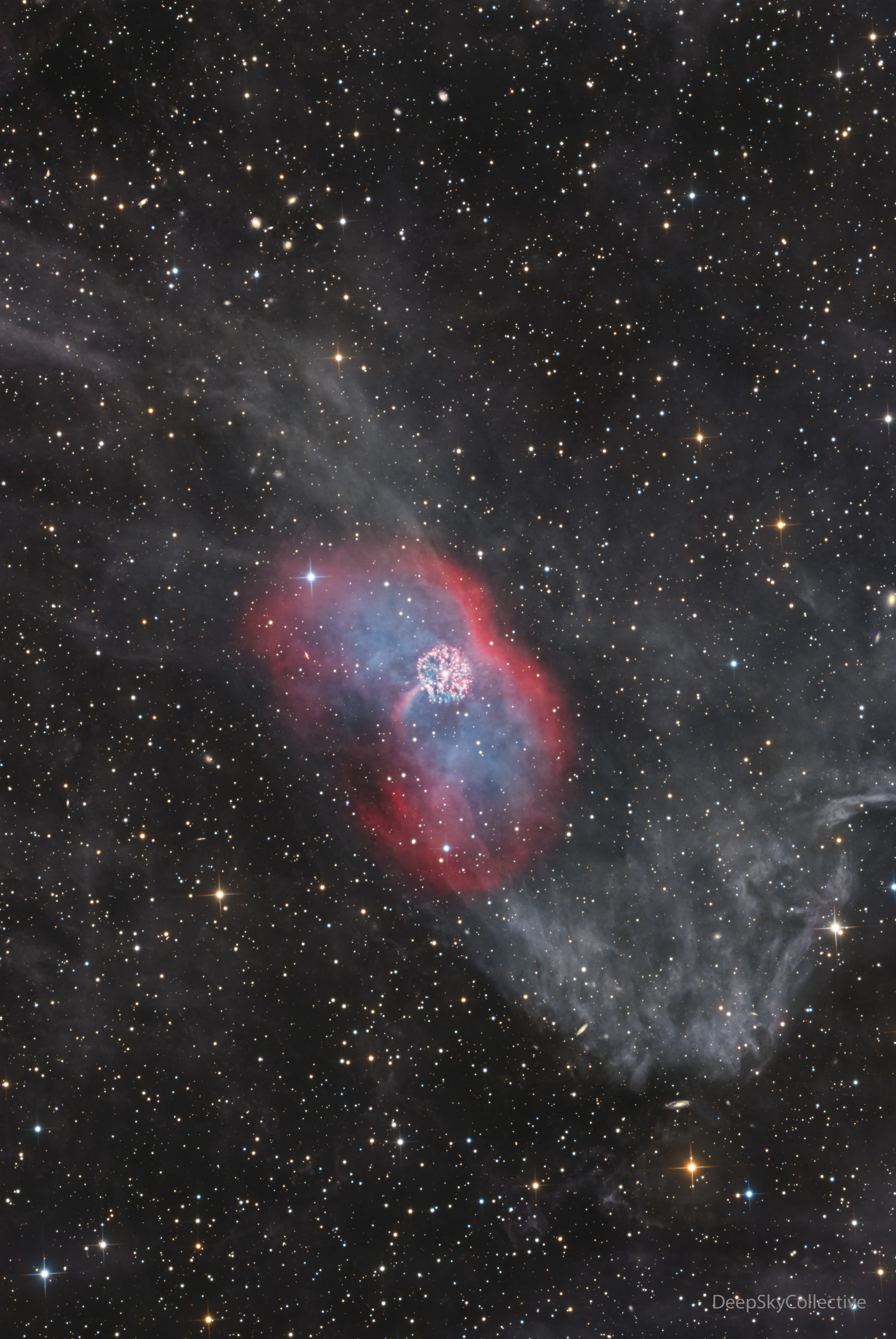
GK Per: Nova and Planetary Nebula
30/04/2024
The star system GK Per is known to be associated with only two of the three nebulas pictured. At 1500 light years distant, Nova Persei 1901 (GK Persei) was the second closest nova yet recorded. At the very center is a white dwarf star, the surviving core of a former Sun-like star. It is surrounded by the circular Firework nebula, gas that was ejected by a thermonuclear explosion on the white dwarf's surface -- a nova -- as recorded in 1901. The red glowing gas surrounding the Firework nebula is the atmosphere that used to surround the central star. This gas was expelled before the nova and appears as a diffuse planetary nebula. The faint gray gas running across is interstellar cirrus that seems to be just passing through coincidently. In 1901, GK Per's nova became brighter than Betelgeuse. Similarly, star system T CrB is expected to erupt in a nova later this year, but we don't know exactly when nor how bright it will become.
Copyright: Deep Sky Collective
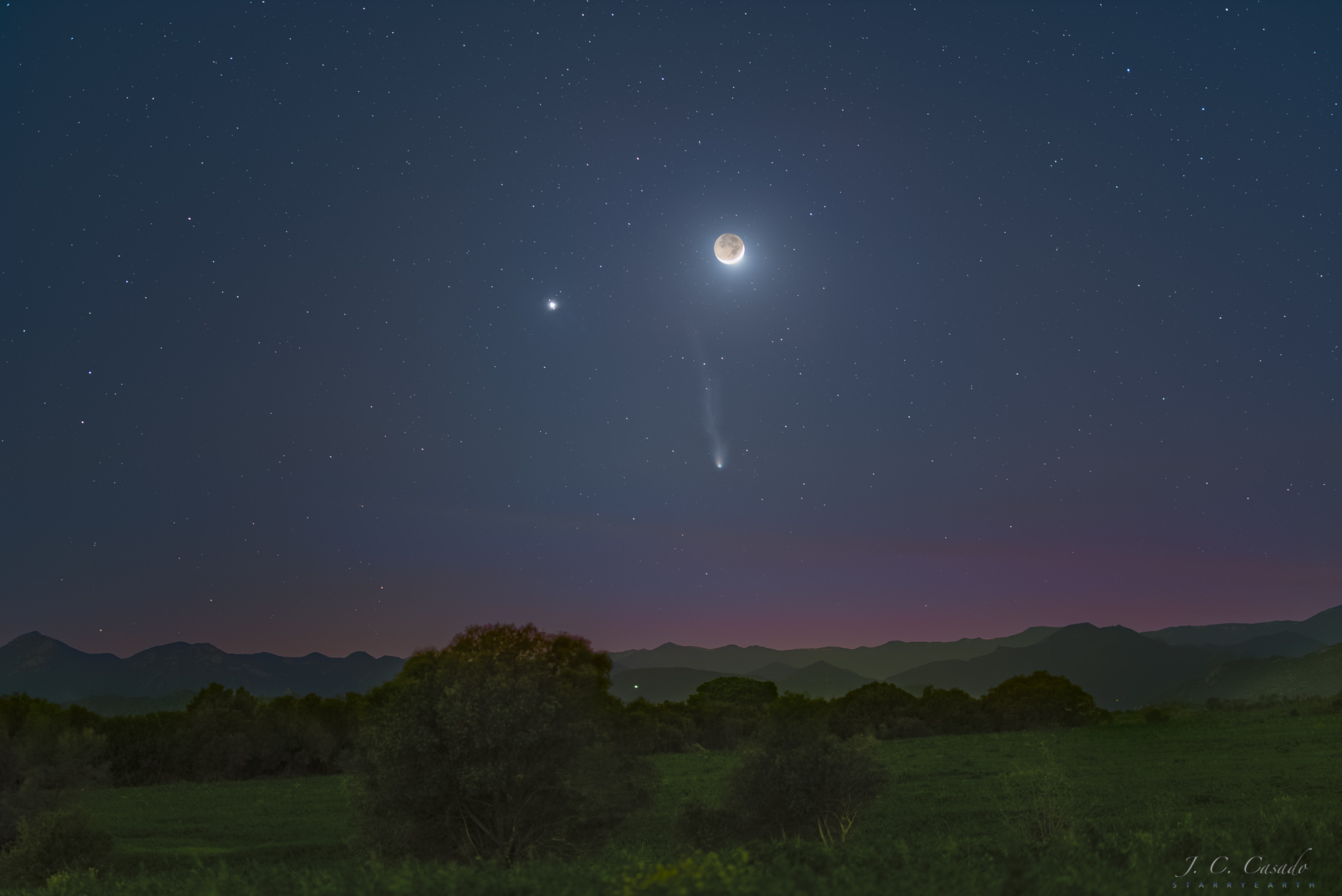
Comet, Planet, Moon
29/04/2024
Three bright objects satisfied seasoned stargazers of the western sky just after sunset earlier this month. The most familiar was the Moon, seen on the upper left in a crescent phase. The rest of the Moon was faintly visible by sunlight first reflected by the Earth. The bright planet Jupiter, the largest planet in the Solar System, is seen to the upper left. Most unusual was Comet 12P/Pons-Brooks, below the Moon and showing a stubby dust tail on the right but an impressive ion tail extending upwards. The featured image, a composite of several images taken consecutively at the same location and with the same camera, was taken near the village of Llers, in Spain's Girona province. Comet Pons-Brooks passed its closest to the Sun last week and is now dimming as it moves into southern skies and returns to the outer Solar System. Almost Hyperspace: Random APOD Generator
Copyright: Juan Carlos Casado
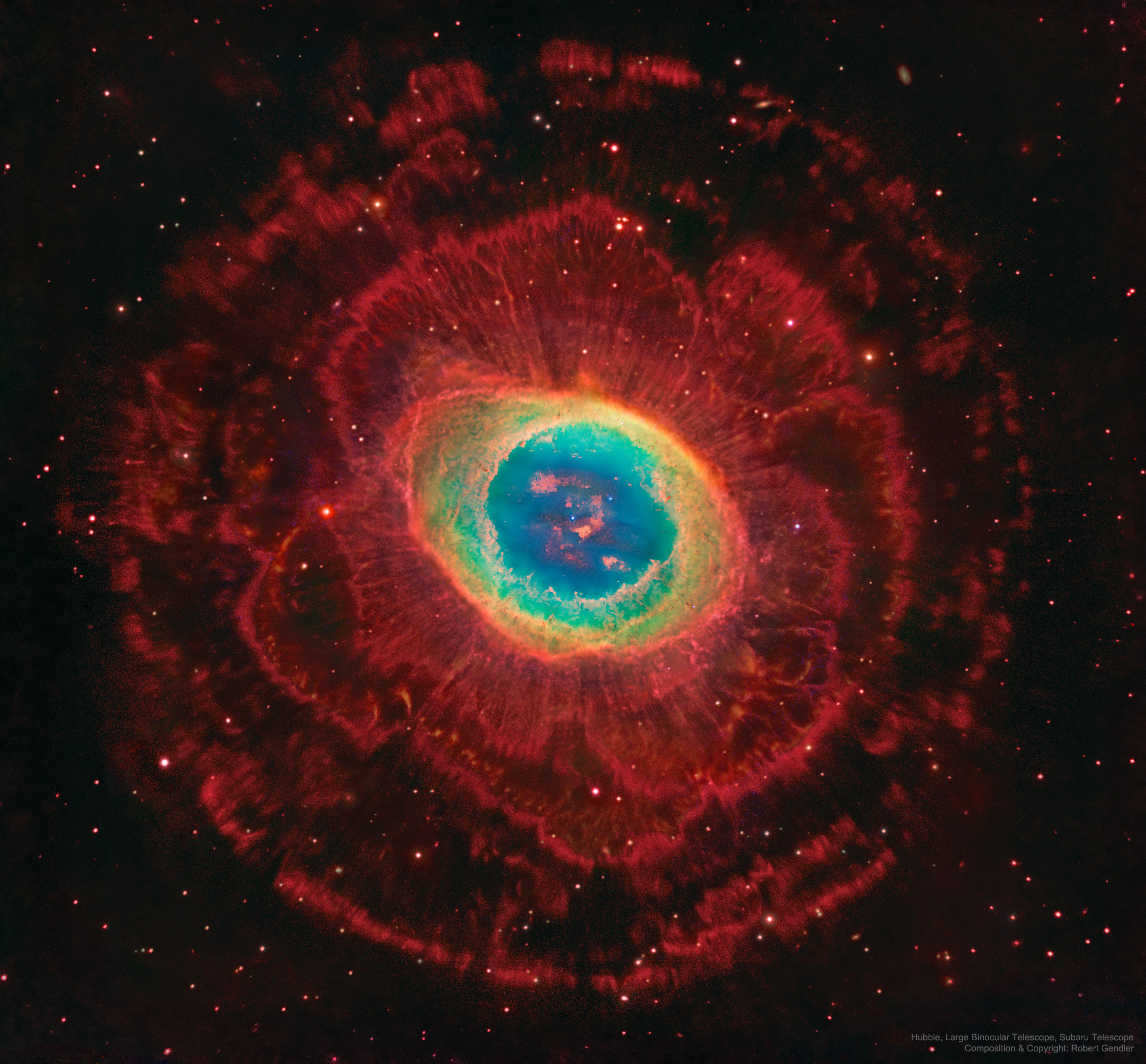
Rings Around the Ring Nebula
28/04/2024
The Ring Nebula (M57) is more complicated than it appears through a small telescope. The easily visible central ring is about one light-year across, but this remarkably deep exposure - a collaborative effort combining data from three different large telescopes - explores the looping filaments of glowing gas extending much farther from the nebula's central star. This composite image includes red light emitted by hydrogen as well as visible and infrared light. The Ring Nebula is an elongated planetary nebula, a type of nebula created when a Sun-like star evolves to throw off its outer atmosphere and become a white dwarf star. The Ring Nebula is about 2,500 light-years away toward the musical constellation Lyra. Your Sky Surprise: What picture did APOD feature on your birthday? (post 1995)
Copyright: Robert Gendler
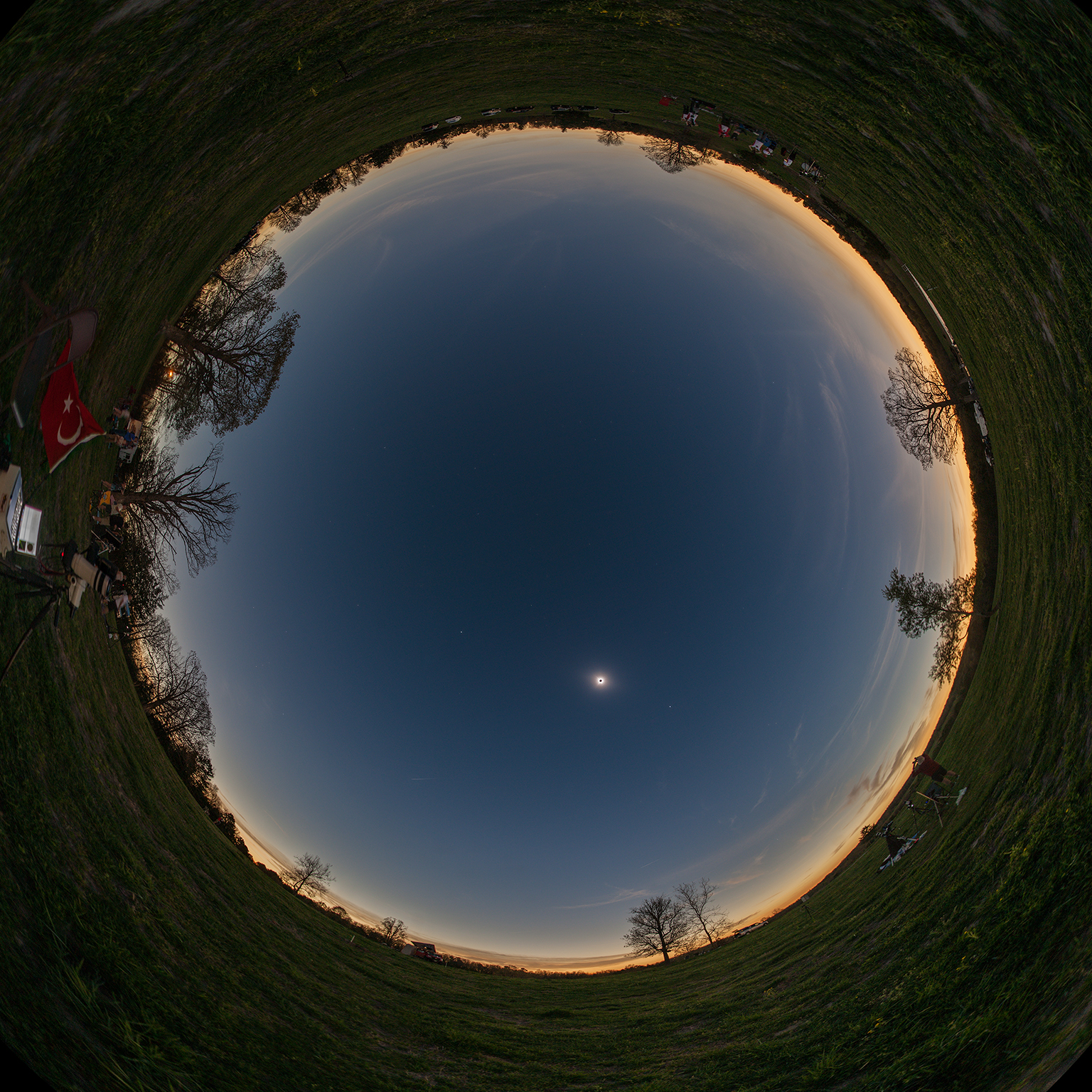
All Sky Moon Shadow
27/04/2024
If the Sun is up but the sky is dark and the horizon is bright all around, you might be standing in the Moon's shadow during a total eclipse of the Sun. In fact, the all-sky Moon shadow shown in this composited panoramic view was captured from a farm near Shirley, Arkansas, planet Earth. The exposures were made under clear skies during the April 8 total solar eclipse. For that location near the center line of the Moon's shadow track, totality lasted over 4 minutes. Along with the solar corona surrounding the silhouette of the Moon planets and stars were visible during the total eclipse phase. Easiest to see here are bright planets Venus and Jupiter, to the lower right and upper left of the eclipsed Sun.
Copyright: Tunc Tezel
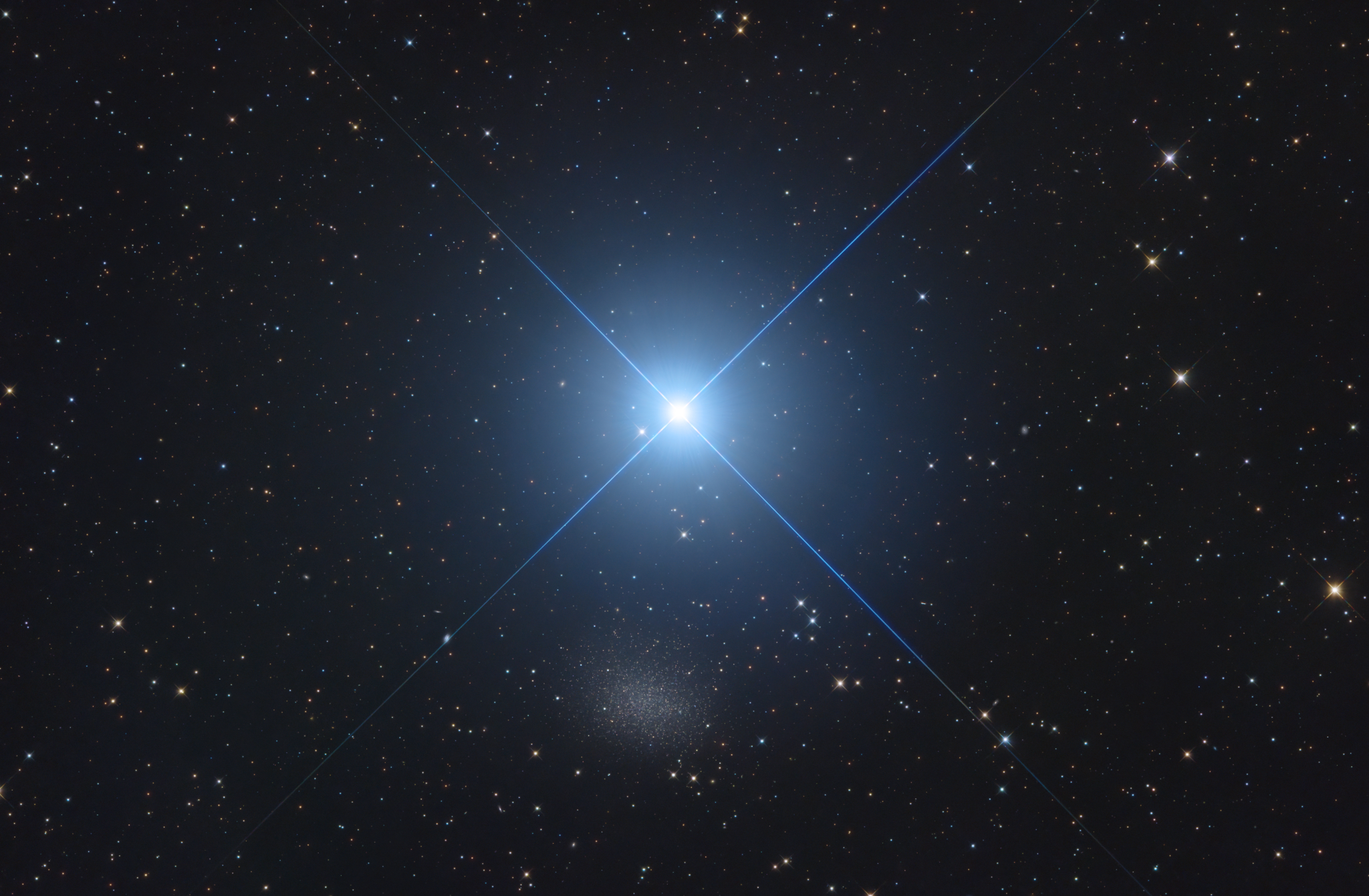
Regulus and the Dwarf Galaxy
26/04/2024
In northern hemisphere spring, bright star Regulus is easy to spot above the eastern horizon. The alpha star of the constellation Leo, Regulus is the spiky star centered in this telescopic field of view. A mere 79 light-years distant, Regulus is a hot, rapidly spinning star that is known to be part of a multiple star system. Not quite lost in the glare, the fuzzy patch just below Regulus is diffuse starlight from small galaxy Leo I. Leo I is a dwarf spheroidal galaxy, a member of the Local Group of galaxies dominated by our Milky Way Galaxy and the Andromeda Galaxy (M31). About 800 thousand light-years away, Leo I is thought to be the most distant of the known small satellite galaxies orbiting the Milky Way. But dwarf galaxy Leo I has shown evidence of a supermassive black hole at its center, comparable in mass to the black hole at the center of the Milky Way.
Copyright: Markus Horn
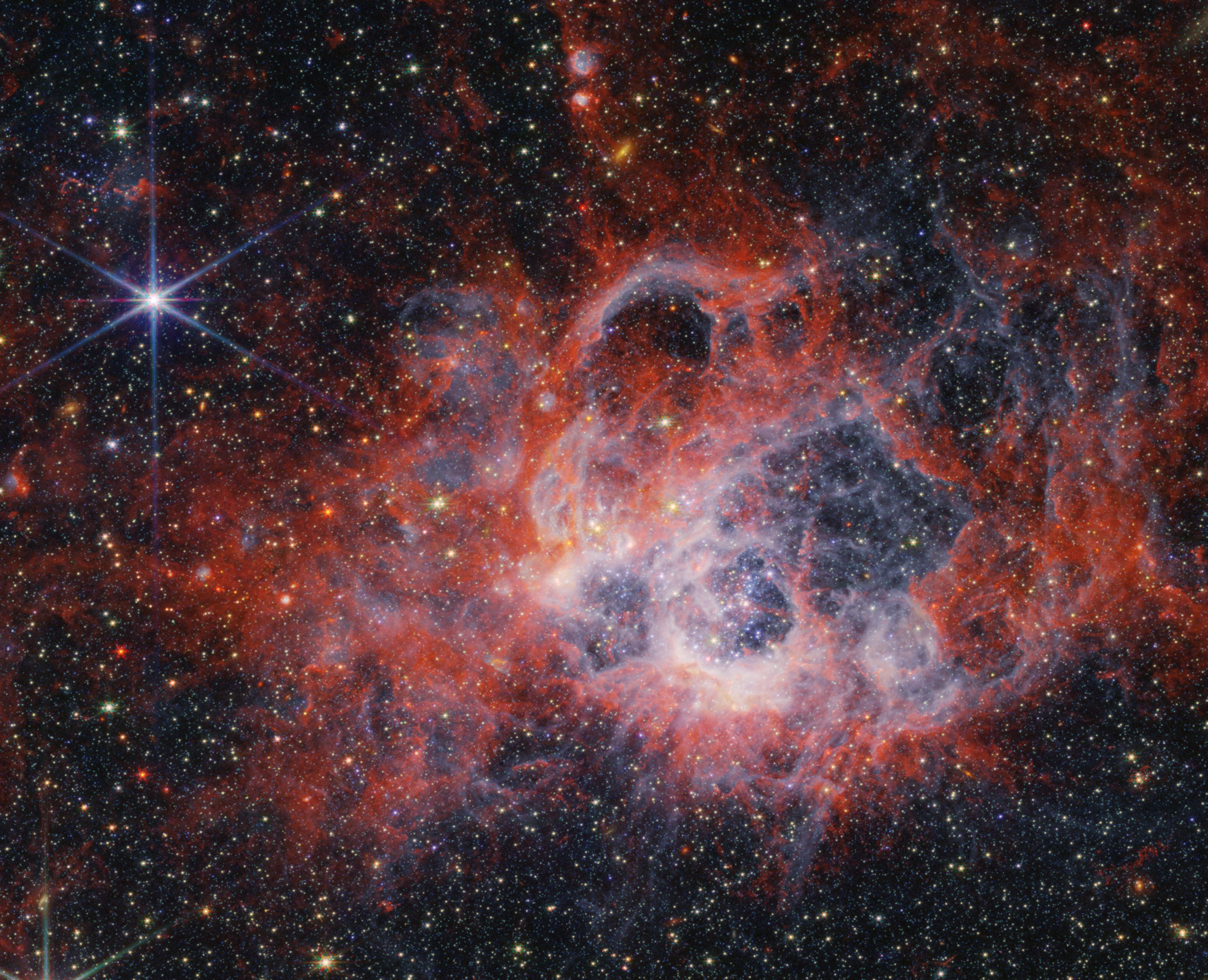
NGC 604: Giant Stellar Nursery
25/04/2024
Located some 3 million light-years away in the arms of nearby spiral galaxy M33, giant stellar nursery NGC 604 is about 1,300 light-years across. That's nearly 100 times the size of the Milky Way's Orion Nebula, the closest large star forming region to planet Earth. In fact, among the star forming regions within the Local Group of galaxies, NGC 604 is second in size only to 30 Doradus, also known as the Tarantula Nebula in the Large Magellanic Cloud. Cavernous bubbles and cavities in NGC 604 fill this stunning infrared image from the James Webb Space Telescope's NIRCam. They are carved out by energetic stellar winds from the region's more than 200 hot, massive, young stars, all still in early stages of their lives.
Copyright: NASA
Η Αστρονομική Εικόνα της Ημέρας από τη NASA (NASA Astronomy Picture of the Day) είναι μια δωρεάν υπηρεσία που παρέχει καθημερινά μια εντυπωσιακή εικόνα από το σύμπαν, την λήψη της οποίας έχει πραγματοποιήσει κάποιος από τους αστρονόμους της NASA ή από κάποιον από τους δορυφόρους ή τα τηλεσκόπια που η NASA λειτουργεί. Οι εικόνες που εμφανίζονται καλύπτουν μια ευρεία γκάμα από θέματα, συμπεριλαμβανομένων των αστερισμών, των γαλαξιών, των πλανητικών συστημάτων, των κομητών, των αστρικών σωμάτων και των παρατηρητηρίων. Κάθε εικόνα συνοδεύεται από μια σύντομη εξήγηση και πληροφορίες σχετικά με το τι παρατηρείται στην εικόνα.