Η Αστρονομική Εικόνα της Ημέρας από τη NASA
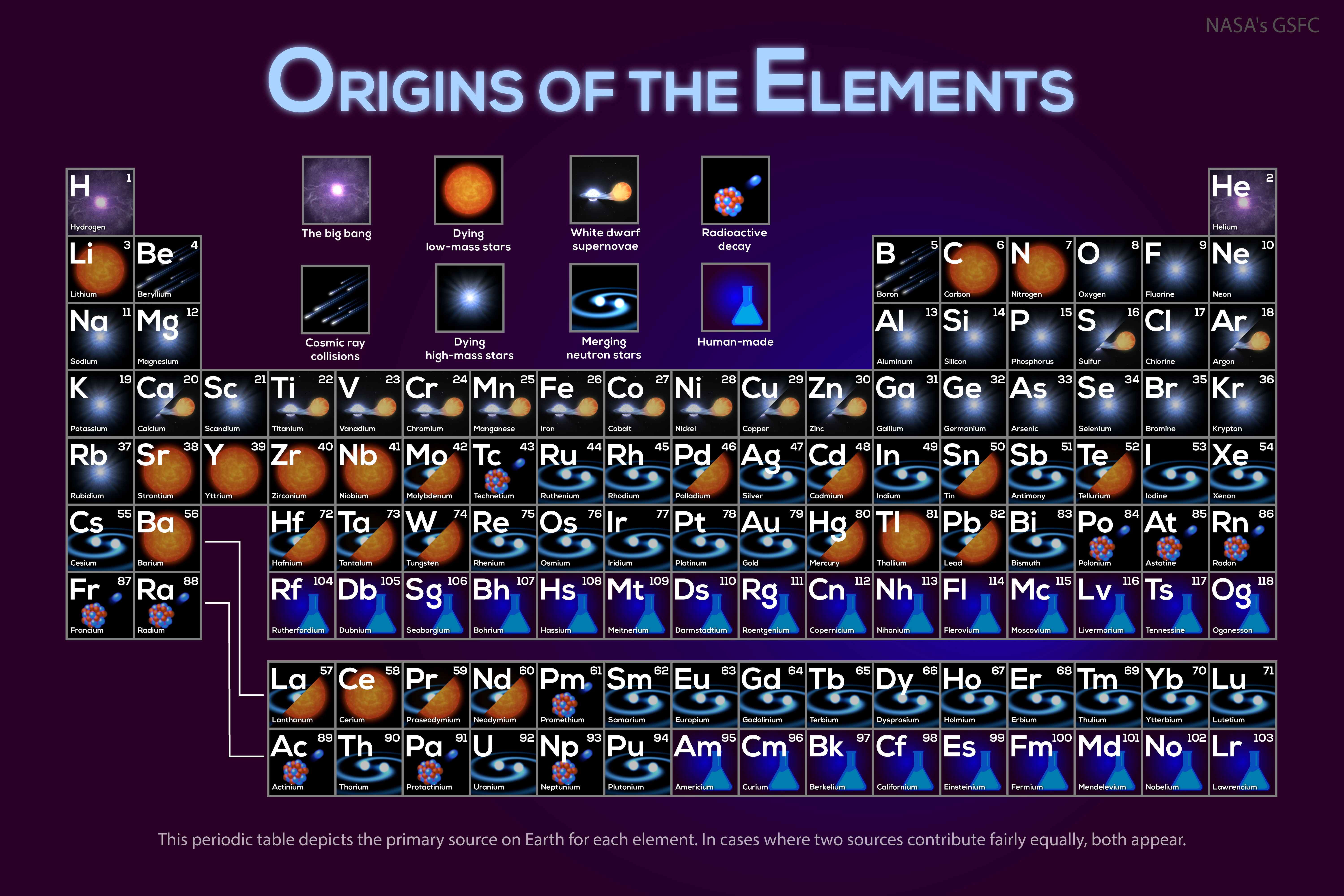
Where Your Elements Came From
14/09/2026
The hydrogen in your body and present in every molecule of water came from the Big Bang. There are no other appreciable sources of hydrogen in the universe. The carbon in your body was made by nuclear fusion in the interior of stars, as was the oxygen. Much of the iron in your body was made during supernovas of stars that occurred long ago and far away. The gold in your jewelry was likely made from neutron stars during collisions that may have been visible as short-duration gamma-ray bursts or gravitational wave events. Elements like phosphorus and copper are present in our bodies in only small amounts but are essential to the functioning of all known life. The featured periodic table is color coded to indicate humanity's best guess as to the nuclear origin of all known elements. The sites of nuclear creation of some elements, such as copper, are not really well known and are continuing topics of observational and computational research. APOD's main NASA site is moving: From apod.nasa.gov to science.nasa.gov/apod
Copyright: NASA
Προηγούμενες Αστρονομικές Εικόνες της Ημέρας από τη NASA
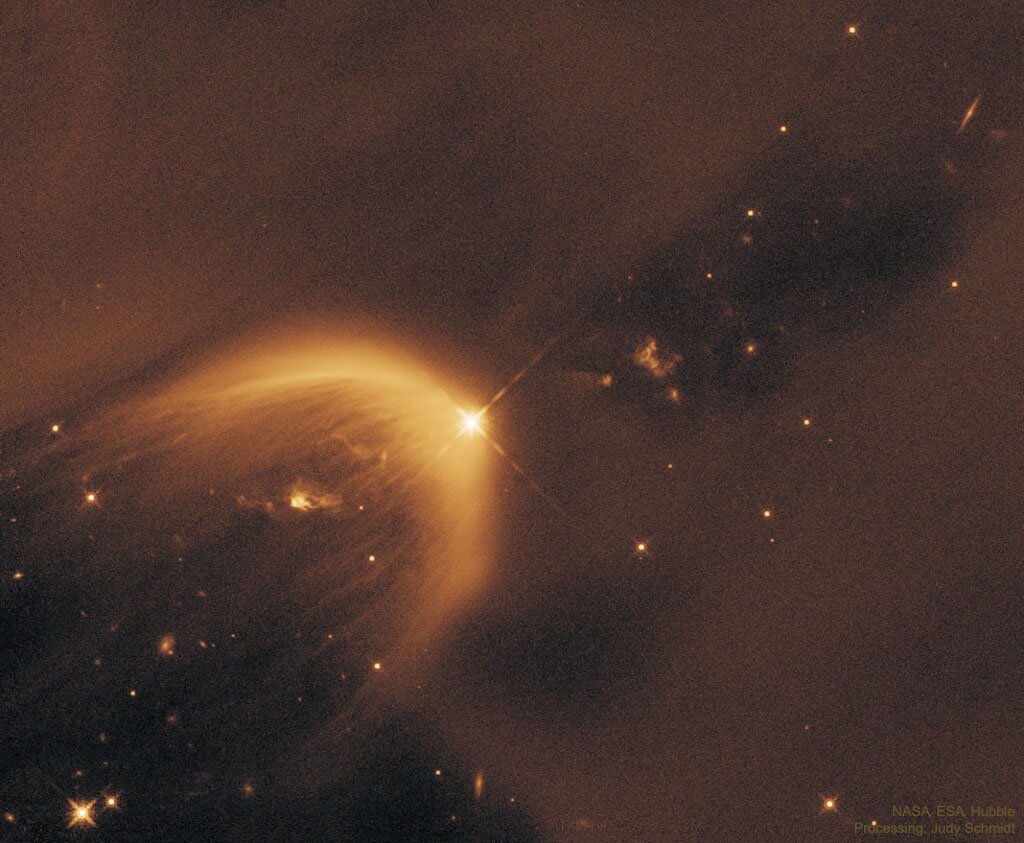
LDN 1471: A Windblown Star Cavity
17/11/2024
What is the cause of this unusual parabolic structure? This illuminated cavity, known as LDN 1471, was created by a newly forming star, seen as the bright source at the peak of the parabola. This protostar is experiencing a stellar outflow which is then interacting with the surrounding material in the Perseus Molecular Cloud, causing it to brighten. We see only one side of the cavity -- the other side is hidden by dark dust. The parabolic shape is caused by the widening of the stellar-wind blown cavity over time. Two additional structures can also be seen either side of the protostar; these are known as Herbig-Haro objects, again caused by the interaction of the outflow with the surrounding material. What causes the striations on the cavity walls, though, remains unknown. The featured image was taken by NASA and ESA’s Hubble Space Telescope after an original detection by the Spitzer Space Telescope. Explore Your Universe: Random APOD Generator
Copyright: NASA

Pluto at Night
16/11/2024
The night side of Pluto spans this shadowy scene. In the stunning spacebased perspective the Sun is 4.9 billion kilometers (almost 4.5 light-hours) behind the dim and distant world. It was captured by far flung New Horizons in July of 2015 when the spacecraft was at a range of some 21,000 kilometers from Pluto, about 19 minutes after its closest approach. A denizen of the Kuiper Belt in dramatic silhouette, the image also reveals Pluto's tenuous, surprisingly complex layers of hazy atmosphere. Near the top of the frame the crescent twilight landscape includes southern areas of nitrogen ice plains now formally known as Sputnik Planitia and rugged mountains of water-ice in the Norgay Montes.
Copyright: NASA

Apollo 12 and Surveyor 3
15/11/2024
Put on your red/blue glasses and gaze across the western Ocean of Storms on the surface of the Moon. The 3D anaglyph features Apollo 12 astronaut Pete Conrad visiting the Surveyor 3 spacecraft in November of 1969. Surveyor 3 had landed at the site on the inside slope of a small crater about 2 1/2 years earlier in April of 1967. Visible on the horizon beyond the far crater wall, Apollo 12's Lunar Module Intrepid touched down less than 200 meters (650 feet) away, easy moonwalking distance from the robotic Surveyor spacecraft. This stereo image was carefully created from two separate pictures (AS12-48-7133, AS12-48-7134) captured on the lunar surface. They depict the scene from only slightly different viewpoints, approximating the separation between human eyes.
Copyright: NASA

IC 348 and Barnard 3
14/11/2024
A great nebulous region near bright star omicron Persei offers this study in cosmic contrasts. Captured in the telescopic frame the colorful complex of dust, gas, and stars spans about 3 degrees on the sky along the edge of the Perseus molecular cloud some 1000 light-years away. Surrounded by a bluish halo of dust reflected starlight, omicron Persei itself is just left of center. Immediately below it lies the intriguing young star cluster IC 348 recently explored by the James Webb Space Telescope. In silhouette against the diffuse reddish glow of hydrogen gas, dark and obscuring interstellar dust cloud Barnard 3 is at upper right. Of course the cosmic dust also tends to hide newly formed stars and young stellar objects or protostars from prying optical telescopes. At the Perseus molecular cloud's estimated distance, this field of view would span about 50 light-years.
Copyright: Ashraf Abu Sara

Barred Spiral Galaxy NGC 1365 from Webb
13/11/2024
A mere 56 million light-years distant toward the southern constellation Fornax, NGC 1365 is an enormous barred spiral galaxy about 200,000 light-years in diameter. That's twice the size of our own barred spiral Milky Way. This sharp image from the James Webb Space Telescope's Mid-Infrared Instrument (MIRI) reveals stunning details of this magnificent spiral in infrared light. Webb's field of view stretches about 60,000 light-years across NGC 1365, exploring the galaxy's core and bright newborn star clusters. The intricate network of dusty filaments and bubbles is created by young stars along spiral arms winding from the galaxy's central bar. Astronomers suspect the gravity field of NGC 1365's bar plays a crucial role in the galaxy's evolution, funneling gas and dust into a star-forming maelstrom and ultimately feeding material into the active galaxy's central, supermassive black hole.
Copyright: NASA
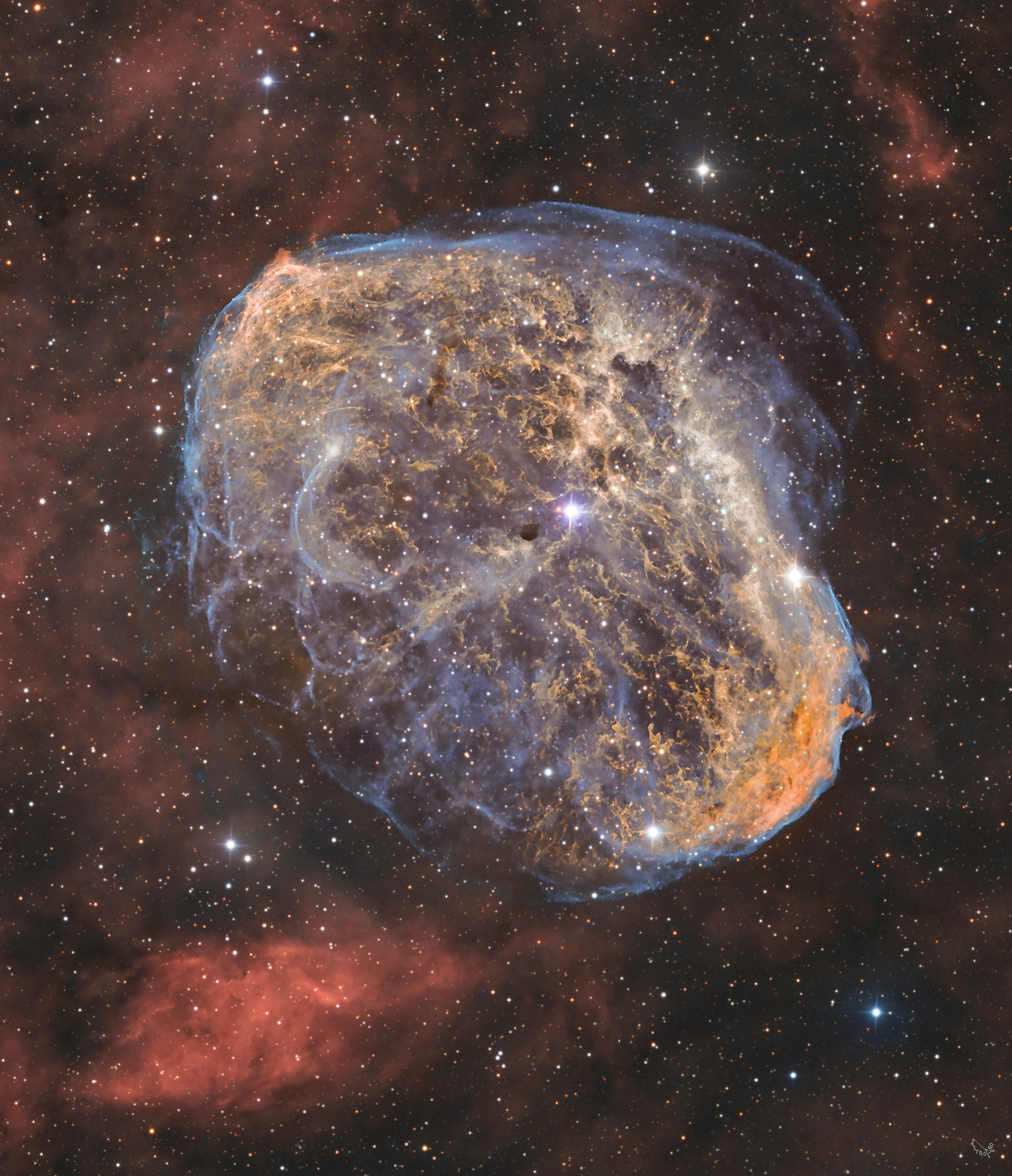
NGC 6888: The Crescent Nebula
12/11/2024
How was the Crescent Nebula created? Looking like an emerging space cocoon, the Crescent Nebula, visible in the center of the featured image, was created by the brightest star in its center. A leading progenitor hypothesis has the Crescent Nebula beginning to form about 250,000 years ago. At that time, the massive central star had evolved to become a Wolf-Rayet star (WR 136), shedding its outer envelope in a strong stellar wind, ejecting the equivalent of our Sun's mass every 10,000 years. This wind impacted surrounding gas left over from a previous phase, compacting it into a series of complex shells, and lighting it up. The Crescent Nebula, also known as NGC 6888, lies about 4,700 light-years away in the constellation of Cygnus. Star WR 136 will probably undergo a supernova explosion sometime in the next million years. Jigsaw Challenge: Astronomy Puzzle of the Day
Copyright: Team ARO
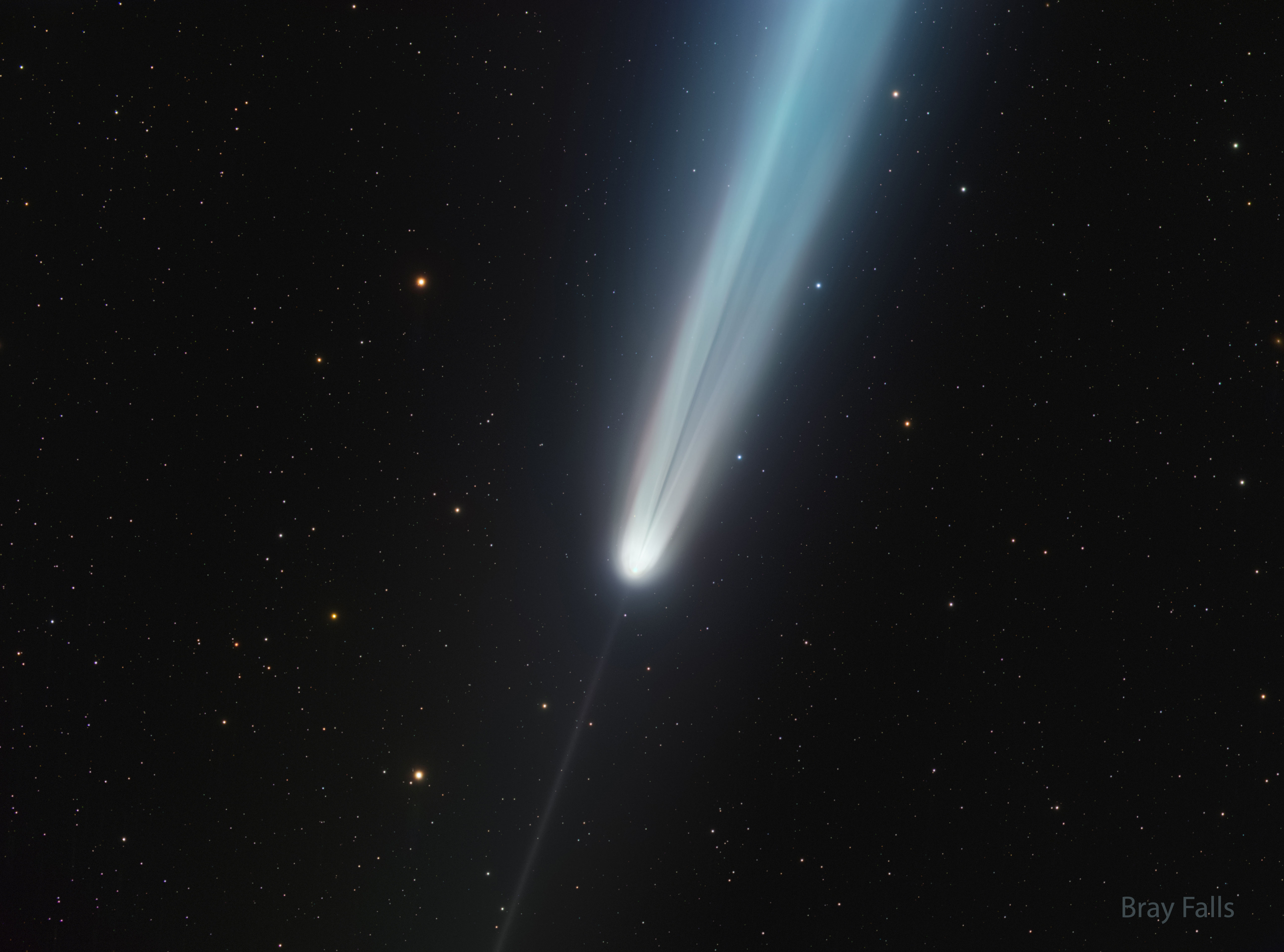
The Unusual Tails of Comet Tsuchinshan-Atlas
11/11/2024
What created an unusual dark streak in Comet Tsuchinshan-Atlas's tail? Some images of the bright comet during mid-October not only caught its impressively long tail and its thin anti-tail, but a rather unexpected feature: a dark streak in the long tail. The reason for the dark streak is currently unclear and a topic of some debate. Possible reasons include a plume of dark dust, different parts of the bright tail being unusually superposed, and a shadow of a dense part of the coma on smaller dust particles. The streak is visible in the featured image taken on October 14 from Texas, USA. To help future analyses, if you have taken a good image of the comet that clearly shows this dark streak, please send it in to APOD. Comet Tsuchinshan–ATLAS has now faded considerably and is returning to the outer Solar System. Gallery: Comet Tsuchinshan-ATLAS in 2024
Copyright: Bray Falls
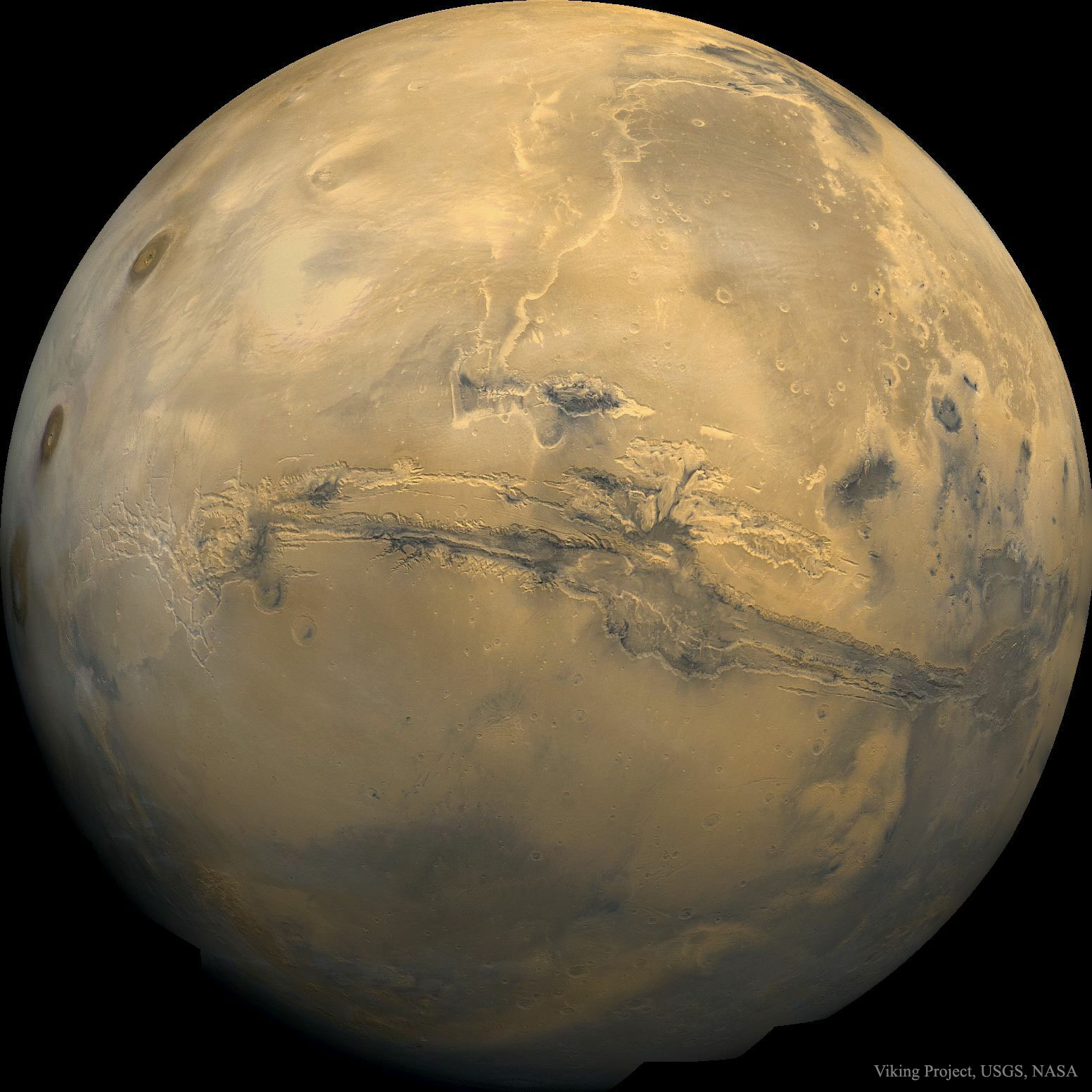
Valles Marineris: The Grand Canyon of Mars
10/11/2024
The largest canyon in the Solar System cuts a wide swath across the face of Mars. Named Valles Marineris, the grand valley extends over 3,000 kilometers long, spans as much as 600 kilometers across, and delves as much as 8 kilometers deep. By comparison, the Earth's Grand Canyon in Arizona, USA is 800 kilometers long, 30 kilometers across, and 1.8 kilometers deep. The origin of the Valles Marineris remains unknown, although a leading hypothesis holds that it started as a crack billions of years ago as the planet cooled. Several geologic processes have been identified in the canyon. The featured mosaic was created from over 100 images of Mars taken by Viking Orbiters in the 1970s.
Copyright: NASA
Η Αστρονομική Εικόνα της Ημέρας από τη NASA (NASA Astronomy Picture of the Day) είναι μια δωρεάν υπηρεσία που παρέχει καθημερινά μια εντυπωσιακή εικόνα από το σύμπαν, την λήψη της οποίας έχει πραγματοποιήσει κάποιος από τους αστρονόμους της NASA ή από κάποιον από τους δορυφόρους ή τα τηλεσκόπια που η NASA λειτουργεί. Οι εικόνες που εμφανίζονται καλύπτουν μια ευρεία γκάμα από θέματα, συμπεριλαμβανομένων των αστερισμών, των γαλαξιών, των πλανητικών συστημάτων, των κομητών, των αστρικών σωμάτων και των παρατηρητηρίων. Κάθε εικόνα συνοδεύεται από μια σύντομη εξήγηση και πληροφορίες σχετικά με το τι παρατηρείται στην εικόνα.