Η Αστρονομική Εικόνα της Ημέρας από τη NASA
Where Your Elements Came From
14/09/2026
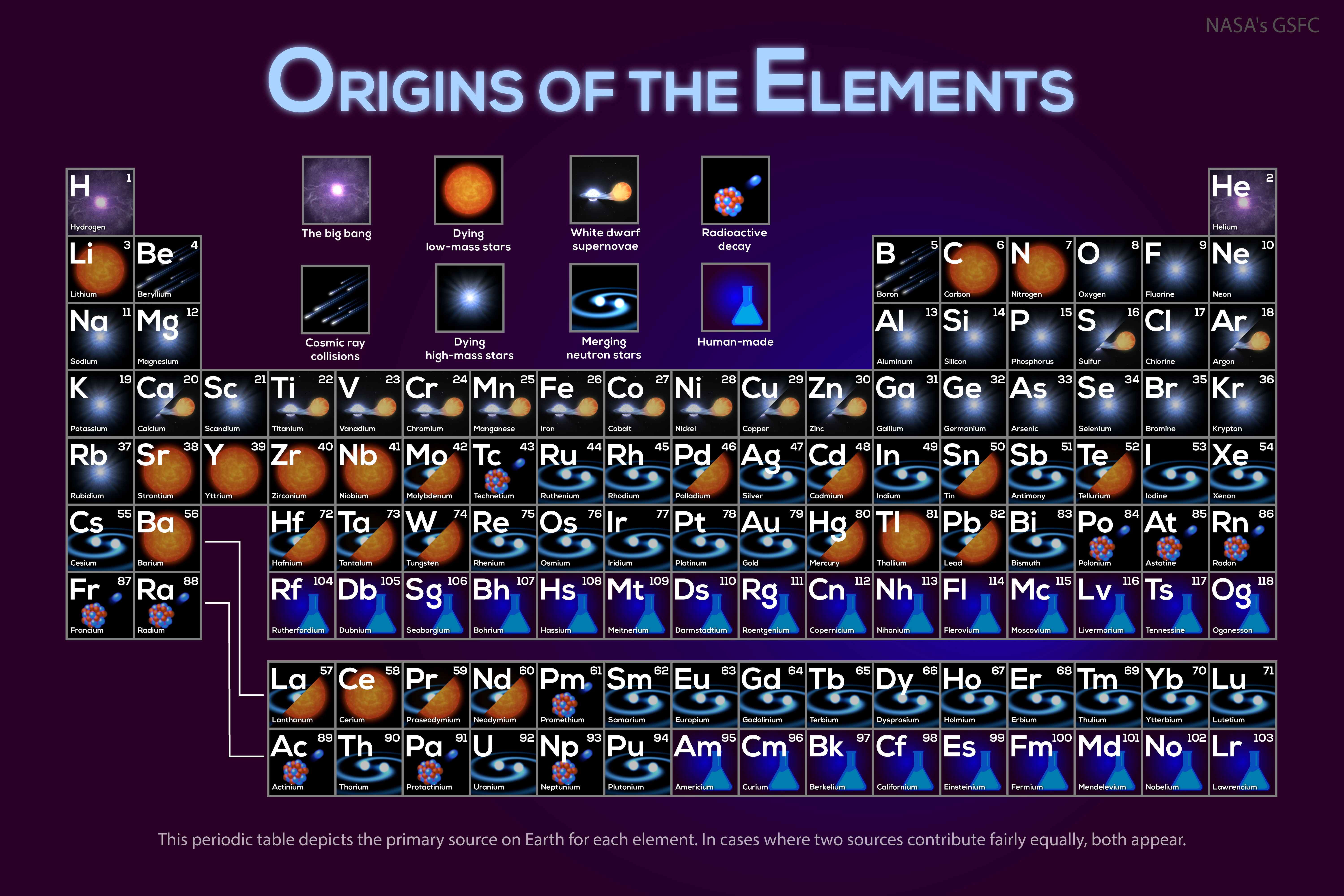
The hydrogen in your body and present in every molecule of water came from the Big Bang. There are no other appreciable sources of hydrogen in the universe. The carbon in your body was made by nuclear fusion in the interior of stars, as was the oxygen. Much of the iron in your body was made during supernovas of stars that occurred long ago and far away. The gold in your jewelry was likely made from neutron stars during collisions that may have been visible as short-duration gamma-ray bursts or gravitational wave events. Elements like phosphorus and copper are present in our bodies in only small amounts but are essential to the functioning of all known life. The featured periodic table is color coded to indicate humanity's best guess as to the nuclear origin of all known elements. The sites of nuclear creation of some elements, such as copper, are not really well known and are continuing topics of observational and computational research. APOD's main NASA site is moving: From apod.nasa.gov to science.nasa.gov/apod
Copyright: NASA
Προηγούμενες Αστρονομικές Εικόνες της Ημέρας από τη NASA

Afterimage Sunset
31/05/2025
On May 7, the Sun setting behind a church bell tower was captured in this filtered and manipulated digital skyscape from Ragusa, Sicily, planet Earth. In this version of the image the colors look bizarre. Still, an intriguing optical illusion known as an afterimage can help you experience the same scene with a more natural looking appearance. To try it, find the sunspots of active region AR4079 grouped near the bottom of the blue solar disk. Relax and stare at the dark sunspot group for about 30 seconds, then close your eyes or shift your gaze to a plain white surface. In a moment an afterimage of the sunset should faintly appear. But the afterimage sunset will have this image's complementary colors and a more normal yellow Sun against a familiar blue sky.
Copyright: Marcella Giulia Pace

Mars in the Loop
30/05/2025
This composite of images spaced a weather-permitting 5 to 9 days apart, from 2024 September 19 (top right) through 2025 May 18 (bottom left), faithfully traces ruddy-colored Mars as it makes a clockwise loop through the constellations Gemini and Cancer in planet Earth's night sky. You can connect the dots and dates with your cursor over the image, but be sure to check out this animation of the Red Planet's 2024/25 retrograde motion. Of course Mars didn't actually reverse the direction of its orbit. Instead, the apparent backwards motion with respect to the background stars is a reflection of the orbital motion of Earth itself. Retrograde motion can be seen each time Earth overtakes and laps planets orbiting farther from the Sun, the Earth moving more rapidly through its own relatively close-in orbit. In this case Mars' apparent eastward motion began to reverse around December 8, when it seemed to linger near open star cluster M44 in Cancer. After wandering back to the west, under Gemini's bright stars Castor and Pollux, Mars returned to pose near M44 by early May. At its brightest near opposition on 2025 January 16, Mars was a mere 96 million kilometers away.
Copyright: Tunc Tezel

International Space Station Crosses the Sun
21/05/2025
Typically, the International Space Station is visible only at night. Slowly drifting across the night sky as it orbits the Earth, the International Space Station (ISS) can be seen as a bright spot about once a month from many locations. The ISS is then visible only just after sunset or just before sunrise because it shines by reflected sunlight -- once the ISS enters the Earth's shadow, it will drop out of sight. The only occasion when the ISS is visible during the day is when it passes right in front of the Sun. Then, it passes so quickly that only cameras taking short exposures can visually freeze the ISS's silhouette onto the background Sun. The featured picture did exactly that -- it is actually a series of images taken a month ago from Sant Feliu de Buixalleu, Spain with perfect timing. This image series was later combined with a separate image highlighting the texture of the active Sun which included several Sun's prominences around the edge. Celestial Surprise: What picture did APOD feature on your birthday? (post 1995)
Copyright: Pau Montplet Sanz
Milky Way over Maunakea
20/05/2025
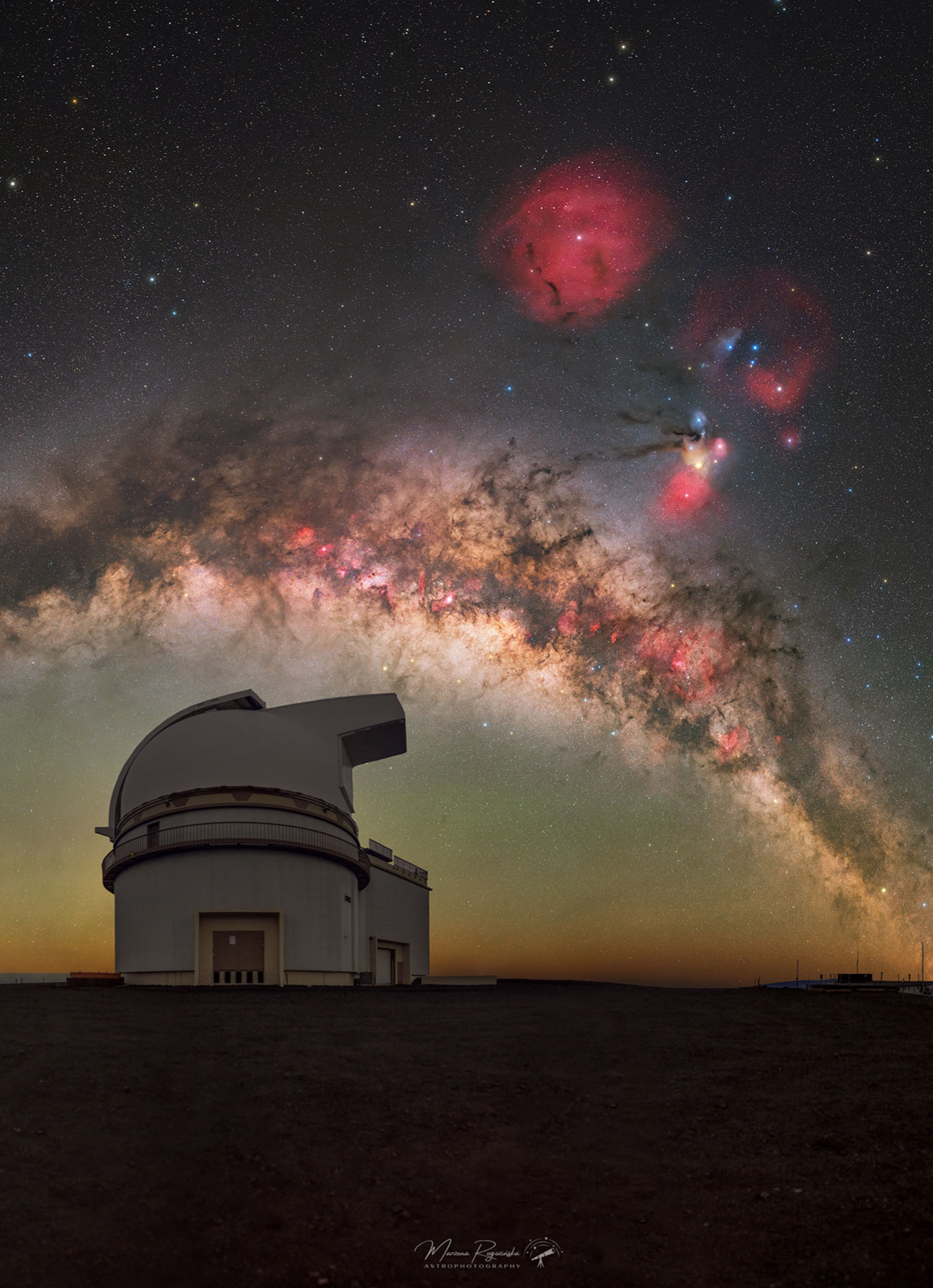
Have you ever seen the band of our Milky Way Galaxy? In a clear sky from a dark location at the right time, a faint band of light becomes visible across the sky. Soon after your eyes become dark adapted, you might spot the band for the first time. It may then become obvious. Then spectacular. One reason for your growing astonishment might be the realization that this fuzzy swath, the Milky Way, contains billions of stars. Visible in the featured image, high above in the night sky, the band of the Milky Way Galaxy arcs. Also visible are the colorful clouds of Rho Ophiuchi on the right, and the red and circular Zeta Ophiuchi nebula near the top center. Taken in late February from Maunakea, Hawaii, USA, the foreground telescope is the University of Hawaii's 2.2-Meter Telescope. Fortunately, you don’t need to be near the top of a Hawaiian volcano to see the Milky Way. Put it All Together: Astronomy Puzzle of the Day
Copyright: Marzena Rogozinska

Ares 3 Landing Site: The Martian Revisited
17/05/2025
This close-up from the Mars Reconnaissance Orbiter's HiRISE camera shows weathered craters and windblown deposits in southern Acidalia Planitia. A striking shade of blue in standard HiRISE image colors, to the human eye the area would probably look grey or a little reddish. But human eyes have not gazed across this terrain, unless you count the eyes of NASA astronauts in the sci-fi novel, "The Martian," by Andy Weir. The novel chronicles the adventures of Mark Watney, an astronaut stranded at the fictional Mars mission Ares 3 landing site, corresponding to the coordinates of this cropped HiRISE frame. For scale, Watney's 6-meter-diameter habitat at the site would be about 1/10th the diameter of the large crater. Of course, the Ares 3 landing coordinates are only about 800 kilometers north of the (real life) Carl Sagan Memorial Station, the 1997 Pathfinder landing site.
Copyright: NASA

Messier 101
16/05/2025
Big, beautiful spiral galaxy M101 is one of the last entries in Charles Messier's famous catalog, but definitely not one of the least. About 170,000 light-years across, this galaxy is enormous, almost twice the size of our own Milky Way. M101 was also one of the original spiral nebulae observed by Lord Rosse's large 19th century telescope, the Leviathan of Parsontown. Assembled from 51 exposures recorded by the Hubble Space Telescope in the 20th and 21st centuries, with additional data from ground based telescopes, this mosaic spans about 40,000 light-years across the central region of M101 in one of the highest definition spiral galaxy portraits ever released from Hubble. The sharp image shows stunning features of the galaxy's face-on disk of stars and dust along with background galaxies, some visible right through M101 itself. Also known as the Pinwheel Galaxy, M101 lies within the boundaries of the northern constellation Ursa Major, about 25 million light-years away.
Copyright: NASA
A Plutonian Landscape
15/05/2025
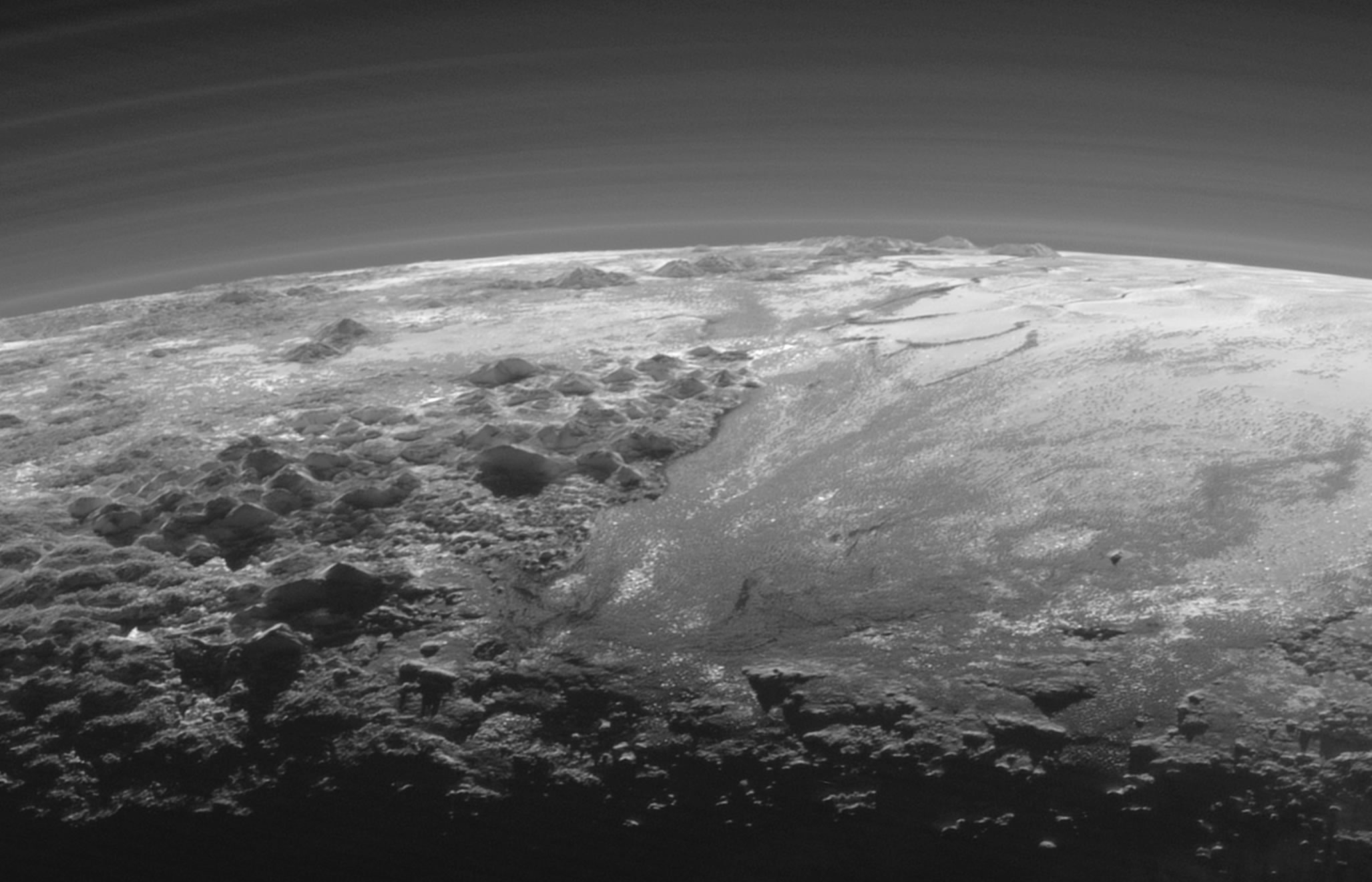
This shadowy landscape of majestic mountains and icy plains stretches toward the horizon on a small, distant world. It was captured from a range of about 18,000 kilometers when New Horizons looked back toward Pluto, 15 minutes after the spacecraft's closest approach on July 14, 2015. The dramatic, low-angle, near-twilight scene follows rugged mountains formally known as Norgay Montes from foreground left, and Hillary Montes along the horizon, giving way to smooth Sputnik Planum at right. Layers of Pluto's tenuous atmosphere are also revealed in the backlit view. With a strangely familiar appearance, the frigid terrain likely includes ices of nitrogen and carbon monoxide with water-ice mountains rising up to 3,500 meters (11,000 feet). That's comparable in height to the majestic mountains of planet Earth. The Plutonian landscape is 380 kilometers (230 miles) across.
Copyright: NASA

NGC 1360: The Robin's Egg Nebula
14/05/2025
This pretty nebula lies some 1,500 light-years away, its shape and color in this telescopic view reminiscent of a robin's egg. The cosmic cloud spans about 3 light-years, nestled securely within the boundaries of the southern constellation of the Furnace (Fornax). Recognized as a planetary nebula, egg-shaped NGC 1360 doesn't represent a beginning, though. Instead, it corresponds to a brief and final phase in the evolution of an aging star. In fact, visible at the center of the nebula, the central star of NGC 1360 is known to be a binary star system likely consisting of two evolved white dwarf stars, less massive but much hotter than the Sun. Their intense and otherwise invisible ultraviolet radiation has stripped away electrons from the atoms in their mutually surrounding gaseous shroud. The blue-green hue inside of NGC 1360 seen here is the strong emission produced as electrons recombine with doubly ionized oxygen atoms. Celestial Surprise: What picture did APOD feature on your birthday? (post 1995)
Copyright: Andrea Iorio, Vikas Chander & ShaRA Team
Η Αστρονομική Εικόνα της Ημέρας από τη NASA (NASA Astronomy Picture of the Day) είναι μια δωρεάν υπηρεσία που παρέχει καθημερινά μια εντυπωσιακή εικόνα από το σύμπαν, την λήψη της οποίας έχει πραγματοποιήσει κάποιος από τους αστρονόμους της NASA ή από κάποιον από τους δορυφόρους ή τα τηλεσκόπια που η NASA λειτουργεί. Οι εικόνες που εμφανίζονται καλύπτουν μια ευρεία γκάμα από θέματα, συμπεριλαμβανομένων των αστερισμών, των γαλαξιών, των πλανητικών συστημάτων, των κομητών, των αστρικών σωμάτων και των παρατηρητηρίων. Κάθε εικόνα συνοδεύεται από μια σύντομη εξήγηση και πληροφορίες σχετικά με το τι παρατηρείται στην εικόνα.