Η Αστρονομική Εικόνα της Ημέρας από τη NASA

Apollo 11: Catching Some Sun
12/09/2026
Bright sunlight glints as long dark shadows mark this image of the surface of the Moon. It was taken on July 20, 1969, by Apollo 11 astronaut Neil Armstrong, the first to walk on the lunar surface. Pictured is the mission's lunar module, the Eagle, and spacesuited lunar module pilot Buzz Aldrin. Aldrin is unfurling a long sheet of foil also known as the Solar Wind Composition Experiment. Exposed facing the Sun, the foil trapped particles streaming outward in the solar wind, catching a sample of material from the Sun itself. Along with 22 kilograms of moon rocks and lunar soil samples, the solar wind collector was returned for analysis in earthbound laboratories. APOD's main NASA site is moving: From apod.nasa.gov to science.nasa.gov/apod
Copyright: NASA
Προηγούμενες Αστρονομικές Εικόνες της Ημέρας από τη NASA
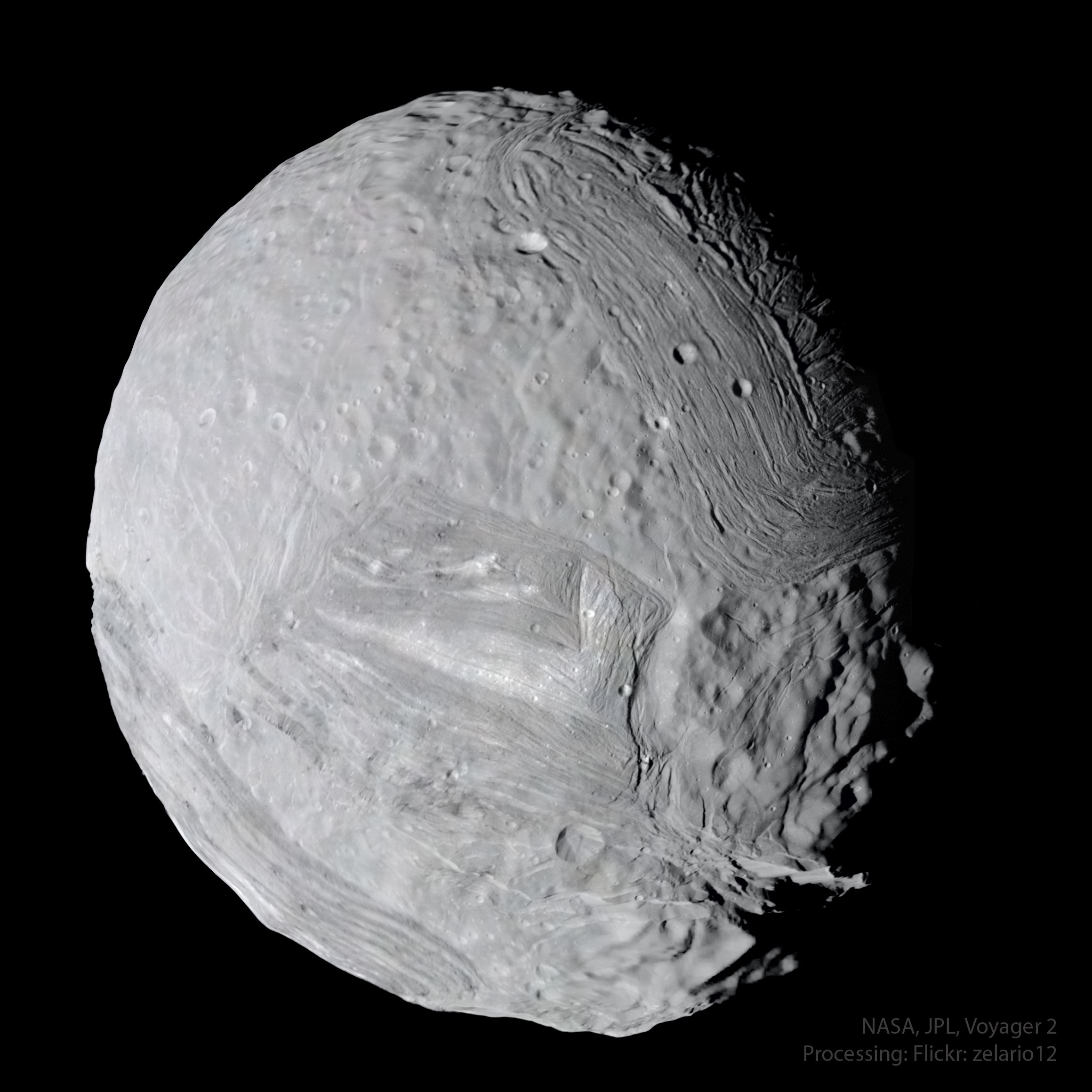
Miranda Revisited
09/02/2026
What is Miranda really like? Visually, old images from NASA's Voyager 2 have been recently combined and remastered to result in the featured image of Uranus's 500-kilometer-wide moon. In the late 1980s, Voyager 2 flew by Uranus, coming close to the cratered, fractured, and unusually grooved moon -- named after a character from Shakespeare’s The Tempest. Scientifically, planetary scientists are using old data and clear images to theorize anew about what shaped Miranda's severe surface features. A leading hypothesis is that Miranda, beneath its icy surface, may have once hosted an expansive liquid water ocean which may be slowly freezing. Thanks to the legacy of Voyager 2, Miranda has joined the ranks of Europa, Titan, and other icy moons in the search for water, and, possibly, microbial life, in our Solar System. Jigsaw Moon: Astronomy Puzzle of the Day
Copyright: NASA
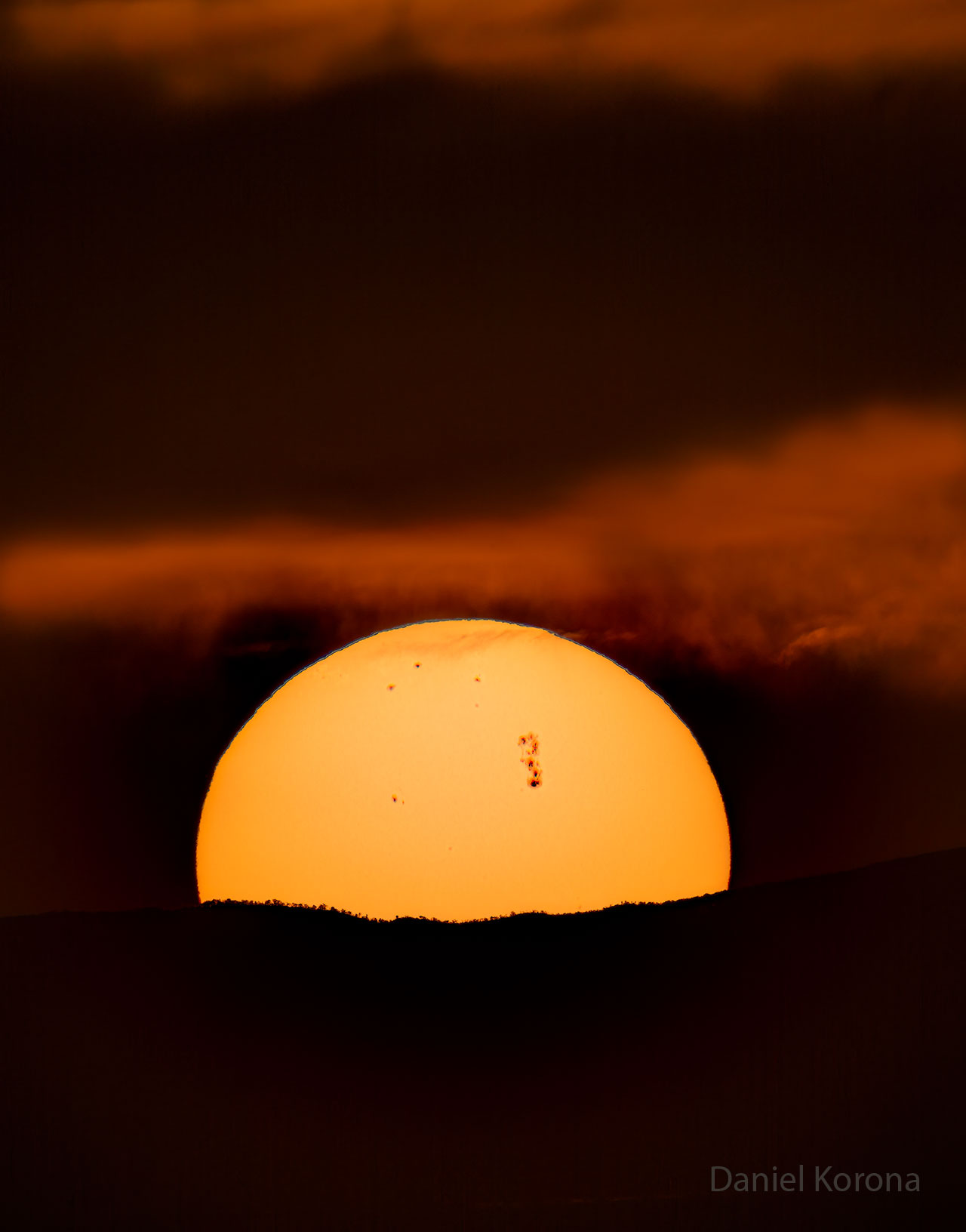
Active Sunspot Region 4366 Crosses the Sun
08/02/2026
An unusually active sunspot region is now crossing the Sun. The region, labelled AR 4366, is much larger than the Earth and has produced several powerful solar flares over the past ten days. In the featured image, the region is marked by large and dark sunspots toward the upper right of the Sun's disk. The image captured the Sun over a hill in Zacatecas, Mexico, 5 days ago. AR 4366 has become a candidate for the most active solar region in this entire 11-year solar cycle. Active solar regions are frequently associated with increased auroral activity on the Earth. Now reaching the edge, AR 4366 will begin facing away from the Earth during the coming week. It is not known, though, if the active region will survive long enough to reappear in about two weeks' time, as the Sun rotates.
Copyright: Daniel Korona
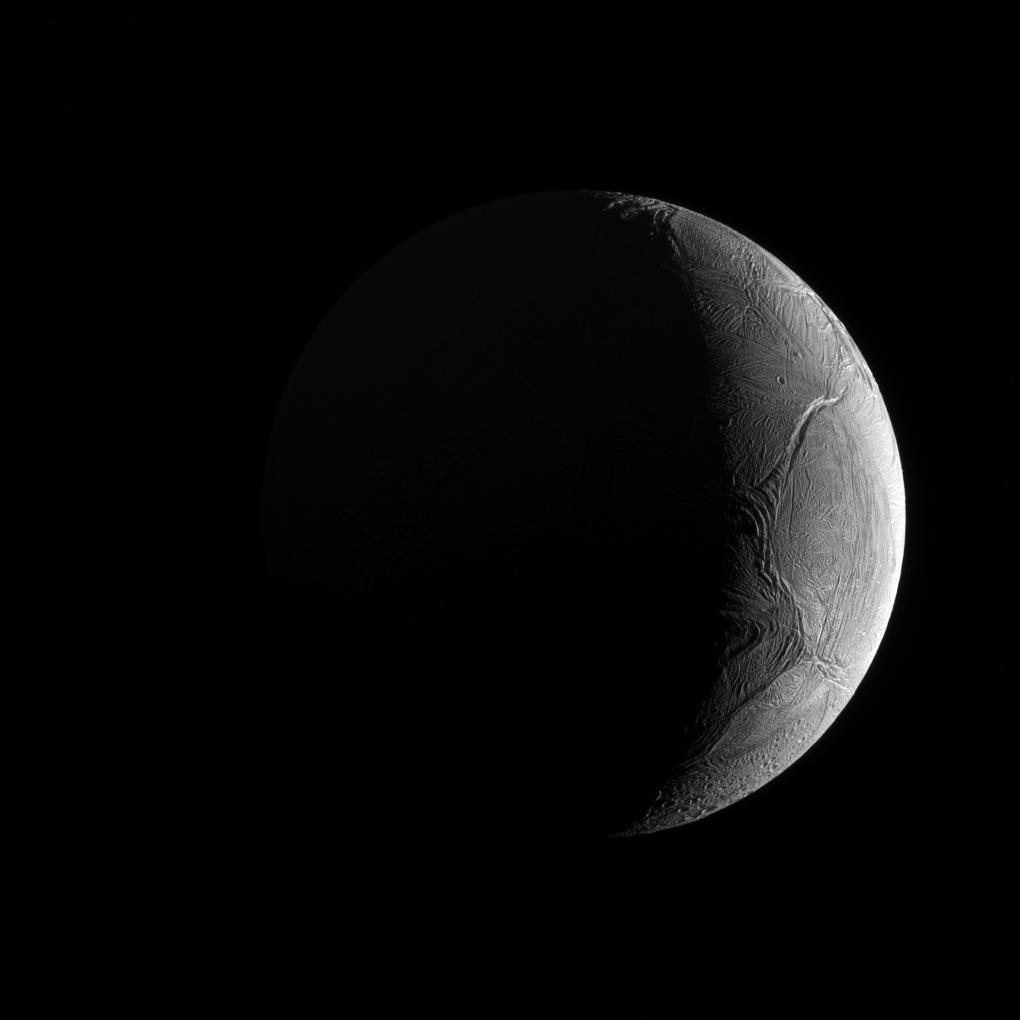
Crescent Enceladus
07/02/2026
Peering from the shadows, the Saturn-facing hemisphere of tantalizing inner moon Enceladus poses in this Cassini spacecraft image. North is up in the dramatic scene captured during November 2016 as Cassini's camera was pointed in a nearly sunward direction about 130,000 kilometers from the moon's bright crescent. In fact, the distant world reflects over 90 percent of the sunlight it receives, giving its surface about the same reflectivity as fresh snow. A mere 500 kilometers in diameter, Enceladus is a surprisingly active moon. Data and images collected during Cassini's flybys have revealed water vapor and ice grains spewing from south polar geysers and evidence of an ocean of liquid water hidden beneath the moon's icy crust.
Copyright: NASA
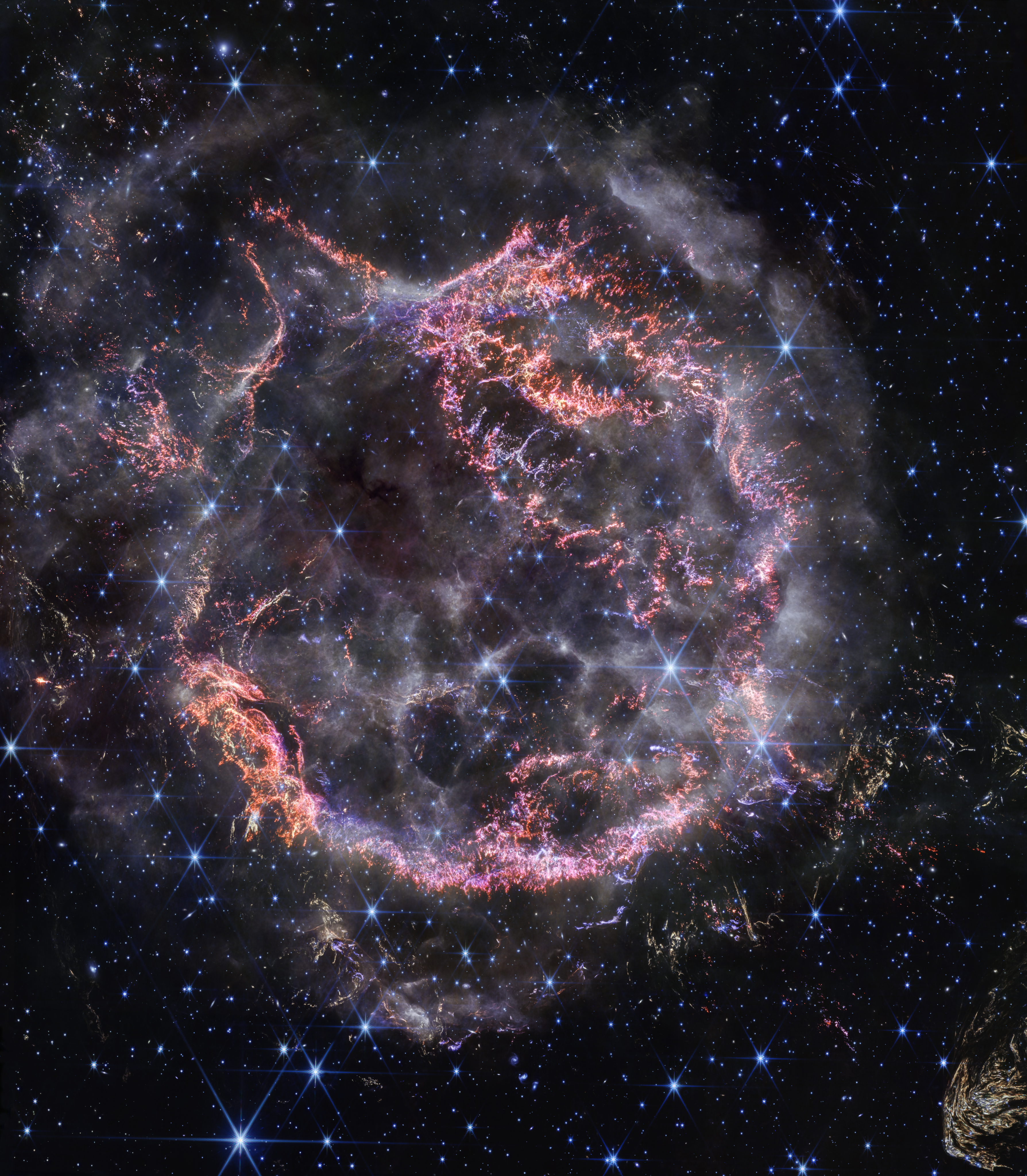
Supernova Remnant Cassiopeia A
06/02/2026
Massive stars in our Milky Way Galaxy live spectacular lives. Collapsing from vast cosmic clouds, their nuclear furnaces ignite and create heavy elements in their cores. After only a few million years for the most massive stars, the enriched material is blasted back into interstellar space where star formation can begin anew. The expanding debris cloud known as Cassiopeia A is an example of this final phase of the stellar life cycle. Light from the supernova explosion that created this remnant would have been first seen in planet Earth's sky about 350 years ago, although it took that light 11,000 years to reach us. This sharp NIRCam image from the James Webb Space Telescope shows the still-hot filaments and knots in the supernova remnant. The whitish, smoke-like outer shell of the expanding blast wave is about 20 light-years across. A series of light echoes from the massive star's cataclysmic explosion are also identified in Webb's detailed images of the surrounding interstellar medium.
Copyright: NASA
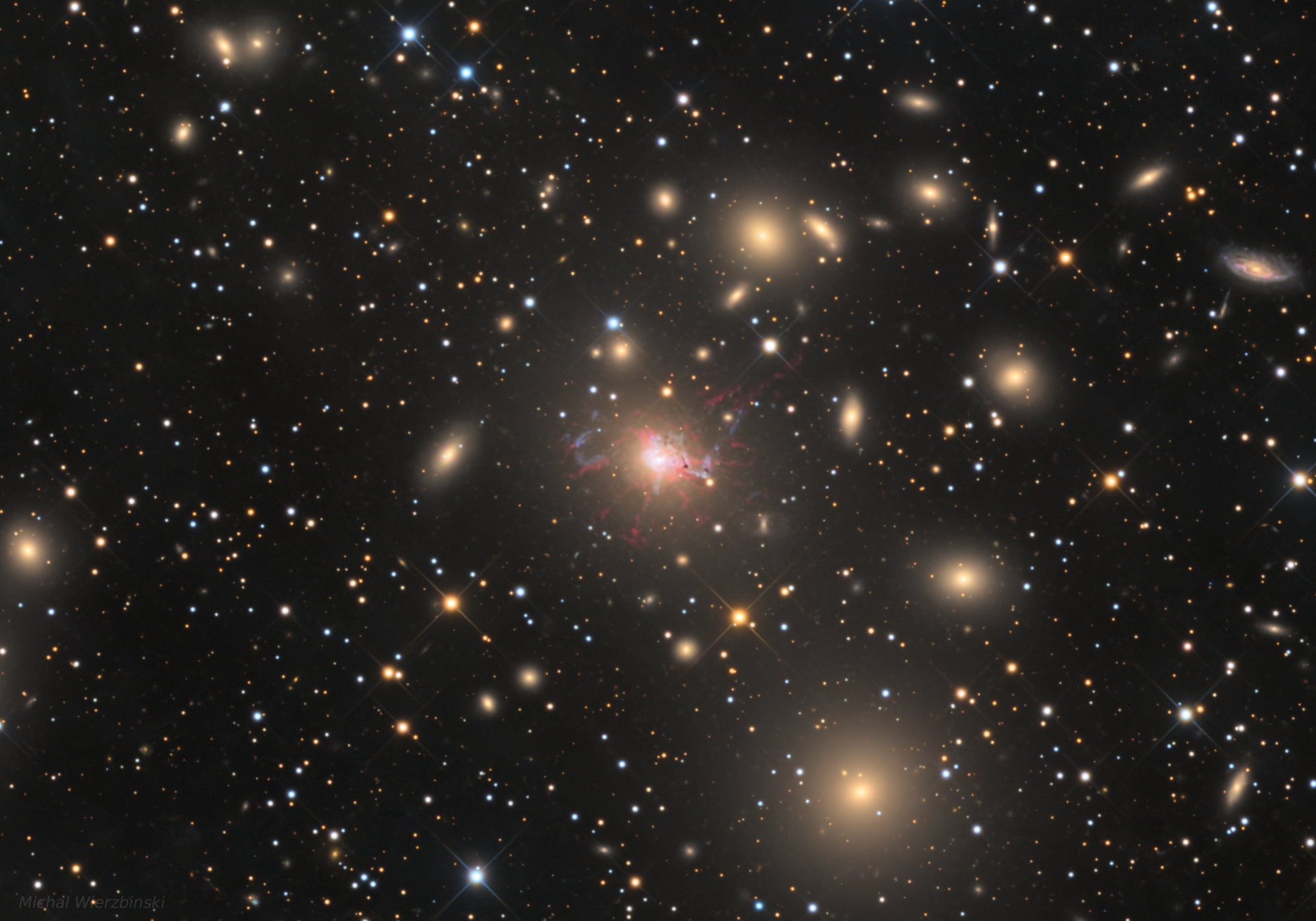
NGC 1275 in the Perseus Cluster
05/02/2026
Active galaxy NGC 1275 is the central, dominant member of the large and relatively nearby Perseus Cluster of Galaxies. Wild-looking at visible wavelengths, the active galaxy is also a prodigious source of x-rays and radio emission. NGC 1275 accretes matter as entire galaxies fall into it, ultimately feeding a supermassive black hole at the galaxy's core. Narrowband image data used in this sharp telescopic image highlights the resulting galactic debris and filaments of glowing gas, some up to 20,000 light-years long. The filaments persist in NGC 1275, even though the turmoil of galactic collisions should destroy them. What keeps the filaments together? Observations indicate that the structures, pushed out from the galaxy's center by the black hole's activity, are held together by magnetic fields. Also known as Perseus A, NGC 1275 itself spans over 100,000 light years and lies about 230 million light years away.
Copyright: Michal Wierzbinski
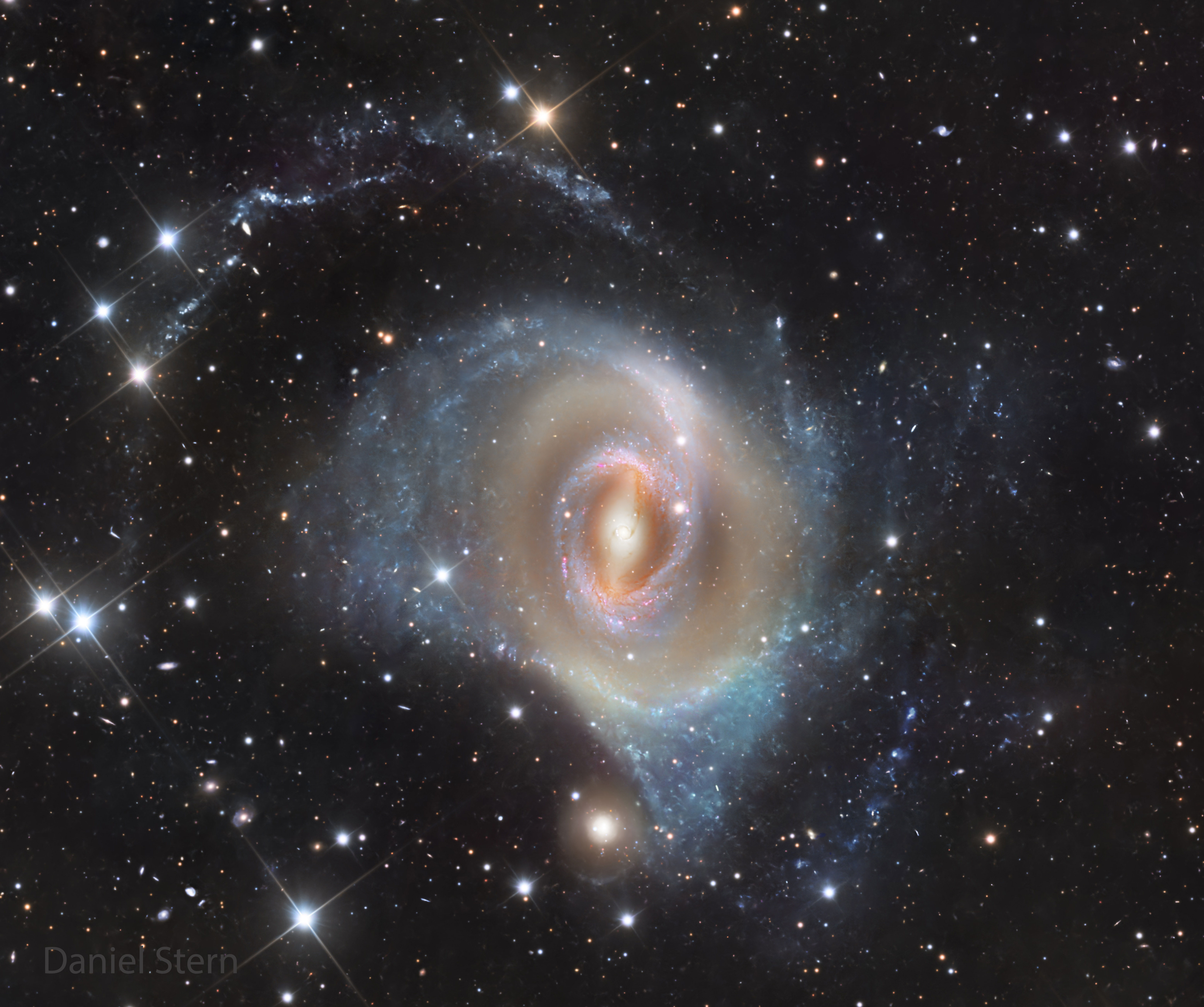
Spiral Galaxy NGC 1512: Wide Field
04/02/2026
Most galaxies don't have any rings -- why does this galaxy have three? To begin, a ring that's near NGC 1512's center -- and so hard to see here -- is the nuclear ring which glows brightly with recently formed stars. Next out is a ring of stars and dust appearing both red and blue, called, counter-intuitively, the inner ring. This inner ring connects ends of a diffuse central bar of stars that runs horizontally across the galaxy. Farthest out in this wide field image is a ragged structure that might be considered an outer ring. This outer ring appears spiral-like and is dotted with clusters of bright blue stars. All these ring structures are thought to be affected by NGC 1512's own gravitational asymmetries in a drawn-out process called secular evolution. The featured image was captured last month from a telescope at Deep Sky Chile in Chile.
Copyright: Daniel Stern
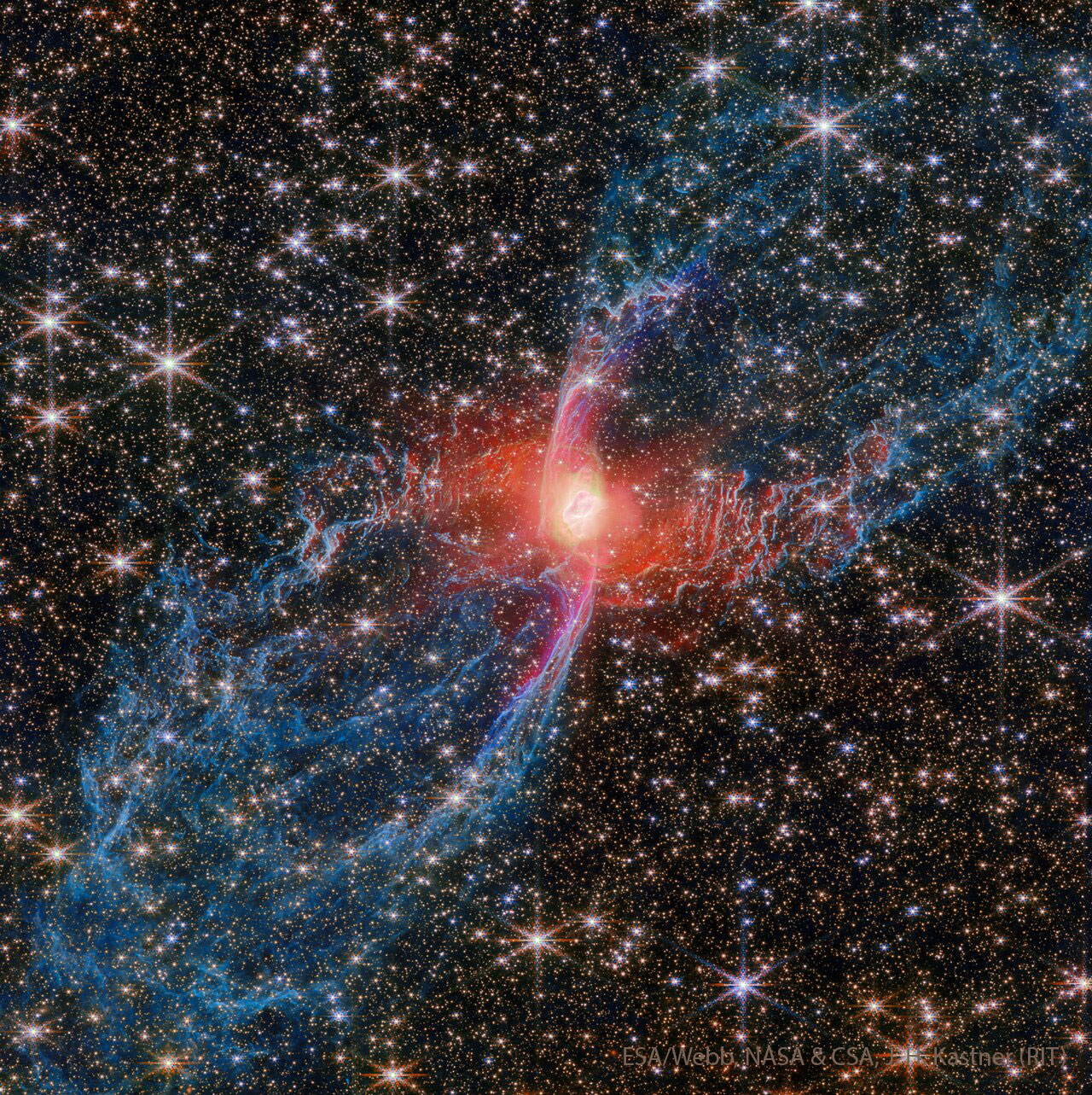
Red Spider Planetary Nebula from Webb
03/02/2026
Oh what a tangled web a planetary nebula can weave. The Red Spider Planetary Nebula shows the complex structure that can result when a normal star ejects its outer gases and becomes a white dwarf star. Officially tagged NGC 6537, this two-lobed symmetric planetary nebula houses one of the hottest white dwarfs ever observed, probably as part of a binary star system. Internal winds flowing out from the central stars, have been measured in excess of 1,000 kilometers per second. These winds expand the nebula, flow along the nebula's walls, and cause waves of hot gas and dust to collide. Atoms caught in these colliding shocks radiate light shown in the featured false-color infrared picture by the James Webb Space Telescope. The Red Spider Nebula lies toward the constellation of the Archer (Sagittarius). Its distance is not well known but has been estimated by some to be about 4,000 light-years.
Copyright: NASA
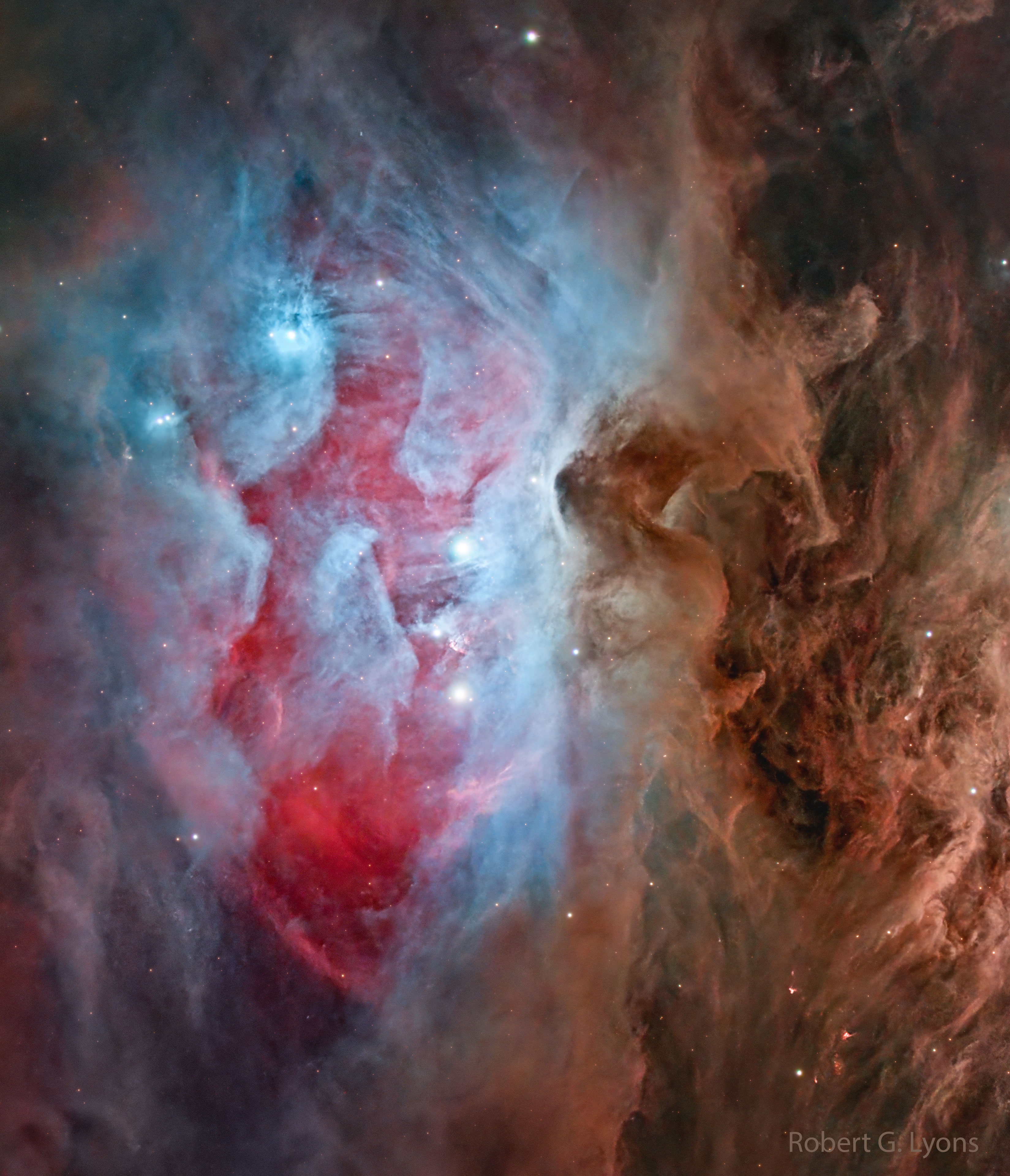
Orion: The Running Man Nebula
02/02/2026
What part of Orion is this? Just north of the famous Orion Nebula is a picturesque star forming region in Orion's Sword that contains a lot of intricate dust -- some of which appears blue because it reflects the light of bright embedded stars. The region's popular name is the Running Man Nebula because, looked at from the right, part of the brown dust appears to be running legs. Cataloged as Sharpless 279, the reflection nebula is not only part of the constellation of Orion, but part of the greater Orion molecular cloud complex. Light from the Running Man's bright stars, including 42 Orionis, the bright star closest to the featured image center, is slowly destroying and reshaping the surrounding dust, which will likely be completely gone in about 10 million years. The nebula spans about 15 light years and lies about 1,500 light years away. Jigsaw Nebula: Astronomy Puzzle of the Day
Copyright: Robert G. Lyons (Robservatory)
Η Αστρονομική Εικόνα της Ημέρας από τη NASA (NASA Astronomy Picture of the Day) είναι μια δωρεάν υπηρεσία που παρέχει καθημερινά μια εντυπωσιακή εικόνα από το σύμπαν, την λήψη της οποίας έχει πραγματοποιήσει κάποιος από τους αστρονόμους της NASA ή από κάποιον από τους δορυφόρους ή τα τηλεσκόπια που η NASA λειτουργεί. Οι εικόνες που εμφανίζονται καλύπτουν μια ευρεία γκάμα από θέματα, συμπεριλαμβανομένων των αστερισμών, των γαλαξιών, των πλανητικών συστημάτων, των κομητών, των αστρικών σωμάτων και των παρατηρητηρίων. Κάθε εικόνα συνοδεύεται από μια σύντομη εξήγηση και πληροφορίες σχετικά με το τι παρατηρείται στην εικόνα.